
Over the last few years, I have had an extended back-and-forth conversation with a Roman Catholic on Twitter. Our conversation spanned a number of long threads, focusing on the liturgical evidence of eucharist found in some of the earliest major sources:
The Didache (c.90)
Ignatius (d.c.108)
Justin Martyr (d.c.165)
Irenaeus (d.c.202)
Cyprian (d.c.258)
This is Part 8. The topic is Ignatius. See the index here.
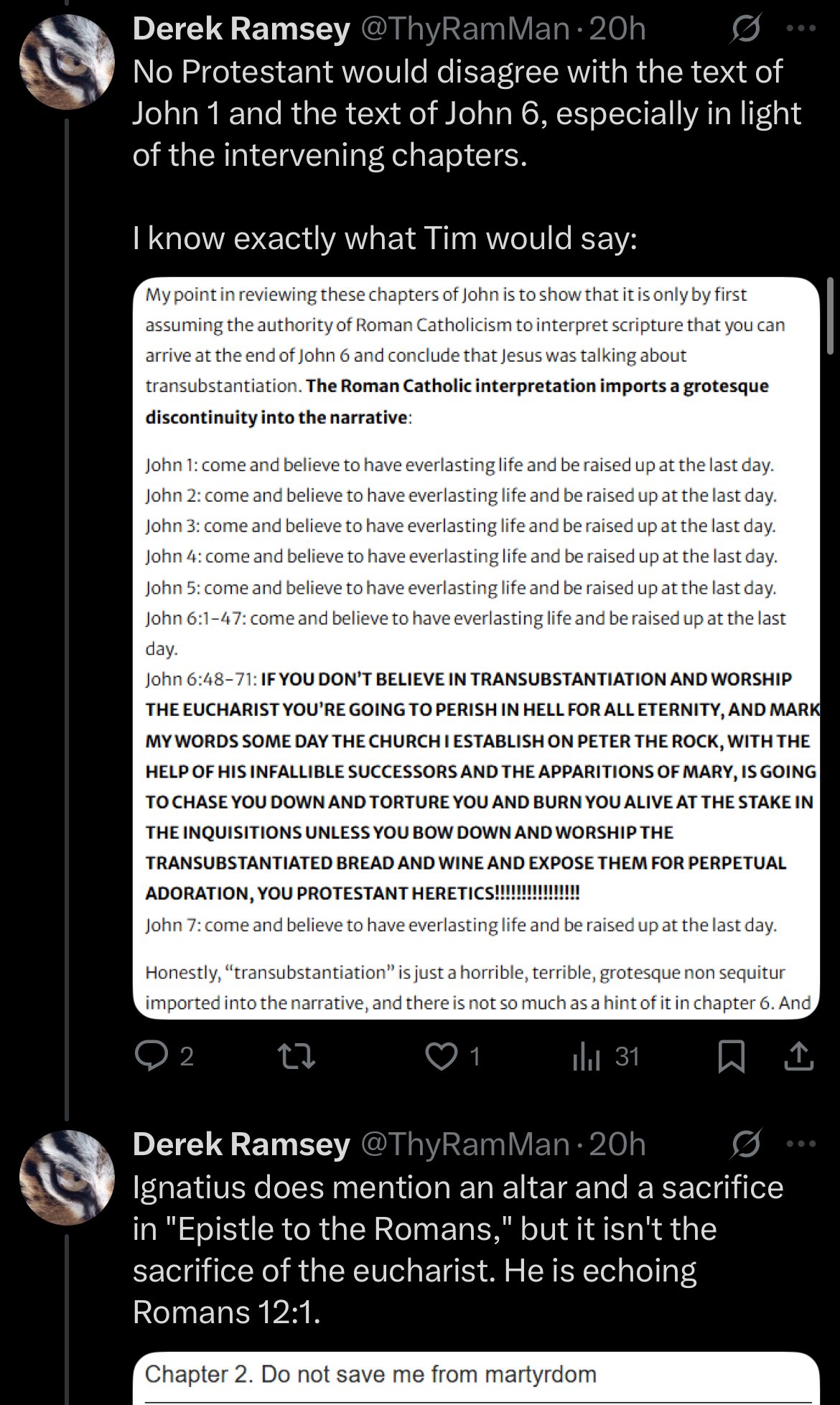
Here, you and Tim more or less strawman the whole Catholic position. The claim is not that John 6:48-71 proves the necessity of believing in transubstantiation, rather the claim is that this passage demonstrates the substantial presence of Christ in the Eucharist.
What is presented here is a gross caricature.
Considering that Tim’s comment was intended to be a sarcastic satire, calling it a caricature is accurate. That is, by design, exactly what it is. Tim demonstrated, through absurdity and exaggeration, that the Catholic claims about John 6—regarding a substantial presence of Christ “in the Eucharist”—are a gross, out-of-context misuse of the words of scripture. The point is, the non-Catholic position does not disagree with the text of John, it disagrees with the way the Catholic position twists scripture to suit its presuppositions of a substantial presence.
The Catholic position is that John 6 is (to use Catholic terminology) Eucharistic. This is why CE claims:
Now, recall in Part 2 and Part 7 how Ignatius, in Letter to the Romans, discussed John 4, John 6, and the “Bread of God” outside the context of the Lord’s Supper. Seeing this as a problem, CE attempted—unsuccessfully!—to import the context of the Lord’s Supper from the Letter to the Smyrnaeans into the Letter to the Romans. We objected to this attempt on contextual, exegetical, and textual grounds.
Neither Ignatius’ Letter to the Romans nor Scripture’s John 6 mention the Lord’s Supper. But, in both cases, Catholics insist that the discussion of bread must be (to use their term) Eucharistic, even though this is never stated. Neither passage uses the word eucharist, nor uses any of descriptions of—or references to—the Last Supper.
From the quote, you can plainly see how CE uses this unstated assumption as a demonstration of the substantial presence of Christ in (to use their term) the Eucharist. But, treating an assumption as a demonstration (i.e. a conclusion) is circular reasoning. Thus, Tim’s hyperbolic “gross caricature” is a perfectly legitimate criticism of this fallacious Catholic pseudo-exegetical approach.
It is this Catholic approach which turns the written word into a “gross caricature.” But, unlike Tim, the Catholic isn’t using satire to prove a point: he’s completely serious.
Now, let’s move on to the next comment.
I’ve already done my exegesis of both of his relevant letters, so I won’t go back over them here. Feel free to respond to them though.
I’m going to ignore your sidetrack (since I don’t appreciate the topic of the conversation being randomly changed to something wholly unrelated), and instead I’ll move onto your bizarre attempts to interpret the epistle.
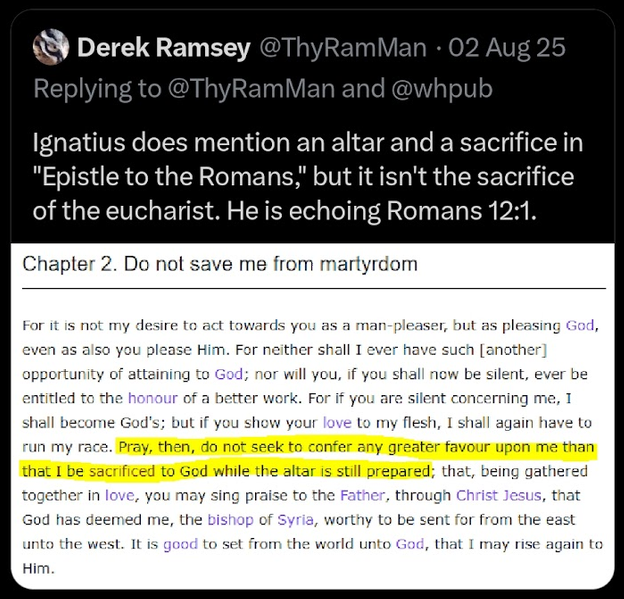
CE seems to ignore my point again, calling it a sidetrack even though it directly pertains to everything we have been discussing. Here is the citation:
Therefore, I urge you, brothers and sisters, by the mercies of God, to present your bodies as a sacrifice—living, holy, and pleasing to God—which is your reasonable service.
In the Letter to the Romans Ignatius mentions personal sacrifice (the kind of thing referred to in Romans). This shows that the altar mentioned (in Chapter 2; highlighted in yellow) has nothing to do with the sacrifice of the tithe (eucharist) or, as the Catholic believes, (to use its terms) the “Sacrifice of the Mass” in “Holy Communion.” Again, Ignatius never mentions eucharist in this letter.
The context is not (to use the Catholic term) Eucharistic, it is self-sacrificial martyrdom for Christ. Anyone who has read the Letter to the Romans knows this is the primary topic of the letter. It is within the context of martyrdom that Ignatius speaks of the altar. Again, Ignatius never mentions eucharist in this context.
For your second argument, I’m not sure what heresy St. Ignatius is supposed to be falling into…
Because Twitter removed my Tweets, I can’t see to what argument CE is referring. I believe the second argument here refers to something I brought up briefly in Part 2, but I’m not completely sure.
My argument comes from “The Eucharist, Part 4: Ignatius of Antioch.” I was sourcing that article when I was writing my reply to CE, it just not clear that this is the case because Twitter has removed my side of the argument. In any case, here is the argument:
In “Letter to Romans,” he calls the blood “love incorruptible”, which if literal is a heresy and if figurative means Ignatius thought the Christ’s blood was a metaphor.
CE has put himself in a box. If we drink the blood of Jesus and that blood is “love incorruptible,” then you really only have two options. The first is to conclude that Ignatius is speaking figuratively when he speaks of drinking Jesus’ blood: that you are not drinking literal blood. This is obviously the case, but it invalidates the Catholic argument that Ignatius believes we eat literal flesh and drink literal blood. But the alternative is heretical.
As I pointed out in Part 2, this is a Gnostic-style heresy. Instead of Jesus having literal, physical, material, natural blood like any other human, he actually has blood made up of divine (that is what is meant by ‘incorruptible’) love. Jesus may have had the appearance of real blood, but in its substance it was actually love (and eternal life). Gnostics believed that Jesus’ flesh and blood were illusory, so understanding the blood as being actual love or eternal life is a very Gnostic thing to believe.
Considering that Ignatius writes against the Gnostic heretics, the idea that he was one of them is utterly absurd. But it’s the box that the Catholic has trapped himself into by assuming that Ignatius isn’t using figures of speech when he writes of eating and drinking the flesh and blood of Jesus.
We avoid all of these problems by simply reading Ignatius figuratively, as he obviously intended. Only the Catholic finds himself obligated to insert his doctrine onto the lips of Ignatius, resulting in numerous absurdities like this. The only way to ‘resolve’ this absurdity is to engage in inconsistent, arbitrary exegesis. For example:
The Bread of God…is the flesh of Jesus Christ
His blood…is love incorruptible.
Understanding one of these phrases literally and the other one figuratively is arbitrary. There is no indication in the text that either phrase is meant to be taken literally. The only reason to understand it this was is if you have prior theological commitments, which simply begs the question. But, the problem is worse than it appears. To wit:
for drink…
…His blood…
…love incorruptible
When the Catholic reads “for drink, his blood,” he takes both drinking and blood to be literal. But when he reads “his blood is love incorruptible” he takes the blood to be a figurative reference. In the former, blood is literal, but in the latter it is figurative. This is a massive hermeneutical double-standard that completely begs the question.
( purple ) It is fair to wonder if I am begging-the-question myself. Yes, I am presenting my own interpretation as a matter of fact, but is it because I have presented an argument to that effect, or is it because I am simply assuming it to be true? Let’s see.
( magenta ) Notice that CE treats “the Eucharist” as a proper noun that doesn’t mean “the thanksgiving.” Now, that begs the question. Since “giving to the poor” and “participating in the thanksgiving” are two ways to say the same thing, they are not, in fact, separate things.
But, let’s examine the claim specifically, and ask:
“Is the abstaining from giving to the poor listed separated from their abstaining from thanksgiving?”
I examined this question in “Translations of Ignatius, Letter to the Smyrnaeans, Chapters 6 and 7” back in September. The answer is, rather unambiguously, “No.”
Here is a quotation of Chapters 6 and 7 with the chapter breaks—which are not original to Ignatius—removed:
They have no regard for love; no care for the widow, or the orphan, or the oppressed; of the bond, or of the free; of the hungry, or of the thirsty. They abstain from the Eucharist and from prayer, because they confess not the Eucharist to be the flesh of our Saviour Jesus Christ, which suffered for our sins, and which the Father, of His goodness, raised up again.
These are not separate statements. On the contrary, they are quite literally placed one sentence before the other. They are connected, back-to-back statements. It is simply an objective fact that they are not “listed separately.” There is no question for me to beg.
This is incredibly ironic.
Recall how CE was unwilling to explain the Letter to the Romans by appealing to the context of the Letter to the Romans itself. Instead, he tried to explain the Letter to the Romans by appealing to the context of the Letter to Smyrneans. But, when it comes to explaining one sentence in Letter to the Smyrneans, he is unwilling to use the preceding sentence of context.
What a massive double standard!
The only reason the two sentences are treated—not listed—separately (by convention!) is because a minority of English translators and editors decided that they must be different thoughts, due to their own personal theological presuppositions (i.e. that eucharist isn’t a related to the tithe offering for those in need). There is nothing in the text itself that indicates that the topic has changed. Baring that, there is nothing in the text itself to separate the two sentences. In other words? These English translators and editors have begged-the-question.
The two sentences are obviously not “listed separately” because they are not separate at all. They are, quite literally, back-to-back sentences. At most you can say that they might be “conceptually separate.” But, you also have to say that the might be “conceptually connected” by default (on account of being back-to-back sentences). Either way, they are not “listed separately.”
Now, it turns out, only a minority of translators have even chosen to place these sentences in strictly separate chapters. Here is the complete list:
| Translator | Chapter(s) |
|---|---|
| (Latin) | 6 & 7 |
| Alexander Roberts James Donaldson |
6 & 7 |
| J. B. Lightfoot J. R. Harmer |
6 |
| James H. Srawley | 6 |
| Kirsopp Lake | 6 & 7 |
| Cyril C. Richardson | Hybrid |
| William A. Jurgens | Hybrid |
| Bart D. Ehrman | 6 & 7 |
| Michael W. Holmes | 6 |
Only three out of eight English translations (plus the Latin version) use only the pro-Catholic, pro-Anglican framing. The rest acknowledged the two sentences together. CE, as per usual, chose a translation that confirmed his bias through the additional of non-original commentary (i.e. chapter breaks).
( cyan ) This leads us to this:
Well, it is referred to uniformly: the two sentences are right there, grouped side-by-side, expressing a single thematic thought. As I’ve said many times before, the two sentences are simply two ways to say the same thing.
The issue isn’t that Ignatius failed to refer to giving to the poor as the eucharist, the failure is with CE’s inability to see the obvious. It doesn’t help that CE chose a biased translation.
( yellow ) Now, let’s roll back to the central question:
Sure, let’s do it.
First, Ignatius uses the phrase “thanksgiving and prayer.” This combination is widely attested in the early church when referring to the tithe. The fact that Ignatius uses this common language is a partial pattern-based demonstration. It strongly militates against the idea that “eucharist=holy communion.”
Second, and more importantly, it trivial to demonstrate that Ignatius explicitly paired giving to the those in need with that “thanksgiving and prayer.” Here it is (with the question begging removed):
They have no regard for love; no care for the widow, or the orphan, or the oppressed; of the bond, or of the free; of the hungry, or of the thirsty. They abstain from thanksgiving and prayer…
Given how absolutely trivial it is to see this relationship, we must conclude that the request for proof by demonstration was not asked-for in good faith. It is not due to a lack of factual demonstration that others deny this back-to-back-sentence connection. It is quite obviously there, but people choose to deny it anyway. A lack of demonstration is simply not the issue here.
The reading of eucharist-as-tithe is quite straightforward from a simple, literal reading of the Ignatian text. This is so obvious that no demonstration is really required. All you need is reading comprehension skills and to have read the sacrificial laws in the Pentateuch. No, the issue is that you reject the demonstration. A lack of demonstration is simply not the issue here, you just don’t like the one you have received.
Third, while I acknowledge that the language in isolation (i.e. without allowing the preceding sentence of context) is ambiguous…
They abstain from thanksgiving and from prayer, because they don’t acknowledge the thanksgiving to be the flesh of our Savior Jesus Christ, which suffered for our sins, and which the Father, of His goodness, raised up again.
…even this is not unprecedented when compared to analogous language found elsewhere:
Against Heresies — Book V, Chapter 3
(Greek version)
When, therefore, the mingled cup and the manufactured bread receives the Word of God, and the thanksgiving becomes the body of Christ , from which things the substance of our flesh is increased and supported, how can they affirm that the flesh is incapable of receiving the gift of God, which is life eternal, which [flesh] is nourished from the body and blood of the Lord, and is a member of Him?
So even if I am artificially hobbled by a translation that arbitrarily divides the two sentences, I can still demonstrate the point anyway!
Again, the problem isn’t a lack of demonstration, it’s that you won’t accept this demonstration as evidence because there exists a Latin version that better suits your bias.
Fourth, what else could it be? As we’ve demonstrated, there isn’t any language in Letter to the Smyrnaeans that directly and independently implies eucharist-as-communion. The idea of a substantial presence doesn’t come from Ignatius’ letter itself. This must be inductively inferred by making an external appeal to the existing church doctrine.
I can demonstrate that there is unambiguous language in the early church referring to the tithe offering as eucharist. But there is no such unambiguous language in the entire early church that refers to eucharist as communion. There is not a single citation that can serve as the source of the idea. All of it is inferred from preexisting assumptions. By contrast, it is easy to look at the early language of the tithe offering as eucharist and use that as an early source of the idea without anachronistically appealing to later doctrinal presumptions.
So, we can demonstrate, by process of elimination, that he must be referring to the tithe. There is no other option.
But if by ‘demonstrate’ you mean “Can I demonstrate the non-Catholic view while assuming that the Catholic view is true?” the answer is obviously and emphatically “No!” This isn’t about demonstrating the facts. I can’t demonstrate anything that will assail Catholic presumptions about their beliefs, as they are not open to rational proof.
Consider Nonna, the wife of Gregory Nazianzus the Elder, who was praised for having been overcome with concern for the poor in front of the eucharist:
…and what is still more wonderful, [Nonna] never so far yielded to the external signs of grief, although greatly moved even by the misfortunes of strangers, as to allow a sound of woe to burst forth before the thanksgiving , or a tear to fall from the eye mystically sealed, or any trace of mourning to be left on the occasion of a festival, however frequent her own sorrows might be; inasmuch as the God-loving soul should subject every human experience to the things of God…
I suppose the Catholic must assume that she was thinking of the poor during the celebration of the Lord’s Supper and, for some reason, was praised for being so distracted and unfocused during that sacred ritual. This all because they can’t accept the obvious that she was overcome for concern for the poor while standing at the altar in front of the tithes (eucharist) for the poor.
At some point the evidence is just so obvious that you have to let the stubborn, obstinate people believe whatever they want even in the face of that evidence. It’s like the atheist who demands evidence for God while simultaneously excluding every piece of evidence that constitutes evidence for God.
We will continue in Part 9.