
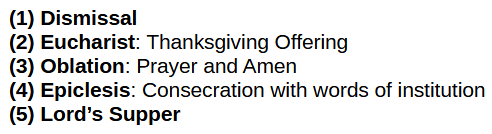
The original liturgy:
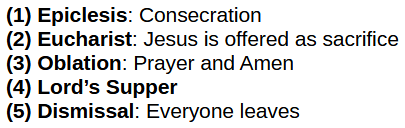
The Roman liturgy:
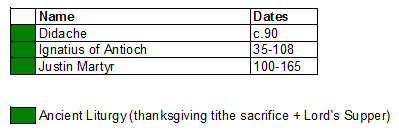
Ignatius
Let’s begin our discussion on Ignatius by first looking at FishEaters’ quotes:
— Fish Eaters
I have no taste for corruptible food nor for the pleasures of this life. I desire the Bread of God, which is the flesh of Jesus Christ, who was of the seed of David; and for drink I desire His blood, which is love incorruptible.
Take care, then, to use one Eucharist, so that whatever you do, you do according to God: For there is one flesh of our Lord Jesus Christ, and one cup in the union of His blood; one altar, as there is one bishop with the presbytery…
They [the Gnostics] abstain from the Eucharist and from prayer, because they do not confess that the Eucharist is the flesh of our Savior Jesus Christ, flesh which suffered for our sins and which the Father, in his goodness, raised up again.
Ignatius is either a flaming heretic, or he understands the elements metaphorically.
First, of “Letter to Romans,” Ignatius calls it the “Bread of God”, not the “Bread of Christ”, which either makes him deny the canonical Trinity doctrine or else he is using “bread” in a broader metaphor than Roman Catholics use it. Either way, the canonical Roman liturgy appears absent.
Second, also of “Letter to Romans,” he calls the blood “love incorruptible”, which if literal is a heresy and if figurative means Ignatius thought the Christ’s blood was a metaphor.
Third, the quote from “Letter to the Philadelphians” is quite vague and ambiguous. It lacks the context (implied by “…, then, …“) that might help us understand what it means. Thus, this neutral quote doesn’t challenge either competing viewpoint.
Fourth, of “Letter to Smyrnaens,” we need to talk about the Gnostics. Let’s look at a larger quote:
Citation: Ignatius of Antioch. “Epistle to the Smyrnaeans.” ¶6-7 (c.110AD)
Notice the part that FishEaters left out in her cherry-picked quotation. It is really important. Can you see it? Here, I’ll highlight it:
The Gnostic heretics failed to care for the widow, orphan, oppressed, slave, free, hungry, and thirsty, because they (1) did not participate in (2) offering (or sacrifice) of thanksgiving and prayer. They did not participate because they didn’t “confess the eucharist to be the flesh of Jesus.” What does this mean?
To confess the thanksgiving [eucharist] was the act of (4) consecrating the portion of the tithe offering used in the Lord’s Supper by saying the words of institution, just as Jesus consecrated the bread and wine after he had given thanks for it and given it to his disciples and they had partaken of it. The church first (1-3) offered the thanksgiving [eucharist] as a tithe. Then they (4-5) celebrated a supper of consecrated bread and wine, taken from a portion of the eucharisted tithe.
First, the thanksgiving [eucharist]—of unconsecrated tithes—was offered. Second, the supper—of (now) consecrated bread and wine—was eaten (but not offered).
But, the Gnostics showed no regard for the needy by refusing to offer their tithes. They denied the death and resurrection of Christ, because they denied Christ’s incarnation in the flesh.[1] Put simply, no Gnostic could say “This is my body; This is my blood” while denying that Jesus ever had a body or blood in the first place. The Gnostics could not (4) confess/consecrate (1-3) the tithe offering because it required them to acknowledge Christ’s body, and so did not (2) offer any tithe at all.
For this reason, it is irrelevant whether or not the consecrated bread was treated as a metaphor/symbol or taken literally. This simply wasn’t the issue being discussed. Ignatius’ concern was that they wouldn’t tithe the eucharist for the real, physical poor and needy because they didn’t think Jesus had a real, physical body. More to the point, if the bread was merely a symbol for Jesus’ real flesh and not literal at all, Ignatius would not have had to alter anything in the quote above.
As with the dismissal of the unbelievers and the unrepentant believers in the Didache’s liturgy, the Gnostics did not (and, indeed, could not) participate in the (1-3) offering of the tithe or the (4-5) celebration of the Lord’s Supper. That is why Ignatius says “they have no regard for love; no care for the widow, or the orphan, or the oppressed; of the bond, or of the free; of the hungry, or of the thirsty” immediately preceding “They abstain from the Eucharist.” These two are intrinsically linked: they are two ways of saying the same thing.
FishEaters had to leave that single sentence out because its inclusion shows that the Roman liturgy was not present in the early church. The original eucharist (thanksgiving) was the tithe: the thanksgiving offering. The only connection between the eucharist offering and the celebration of the Lord’s Supper is that a small portion of the bread and wine of the eucharist were the source of the food used in the Supper. The (consecrated) eucharist was eaten within the Lord’s Supper, just as the (unconsecrated) eucharist was eating by the poor and needy—including unbelievers—outside of the Lord’s Supper.
The Roman Catholic has to come up with a contrived explanation for why Ignatius is talking about helping the poor in the context of the Eucharist. The Protestant need only say “these are the same thing”: the eucharist is, fundamentally, about helping the poor and those in need.
Now, let’s continue to another of Ignatius’ writings.
Citation: Ignatius, “To The Trallians“, Chapter 8
Here Ignatius speaks of faith being the flesh of Jesus and love being the blood of Christ, two clearly metaphorical uses. As many other early writers did, Ignatius referred to the flesh and blood of Jesus Christ using clearly non-literal, figurative language.
Footnotes
[1] From “The Epistle of Ignatius to the Smyrnaeans:”
“…not, as certain unbelievers maintain, that He only seemed to suffer…”
“…but blasphemes my Lord, not confessing that He was [truly] possessed of a body?”
Pingback: Sacraments, Part 1: Divisions
See page 103 of this book for James A. Kleist, S.J.’s abbreviated translation of Ignatius to the Romans.
The full work, from 1949, is here
From PG 5:
Ἄρτον Θεοῦ θέλω, ἄρτον οὐράνιον, ἄρτον ζωῆς, ὅς ἐστιν σὰρξ Ἰησοῦ Χριστοῦ, τοῦ Υἱοῦ τοῦ Θεοῦ, τοῦ γενομένου ἐν ὑστέρῳ ἐκ σπέρματος Δαυίδ καὶ Ἀβραάμ καὶ πόμα Θεοῦ θέλω, τὸ αἷμα αὐτοῦ, ὅ ἐστιν ἀγάπη ἄφθαρτος, καὶ ἀένναος ζωή.
From footnote 82:
(82) Θεοῦ post πῶμα, et paulo infra καὶ ἀένναος ζωὴ nec in Syro, nec in veteri versione Latina est.
“‘Θεοῦ’ (‘of God’) after ‘drink’ (πῶμα), and a little further down ‘and eternal life’ (καὶ ἀένναος ζωὴ) are not found in the Syriac, nor in the old Latin version.”
[…]
One of these might be the J.B. Lightfoot translation:
“I have no taste for corruptible food or for the delights of this life. Bread of God is what I desire; that is, the Flesh of Jesus Christ, who was of the seed of David; and for my drink I desire His Blood, that is, incorruptible”
“I have no desire for the food that perisheth nor for the pleasures of this life. I desire the bread of God, which is the flesh of Jesus Christ, who was of the seed of David; and for drink I desire His blood, which is love incorruptible.”