
This is part of a series on Roman Catholicism and the eucharist. See this index.
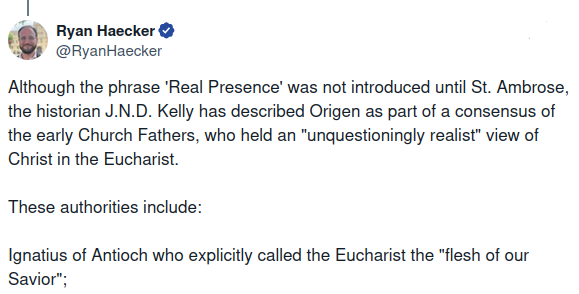
A few weeks back, I wrote “Translations of Justin Martyr, First Apology, Chapter 66.” There we identified a common Catholic proof-text and analyzed the different translations.
Another common proof text comes from Ignatius’ Letter to the Smyrnaeans (see: “The Eucharist, Part 4: Ignatius of Antioch“). The flaw in using this passage as a proof-text is (mostly) not in the way it is translated, but in the way it is selectively quoted. Unlike the Justin Martyr text, this one is not subject to a whole lot of disagreement over the translation. The context, in this case, is far more important.
In any case, I have not seen an online resource that that collects the different translations, so here they are:
J.P. Migne – Patrologia Graeca, Volume 5 (1894), cols 711,713
περὶ ἀγάπης οὐ μέλει αὐτοῖς, οὔτε περὶ χήρας, ἢ περὶ ὀρφανοῦ, οὔτε περὶ θλιβομένου, οὔτε περὶ δεδεμένου ἢ λελυμένου, οὔτε περὶ πεινῶντος ἢ διψῶντος. Εὐχαριστίας καὶ προσευχῆς ἀπέχονται, διὰ τὸ μὴ ὁμολογεῖν τὴν εὐχαριστίαν σάρκα εἶναι τοῦ Σωτῆρος ἡμῶν Ἰησοῦ Χριστοῦ, τὴν ὑπὲρ τῶν ἁμαρτιῶν ἡμῶν παθοῦσαν, ἣν τῇ χρηστότητι ὁ Πατὴρ ἤγειρεν.
Carl Joseph Hefele, Opera Patrum Apostolicorum, 3rd ed. (1847)
J.P. Migne, Patrologia Graeca, Vol. 5 (1894), cols 712,714
Non charitas eis curae est, non vidua, non pupilla, non oppressus, non vinctus vel solutus, non esuriens vel sitiens. Ab Eucharistia et oratione abstinent, eo quod non confiteantur Eucharistiam carnem esse Salvatoris nostri Jesu Christi, quae pro peccatis nostris passa est, quamque Pater benignitate sua suscitavit.
They have no regard for love; no care for the widow, or the orphan, or the oppressed; of the bond, or of the free; of the hungry, or of the thirsty. They abstain from the Eucharist and from prayer, because they confess not the Eucharist to be the flesh of our Saviour Jesus Christ, which suffered for our sins, and which the Father, of His goodness, raised up again.
They have no care for love, none for the widow, none for the orphan, none for the afflicted, none for the prisoner, none for the hungry or thirsty. They abstain from eucharist (thanksgiving) and prayer, because they allow not that the eucharist is the flesh of our Saviour Jesus Christ, which flesh suffered for our sins, and which the Father of His goodness raised up.
They have no thought for love, nor for the widow, the orphan, the afflicted, the prisoner, the hungry nor the thirsty. They withhold themselves from Eucharist and prayer, because they confess not that the Eucharist is the flesh of our Saviour Jesus Christ, which flesh suffered for our sins, and which in His loving – kindness the Father raised up .
For love they have no care, none for the widow, none for the orphan, none for the distressed, none for the afflicted, none for the prisoner, or for him released from prison, none for the hungry or thirsty. They abstain from Eucharist and prayer, because they do not confess that the Eucharist is the flesh of our Savior Jesus Christ who suffered for our sins, which the Father raised up by his goodness.
They care nothing about love: they have no concern for widows or orphans, for the oppressed, for those in prison or released, for the hungry or the thirsty. They hold aloof from the Eucharist and from services of prayer, because they refuse to admit that the Eucharist is the flesh of our Saviour Jesus Christ, which suffered for our sins and which, in his goodness, the Father raised [from the dead].
For love they have no care, nor for the widow, nor for the orphan, nor for the distressed, nor for those in prison or freed from prison, nor for the hungry and thirsty. They abstain from the Eucharist and from prayer, because they do not confess that the Eucharist is the Flesh of our Savior Jesus Christ, Flesh which suffered for our sins and which the Father, in His goodness, raised up again.
They have no interest in love, in the widow, the orphan, the oppressed, the one who is in chains or the one set free, the one who is hungry or the one who thirsts. They abstain from the eucharist and prayer, since they do not confess that the eucharist is the flesh of our saviour Jesus Christ, which suffered on behalf of our sins and which the Father raised in his kindness
They have no concern for love, none for the widow, none for the orphan, none for the oppressed, none for the prisoner or the one released, none for the hungry or thirsty. They abstain from Eucharist and prayer because they refuse to acknowledge the Eucharist is the flesh of our savior Jesus Christ, which suffered for our sins and which the Father by his goodness raised up
Here are the affiliations of the translators, along with the date of translation given above:
| Translator | Date | Affiliation |
|---|---|---|
| (Latin) | 1600s – 1800s | Anglican, Catholic, Remonstrant |
| Alexander Roberts James Donaldson |
1885 | Scottish Presbyterian |
| J. B. Lightfoot J. R. Harmer |
1889 | Anglican |
| James H. Srawley | 1900 | Anglican |
| Kirsopp Lake | 1912 | Anglican |
| Cyril C. Richardson | 1953 | Episcopalian |
| William A. Jurgens | 1970 | Roman Catholic |
| Bart D. Ehrman | 2003 | Agnostic; former Evangelical |
| Michael W. Holmes | 2007 | Baptist |
The translations are more-or-less identical. Unlike the Justin Martyr translation (and with the two exceptions described below), there does not appear to be a significant denomination divide on the translations themselves. The most quoted sentence fragment (highlighted in yellow) does not differ significantly among the various translations.
The first significant issue is with the inappropriate transliteration and capitalization of ‘eucharist’:
| Translator | Eucharist Proper Noun |
|---|---|
| (Latin) | Yes |
| Alexander Roberts James Donaldson |
Yes |
| J. B. Lightfoot J. R. Harmer |
No |
| James H. Srawley | Yes |
| Kirsopp Lake | Yes |
| Cyril C. Richardson | Yes |
| William A. Jurgens | Yes |
| Bart D. Ehrman | No |
| Michael W. Holmes | Yes |
All but two of the translators choose ‘Eucharist’ as a proper noun. Every single translation transliterates the term. There isn’t a single translation on this list that fully translates it naturally and without the sacramental presupposition:
…they abstain from thanksgiving and prayer, since they do not acknowledge the thanksgiving to be the flesh of our Saviour Jesus Christ…
The meaning of the text is much clearer if you explicitly associate the two sentences together and you actually translate the term:
They abstain from thanksgiving and prayer—having no regard for love; no care for the widow, or the orphan, or the oppressed; of the bond, or of the free; of the hungry, or of the thirsty—because they confess not the thanksgiving to be the flesh of our Savior Jesus Christ, which suffered for our sins, and which the Father, of His goodness, raised up again.
By transliterating ‘eucharist’ instead of translating it, it is quite challenging to understand the text; to understand why abstaining from “thanksgiving and prayer” constitutes a disregard for those in need.
Interestingly, even the Baptist Michael W. Holmes—editor of the modern NRSVue Bible translation—uses the proper noun “Eucharist” instead of simply translating it as “thanksgiving.” Notably, he does not transliterate “eucharist” as “eucharist” or “Eucharist” in the NRSVue, so it is unclear why he does so here.
As I noted above, it is the context which drives the interpretation, not the translation. This leads us to the second significant issue. One such example of how context drives the interpretation is the way the translators divide up the translation into paragraph and chapter breaks. This grouping implicitly determines what the translator thinks the context is.
This table shows what each translator chose to use as a chapter organization:
| Translator | Chapter(s) |
|---|---|
| (Latin) | 6 & 7 |
| Alexander Roberts James Donaldson |
6 & 7 |
| J. B. Lightfoot J. R. Harmer |
6 |
| James H. Srawley | 6 |
| Kirsopp Lake | 6 & 7 |
| Cyril C. Richardson | Hybrid |
| William A. Jurgens | Hybrid |
| Bart D. Ehrman | 6 & 7 |
| Michael W. Holmes | 6 |
Traditionally the work is divided up so that the passage we are examining begins in chapter 6. However, where chapter 6 ends is not consistent, resulting in some translations where the second sentence we are examining is the first sentence of chapter 7.
(Thanks to commenter Jeff for pointing this out)
Roberts & Donaldson, Lake, and Ehrman separate the two sentences into separate paragraphs in separate chapters. Lightfoot & Harmer, Srawley, and Holmes combine the two sentences into one paragraph. Notably, Michael Holmes’ translation is (somewhat) repeatedly cited by other authors as coming from chapter 6 (e.g. here), but I have not verified this directly from the primary source.
Jurgens and Richardson use a hybrid approach. They both include the “6 and 7” chapter designations as inline notations, however they primarily structure it so that the two sentences are part of a single paragraph.
Five—more than half—of the English translators group the two sentences together (as I have done). The three other English translators explicitly separate them with paragraph and chapter breaks. Among of the latter is the translation that is most commonly cited by Roman Catholic apologists.
Obviously when translators separate the two sentences into different paragraphs and chapters, they are able to avoid the (clear, IMO) interpretation that the ‘eucharist’ of the early church was the giving of tithes and offerings for those in need:
They abstain from thanksgiving and prayer—having no regard for love; no care for the widow, or the orphan, or the oppressed; of the bond, or of the free; of the hungry, or of the thirsty—because they confess not the thanksgiving to be the flesh of our Savior Jesus Christ, which suffered for our sins, and which the Father, of His goodness, raised up again.
The conclusion is straightforward:
Ignatius’ concern was that they wouldn’t tithe the eucharist for the real, physical poor and needy because they didn’t think Jesus had a real, physical body. More to the point, if the bread was merely a symbol for Jesus’ real flesh and not literal at all, Ignatius would not have had to alter anything in the quote above.
As with the dismissal of the unbelievers and the unrepentant believers in the Didache’s liturgy, the Gnostics did not (and, indeed, could not) participate in [first] the offering of the tithe or [second] the celebration of the Lord’s Supper. That is why Ignatius says…
…immediately preceding:
These two are intrinsically linked: they are two ways of saying the same thing.
This is, of course, why the two sentences should be grouped together by translators. Not only are they the same context, they are one thought.
Since the translations are so similar in wording perhaps what might be more significant is how the translations handle the chapter break. Who makes “they abstain from eucharis and prayer” the beinning and leaves the bit about orphans etc. in the previous chapter.
Jeff,
That’s a really good point.
Not all the translations put the chapter break in the same location. Some of the older translations use different breaks. I’ve updated the post to include this information.
Peace,
DR
Since reading this post I learned about a saint Tarcisius who is said to have been killed by a pagan mob who were trying to take the eucharist off him while he was delivering it to the sick or poor or something like that.
And I wonder now if the original story wasn’t that this eucharist was money as you describe with the thanksgiving offering. Its hard to imagine that the mob of pagans were after a wafer.
The original story comes from Damasus in the late 4th century. Of course to Damasus, the “eucharist” meant something different than to the Christians of the mid 3rd century.
I doubt it was currency. As far as I can tell, gifts of money only became common in the 4th century.
Here is what Adolf Harnack says in “Mission and Expansion of Christianity in the First Three Centuries”:
It makes much more sense that they were stealing the tithes for the poor and imprisoned rather than a few bits of bread. These were meals. He was delivering food for the hungry.
Here is where the historical revisionism comes in to play. Here is the an segment from the entry from the Catholic Encyclopedia Acolyte:
The problem, of course, is that Tarcisius died in 257AD, long before the point where Christianity was recognized as valid and sacraments were allowed to be performed to those in prison. The reference above is from the early 5th century!
But this is quite funny, because the linked article on “TARSICIUS” questions the idea that he was an acolyte:
The Catholic Encyclopedia is contradicting itself in its attempt to justify its anachronistic view of “eucharist.”
The point, of course, is that he was a deacon who was entrusted to delivery the eucharist (the tithes of food for the poor). He was accosted by a “mob” of thieves, who killed him and stole the food. It is not difficult to imagine that criminals would routinely prey on family members bringing food to their imprisoned loved ones.