
Over the last few years, I have had an extended back-and-forth conversation with a Roman Catholic on Twitter. Our conversation spanned a number of long threads, focusing on the liturgical evidence of eucharist found in some of the earliest major sources:
The Didache (c.90)
Ignatius (d.c.108)
Justin Martyr (d.c.165)
Irenaeus (d.c.202)
Cyprian (d.c.258)
This is Part 6. The topic is Irenaeus. See the index here.
Onto the next part of the thread.
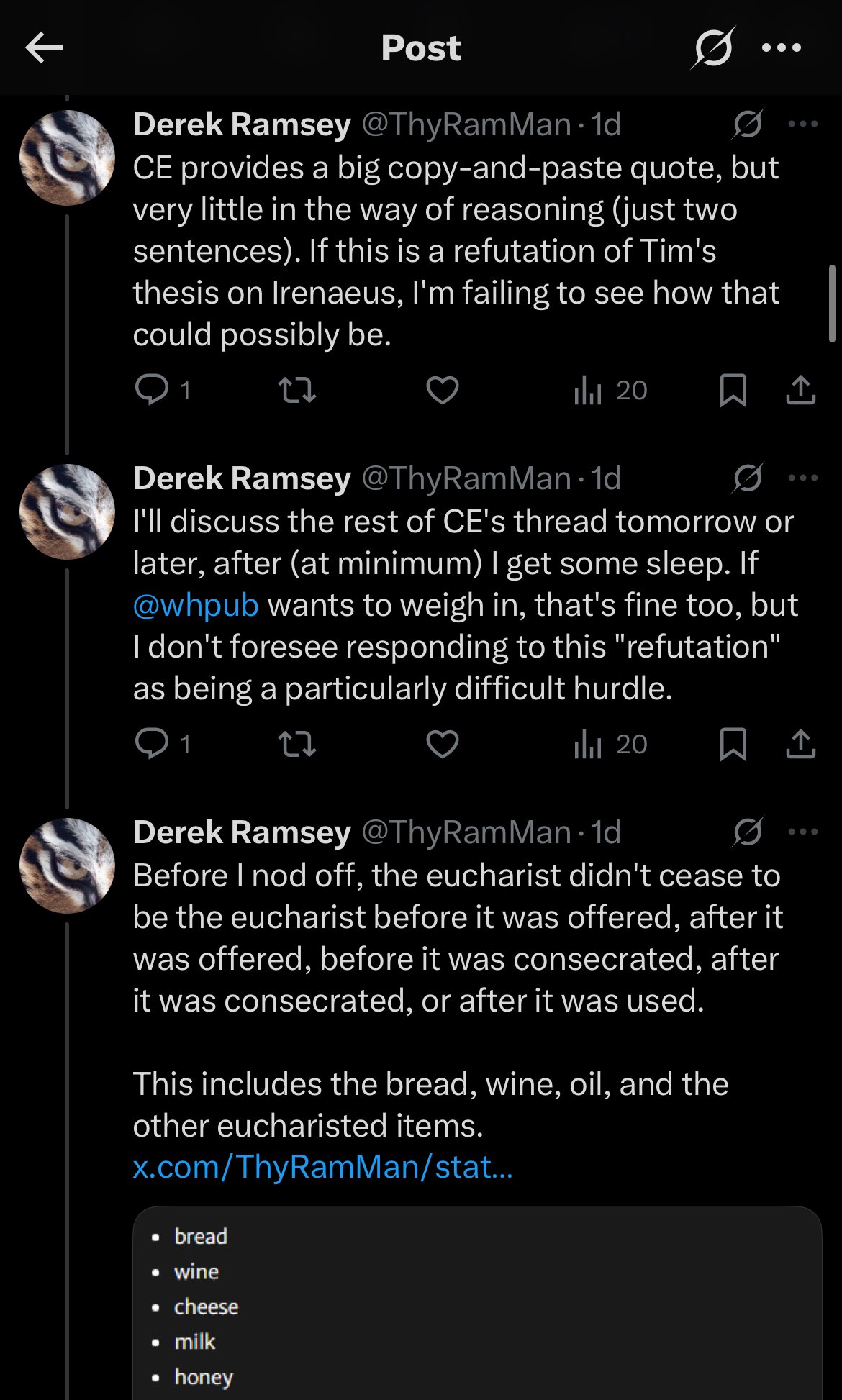
My main objective here is posting the long quote was to demonstrate that St. Irenaeus, when referring to the Eucharist , was referring to holy communion , and not the offering of anything other than bread and wine .
Considering this is quite self-evident in the text , there wasn’t a whole lot to do beyond quoting St. Irenaeus’s usage of the phrase.
Ho, boy. I hope you can see how loaded these statements are!
By now, you can see that using the term “Eucharist” (highlighted in orange) begs-the-question all on its own, but it further begs-the-question to explicitly define it as “holy communion” (highlighted in pink). Saying that this is “self-evident” (highlighted in magenta) is some pretty blatant question begging, as we noted in Part 4. But the highlight in yellow truly takes the prize for the greatest begged question of them all. Did you catch it?
St. Irenaeus…. when referring to holy communion…. not the offering of anything other than bread and wine.
CE just throws in the anachronistic claim that Irenaeus was offering bread and wine during communion.
To the modern Catholic the consecrated bread and wine are offered as a sacrifice of Jesus’ literal flesh and blood. But, in the early church, the sacrificial offering was the tithe (see here and here). By the time the early church celebrated communion, the sacrificial offerings had all been completed. There was nothing left to offer. There was just one sacrifice of eucharist in the early church: a eucharist that was (during the thanks offering) sacrificed-but-not-consecrated and then was (during the celebration of communion) consecrated-but-not-sacrificed.
CE just throws in the reference to “offering” (highlighted in yellow) and just assumes that Irenaeus was describing an offering of consecrated bread and wine. CE is conflating the way his church now uses these terms with the way the early church used them, but their uses are mutually exclusive. This is the most egregious instance of question begging so far.
Lastly, CE has made a mountain out of a molehill: there is nothing to be gleaned from the fact that the ‘eucharist’ mentioned here only referred to bread and wine. This is expected by both the Catholic and the non-Catholic position. The point is simply irrelevant.
The context here is communion, so only eucharisted bread and wine were consecrated and eaten as part of the Lord’s Supper. Irenaeus would not bring up any other eucharistic elements in the context of communion, as the other eucharisted elements were not consecrated or eaten during the celebration of the Lord’s Supper.
Onto the last thing you posted before you went to sleep.
3. When, therefore, the mingled cup and the manufactured bread receives the Word of God, and the Eucharist of the blood and the body of Christ is made, from which things the substance of our flesh is increased and supported , how can they affirm that the flesh is incapable of receiving the gift of God, which is life eternal, which [flesh] is nourished from the body and blood of the Lord, and is a member of Him?— even as the blessed Paul declares in his Epistle to the Ephesians, that we are members of His body, of His flesh, and of His bones. Ephesians 5:30 He does not speak these words of some spiritual and invisible man, for a spirit has not bones nor flesh; Luke 24:39 but [he refers to] that dispensation [by which the Lord became] an actual man, consisting of flesh, and nerves, and bones — that [flesh] which is nourished by the cup which is His blood, and receives increase from the bread which is His body. And just as a cutting from the vine planted in the ground fructifies in its season, or as a grain of wheat falling into the earth and becoming decomposed, rises with manifold increase by the Spirit of God, who contains all things, and then, through the wisdom of God, serves for the use of men, and having received the Word of God, becomes the Eucharist, which is the body and blood of Christ; so also our bodies, being nourished by it…
In Chapter 3, St. Irenaeus explains that the Eucharist (thanksgiving) is made after the words of operation [sic] , so in his framework the Eucharistic elements can only be properly called the Eucharist after the words of consecration .
What Ireneaus means by eucharist is not what CE means by Eucharist. This question begging conflation (highlighted in orange) is a rather tiresome presumption that CE repeats over and over again in his response.
In Part 5, we discussed the problems with claiming (highlighted in yellow) that “the eucharist is made” is a reference to ‘eucharist’ only referring to the consecrated elements. It is discussed in great detail there, but let’s briefly summarize the two major problems with CE’s argument.
First, this reading (highlighted in cyan) is only found in the Latin. Irenaeus wrote in Greek and the Greek wording makes the opposite claim from the one CE is making here. If the Greek reading turns out to be the correct one, it utterly refutes CE’s claim, constituting direct proof that the eucharist was the eucharist before it was consecrated.
Second, the eucharist mentioned in the Latin version is not stated absolutely and exclusively as the eucharist. It is qualified with the prepositional phrase “…of the blood and the body.” Even if the Latin version turns out to be correct, it only indicates that the consecrated bread and wine is the specific eucharist being discussed, to which I completely agree.
Put succinctly: Irenaeus says that the eucharist of the blood and the body is made after the consecration (whereas before that it is merely the eucharist of the tithe).
If Irenaeus had instead wanted to make the claim CE is now putting onto his lips, he need only have said “the eucharist is made” (without the qualifier). But, of course, the eucharist isn’t made in the consecration. It is made in the tithe. Only in the consecration is it made into the eucharist of the blood and the body of Christ.
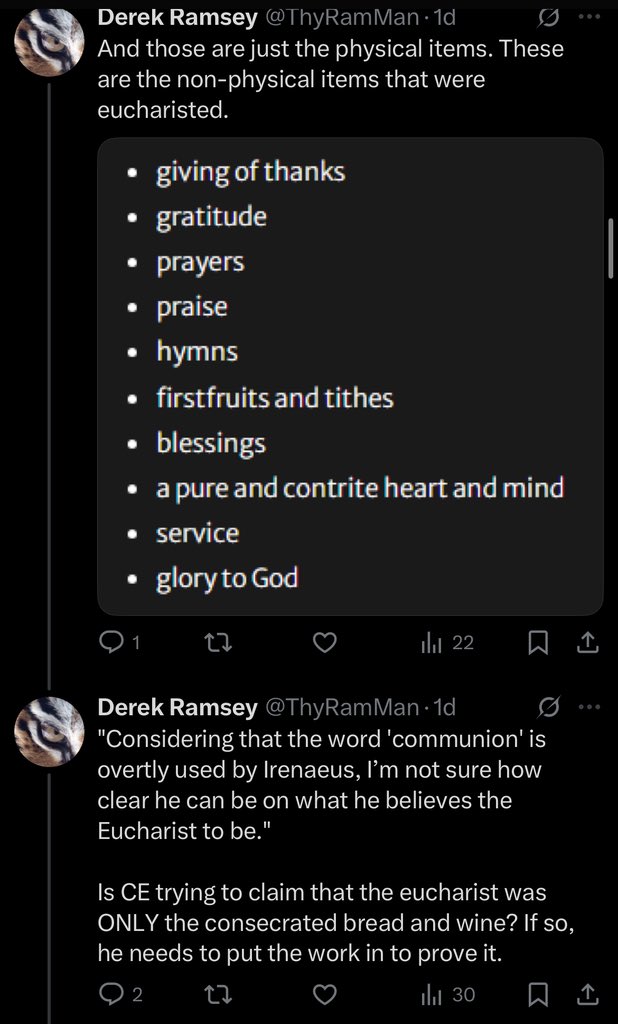
Now, the rest of the last message I’ve screenshotted and these two last messages is where I take serious issue: I can accept that early Christians could have offered up foodstuffs in thanksgiving to God, this is no issue. I’m contending that the thanksgiving being referenced in the chapter undeniably refers to communion .
What I have shown previously in this thread should already prove this, but I’ll go back over the relevant portions of the chapter again to prove it here.
The thanksgiving being referenced in the chapter most certainly does not refer to communion. There is nothing in Irenaeus that indicates that, as we’ve pointed out over and over again. Everything that CE has shown previously was deeply flawed and so proves nothing at all.
But I agree: let’s go over the ‘proof’ again. It should be instructive.
2. But vain in every respect are they who despise the entire dispensation of God, and disallow the salvation of the flesh, and treat with contempt its regeneration, maintaining that it is not capable of incorruption. But if this indeed do not attain salvation, then neither did the Lord redeem us with His blood, nor is the cup of the Eucharist the communion of His blood, nor the bread which we break the communion of His body. 1 Corinthians 10:16 For blood can only come from veins and flesh, and whatsoever else makes up the substance of man, such as the Word of God was actually made. By His own blood he redeemed us, as also His apostle declares, In whom we have redemption through His blood, even the remission of sins. Colossians 1:14 And as we are His members, we are also nourished by means of the creation (and He Himself grants the creation to us, for He causes His sun to rise, and sends rain when He wills Matthew 5:45). He has acknowledged the cup (which is a part of the creation) as His own blood, from which He bedews our blood; and the bread (also a part of the creation) He has established as His own body, from which He gives increase to our bodies.
In paragraph 2, St. Irenaeus identifies the “cup of the Eucharist ” and the “bread which we break the communion of His body.” Notice how, in this passage, these are the only two Eucharistic elements identified.
This proves precisely nothing, other than (you guessed it), that CE begs-the-question (highlighted in orange).
Under the strict non-Catholic view—which rejects any kind of substantial presence—the cup (of the eucharist) and the bread (which is broken) are the communion of his body. Similarly, under the non-Catholic view, only two elements of the eucharist are identified in communion: bread and wine.
There is no conflict here. Every Christian sect that celebrates communion believes that Jesus said “this is my body” and “this is my blood” over bread and wine (respectively).
3. When, therefore, the mingled cup and the manufactured bread receives the Word of God, and the Eucharist of the blood and the body of Christ is made, from which things the substance of our flesh is increased and supported, how can they affirm that the flesh is incapable of receiving the gift of God, which is life eternal, which [flesh] is nourished from the body and blood of the Lord, and is a member of Him?— even as the blessed Paul declares in his Epistle to the Ephesians, that we are members of His body, of His flesh, and of His bones. Ephesians 5:30 He does not speak these words of some spiritual and invisible man, for a spirit has not bones nor flesh; Luke 24:39 but [he refers to] that dispensation [by which the Lord became] an actual man, consisting of flesh, and nerves, and bones — that [flesh] which is nourished by the cup which is His blood, and receives increase from the bread which is His body. And just as a cutting from the vine planted in the ground fructifies in its season, or as a grain of wheat falling into the earth and becoming decomposed, rises with manifold increase by the Spirit of God, who contains all things, and then, through the wisdom of God, serves for the use of men, and having received the Word of God, becomes the Eucharist, which is the body and blood of Christ; so also our bodies, being nourished by it…
Then, in paragraph 3, near the beginning, St. Irenaeus talks about how the “manufactured” bread receives the “Word of God” (the words of consecration), after which the “Eucharist of the blood and the body of Christ is made.”
So, as is plain from the text, the Eucharist/Thanksgiving being referred to here isn’t just a general thanksgiving of prayer or fruits, it’s the particular thanksgiving of the body and blood of Christ, holy communion.
The Christians of St. Irenaeus’s time may have made other thanksgivings, but the thanksgiving of holy communion is clearly differentiated.
Regarding the yellow highlight, I will simply refer you back to what we’ve already discussed in the First and Second points above. But if that’s not good enough, I’ll leave you with this translator note:
As above, CE has proved nothing except that he can make assumptions and pass them off as fact (i.e. he can beg-the-question). After all that time and space spent on Irenaeus, CE has done nothing to prove his claims.
By contrast, if the Greek text mentioned in the translator’s note turns out to be authentic, and there is some reason to think it is, it constitutes clear proof that CE’s claims are false. Sure, it is qualified proof, but it is an objective proof. This is far better than the subjective assumptions that CE has put forth as proof.
Now, we can move onto St. Ignatius.
Let’s do that in Part 7.