
Over the last few years, I have had an extended back-and-forth conversation with a Roman Catholic on Twitter. Our conversation spanned a number of long threads, focusing on the liturgical evidence of eucharist found in some of the earliest major sources:
The Didache (c.90)
Ignatius (d.c.108)
Justin Martyr (d.c.165)
Irenaeus (d.c.202)
Cyprian (d.c.258)
This is Part 7. The topic is Ignatius. See the index here.
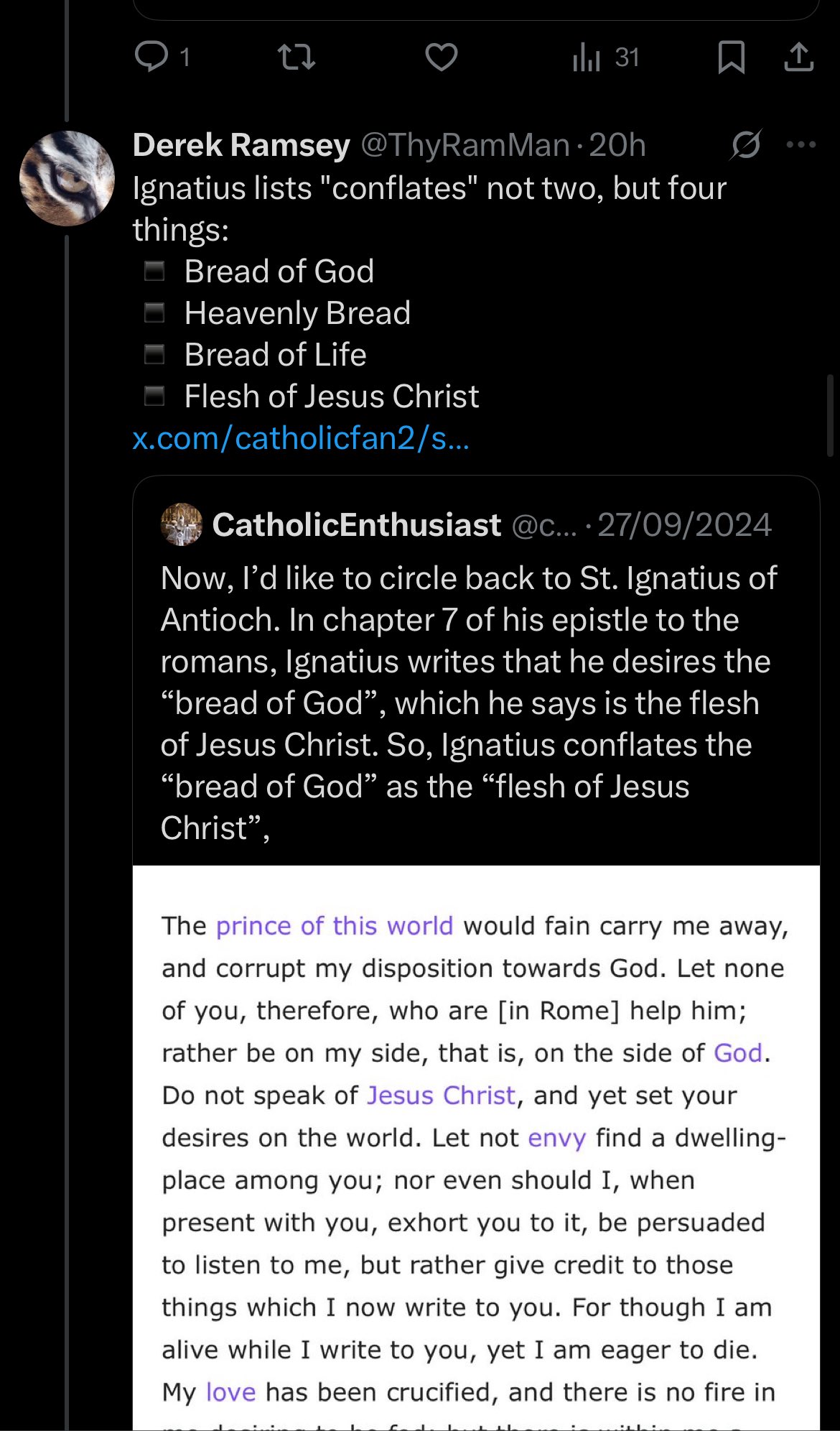
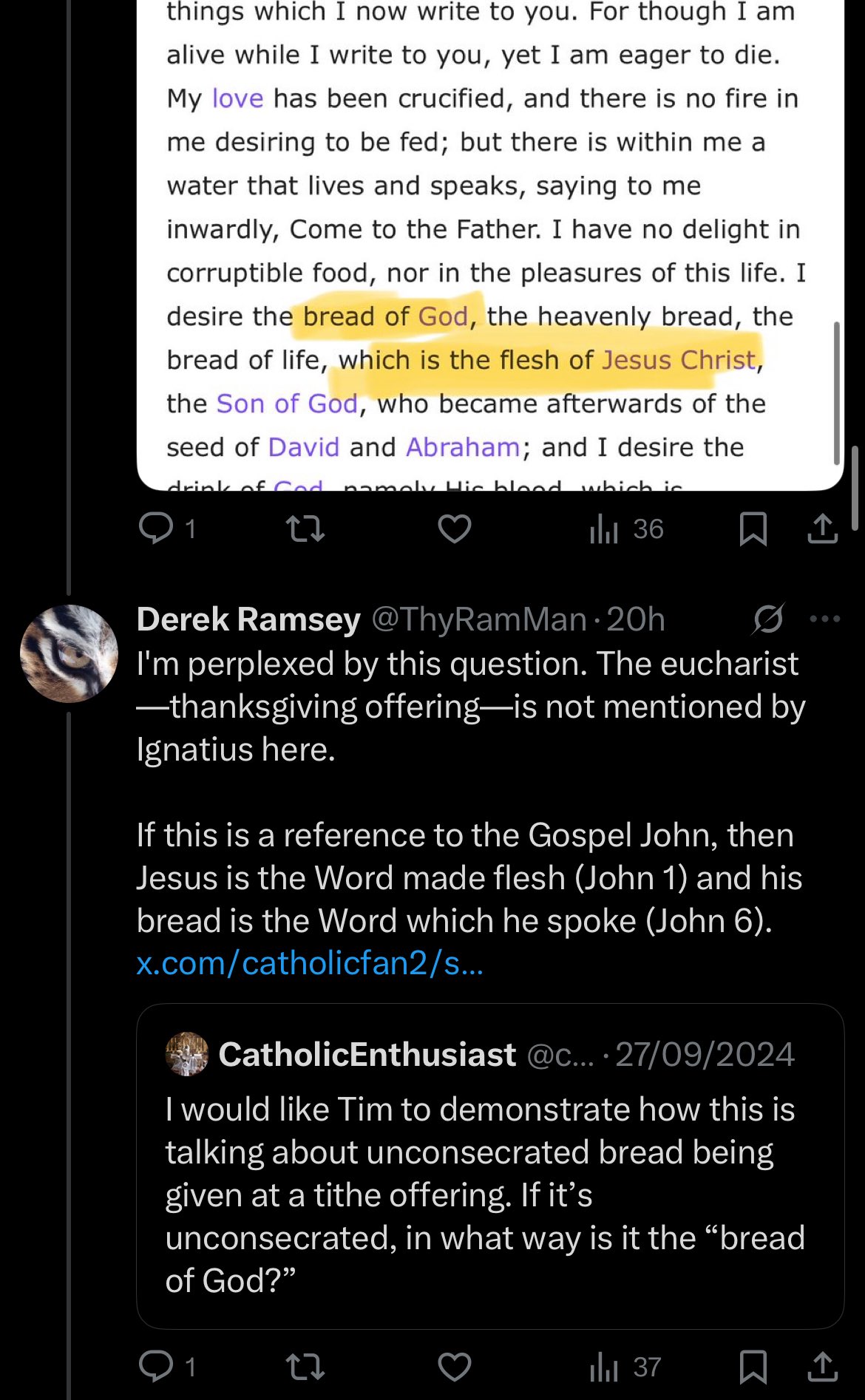
I will concede I could have done a far better job with regard to exegesis here, so I will explicate my aim now. When trying to understand Ignatian theory, it is best to look at all of his authentic works in order to properly assess what he believed when writing his epistles.
This is somewhat ironic, considering how CE’s argument from Irenaeus was deeply flawed because he had neglected—multiple times—to consider the authenticity of what he was citing. Ignatius’ writings come from multiple conflicting sources, and it’s not completely certain that any are truly authentic. But I don’t want to get bogged down on that, so unless it is pertinent to our discussion, we’ll set that aside. I’m just not sure why CE is making a big deal about it now, all of the sudden. Does he think I cited a spurious work? Who knows, as he doesn’t say.
In any case, it’s fine to restrict the discussion to the seven “authentic” letters of Ignatius: to the Ephesians, to the Magnesians, to the Trallians, to the Romans, to the Philadelphians, to the Smyrnaeans, and to Polycarp. We are just going to talk about two of them anyway.
Now, let us examine his epistle to the Romans, Chapter 7.
The prince of this world would fain carry me away, and corrupt my disposition towards God. Let none of you, therefore, who are [in Rome] help him; rather be on my side, that is, on the side of God. Do not speak of Jesus Christ, and yet set your desires on the world. Let not envy find a dwelling-place among you; nor even should I, when present with you, exhort you to it, be persuaded to listen to me, but rather give credit to those things which I now write to you. For though I am alive while I write to you, yet I am eager to die. My love has been crucified, and there is no fire in me desiring to be fed; but there is within me a water that lives and speaks, saying to me inwardly, Come to the Father. I have no delight in corruptible food, nor in the pleasures of this life. I desire the bread of God, the heavenly bread, the bread of life, which is the flesh of Jesus Christ, the Son of God, who became afterwards of the seed of David and Abraham; and I desire the drink of God, namely His blood, which is incorruptible love and eternal life.
It is certainly true that the Eucharist is not mentioned here. However, observe what St. Ignatius was speaking of before he brought up the “bread of God.” St. Ignatius explains that he has no desire for earthly food, but rather the bread of God.
This is important, because it infers that St. Ignatius desires food, but rather of the Godly and spiritual variety. Now, it’s very much true that [this] by itself doesn’t prove anything about his beliefs concerning Holy Communion. St. Ignatius could regard the bread of God as scripture, or something else entirely.I’m perplexed as to why CE is bringing this up. He is correct that if Ignatius takes the food to mean God’s teachings in scripture (or something else other than literal flesh), then this supports a non-Catholic explanation. But, it seems to me, what Ignatius is saying here isn’t evidence for or against any position under debate. I don’t see this quotation as important at all.
This feels like a dodge. I objected by noting that Ignatius never mentions the thanksgiving offering (the eucharist) anywhere in Letter to the Romans. This fact remains uncontested. Instead of acknowledging that this poses a serious contextual problem for his argument (re: the eucharist), he brought up this irrelevant side discussion as an “important” defense. But, my objection remains, still unaddressed.
So, to fully understand this passage [in Chapter 7 of the Epistle to the Romans], we must look to where St. Ignatius does mention the Eucharist. We can find such a passage in the epistle to the Smyrnaeans.
No, this too is a dodge. You can’t so easily retreat from the contextual problems we discussed in Part 2 regarding the Letter to the Romans by appealing to the Letter to the Smyrnaeans. The problems in the former are structural problems inherent to the letter itself: it’s simply not talking about eucharist at all.
The issue isn’t that we lack enough context. The discrepancy—between what Ignatius wrote and what CE is claiming it means—wouldn’t go away regardless of what Ignatius might say in another letter, whether for or against the Catholic position. You can’t rationalize the problems away by appealing to a completely different context.
It is also highly suspect to prioritize indirect contextual analysis over direct exegesis (e.g. the heavy use of figures of speech in Chapter 7 of Letter to the Romans).
I am exegeting Letter to the Romans by citing Letter to the Romans. CE is exegeting Letter to the Romans by citing Letter to the Smyrnaeans. I can’t think of any reason why I should allow that. CE has the obligation to justify that choice, to justify why he should be permitted to even consider doing so in the first place. By default, his exegetical approach is the inferior one.
It would be another thing entirely if Letter to the Romans was unclear and we needed to look elsewhere to “break the tie.” But that is not the case here. The Letter to the Romans is not unclear at all. In fact, I have to question CE’s motives for why he is trying to import a eucharistic context where none is obviously present and it is not required to understand anything that was written.
This is, for what its worth, the same objection I have to the Catholic approach to John 6. It isn’t a eucharistic context, but the Roman Catholic Church insists that it is for reasons of theology, rather than reasons of exegesis. That’s fine if you want to believe whatever you want because your church tells you to believe it, but I’m simply not going to allow that in a rational, intellectual discussion. Here the standard of evidence is more than “because my church says so.”
I suppose this would be somewhat tolerable if CE’s citation of Letter to the Smyrnaeans was well-founded, but I’m quite familiar with the extremely poor exegetical approach that Catholics bring to that letter. Even calling it “exegesis” is a stretch. So, let’s get to it, shall we?
They abstain from the Eucharist and from prayer, because they confess not the Eucharist to be the flesh of our Saviour Jesus Christ, which suffered for our sins, and which the Father, of His goodness, raised up again. Those, therefore, who speak against this gift of God, incur death in the midst of their disputes. But it were better for them to treat it with respect, that they also might rise again. It is fitting, therefore, that you should keep aloof from such persons, and not to speak of them either in private or in public, but to give heed to the prophets, and above all, to the Gospel, in which the passion [of Christ] has been revealed to us, and the resurrection has been fully proved. But avoid all divisions, as the beginning of evils.
Now, we first must establish what thanksgiving is being referred to here. With St. Irenaeus, we can observe that he clearly differentiated holy communion as its own Eucharist, however with St. Ignatius this is less clear.
Our first clue, however, is in the first sentence. St. Ignatius states that the heretics abstain from THE Eucharist. Why is this important? If he were referring to just a general thanksgiving of foodstuffs, prayer, and first fruits, we would expect him to just reference thanksgiving in the indefinite article.However, his reference to the Eucharist in the definite article indicates that he is referring to a particular thanksgiving . Considering this particular Eucharist is differentiated from praise , it becomes even less likely that this eucharist is general as opposed to particular.
If you, Dear Reader, want to know why I have such low regard for the “exegetical” approach of typical Catholic apologists (even the smart ones!), this is a prime example. Due to extreme confirmation bias, Catholics will see their theology in everything, no matter how ridiculous it is. Since their beliefs are all ultimately just fallacious arguments from (church) authority, I suppose we should not be surprised by this.
Remember how in Part 1 we saw that CE was duped by translators? At the same time, we didn’t uncritically excuse him of his mistake, because he shouldn’t have been so credulous: he should be skeptical about the truth of his faith. Well, here he is being duped again. As before, CE really does not know what he is talking about.
Here is the first sentence in the original Greek:
Εὐχαριστίας καὶ προσευχῆς ἀπέχονται, διὰ τὸ μὴ ὁμολογεῖν τὴν εὐχαριστίαν σάρκα εἶναι τοῦ σωτῆρος ἡμῶν Ἰησοῦ Χριστοῦ τὴν ὑπὲρ τῶν ἁμαρτιῶν ἡμῶν παθοῦσαν, ἣν τῇ χρηστότητι ὁ θεοῦ συζητοῦντες ἀποθνήσουσιν· συνέφερεν δὲ αὐτοῖς ἀγαπᾶν, ἵνα καὶ ἀναστῶσιν
Do you see the first word in the sentence? That’s the word “eucharistia” and it is used without the definite article. That statement I highlighted in yellow?
Absolutely, unambiguously false.
The reason why the translation that CE cited says “the Eucharist” is because CE cited one of the translations where the translator added the definite article into his English translation and used “Eucharist” as a proper noun. CE chose a translation that confirmed his bias, and, unsurprisingly, ended up confirming his bias. Unfortunately, his unwise credulity led him to make an erroneous statement (highlighted in yellow) and draw an erroneous conclusion (highlighted in red):
However, his reference to the Eucharist in the definite article indicates that he is referring to a particular thanksgiving .
Let’s make this abundantly clear: if Ignatius had wanted to use the definite article here, he could have done so. It was entirely permissible under proper Greek language syntax and grammar. But, he chose not to. CE not only didn’t know this, but he doesn’t know why half of English translators left out the definite article when translating this passage.
Alas, that is not the only critical error. Do you see the part highlighted in magenta?
If he were referring to just a general thanksgiving of foodstuffs, prayer, and first fruits, we would expect him to just reference thanksgiving in the indefinite article .
This is, frankly, an incredibly embarrassing blunder: there is no indefinite article in Koine Greek. So, let’s fix that up:
If he were referring to just a general thanksgiving of foodstuffs, prayer, and first fruits, we would expect him to reference thanksgiving without a definite article.
That’s right, if Ignatius had wanted to use ‘eucharistia’ in the indefinite sense, he would have needed—by the rules of grammar—to drop the definite article, which is precisely what he did!
However, all that being true, I can’t simply declare victory on the spot because in Greek the line between the definite and indefinite is blurred. There are times when English requires a definite article but the Greek does not. There are also times when Greek uses a definite article when English would not. There are times when when one language requires the article while the other, by convention, leaves it out. Additionally, there are times when the definite article in Greek does not even function the same way that it does in English.
In reality, the definite and indefinite senses in Greek do not operate the same strict manner as in English. By dropping the definite article, it can merely change the emphasis of the sentence without implying either a strict definite or indefinite sense.
The kind of analysis that CE wants to perform cannot be blithely done on Ignatius’ Greek. The fact that Ignatius left out the article doesn’t really tell us a whole lot. He could, in theory, have meant it definitely, indefinitely, or qualitatively, depending on the context. Or, more likely, he simply wanted to set the emphasis of the sentence without implying anything at all about definiteness. This, of course, means that the context is what matters. But CE is trying to say what the context is by pointing to the presence of the article (which isn’t even there!). This is exactly the opposite of the correct exegetical approach.
If one does not blindly accept Catholic theology, then they are free to include all the context and to translate the passage neutrally, leading to the following reading of Letter to the Smyrnaeans:
They abstain from thanksgiving and prayer —having no regard for love; no care for the widow, or the orphan, or the oppressed; of the bond, or of the free; of the hungry, or of the thirsty—because they confess not the thanksgiving to be the flesh of our Savior Jesus Christ, which suffered for our sins, and which the Father, of His goodness, raised up again.
The eucharist is the thanks offering of gifts, tithes, prayers, and praise. The gifts constitute a love offering for those in need (e.g. widows, orphans, oppressed, bonded, free, hungry, and thirsty) The abstention by the Gnostics reflects their refusal to bring the eucharist—tithe offerings—to the altar for the distribution to the poor and for the celebration of the Lord’s Supper where the flesh of Jesus was affirmed in the consecration (i.e. “this is my body…this is my blood). In the early church, you could not participate in the celebration of the Lord’s Supper if you did not participate in the tithe offering (the eucharist). Removing unbelievers, catechumans, and the unrepentant from the tithe offering is formally called “the dismissal”—from which Roman Catholics ironically derive the name “missa” or “Mass” (which literally means ‘dismissal’).
Nowhere does Ignatius use the proper noun “The Eucharist.” When he uses the definite article to describe “the thanksgiving,” the definite article is there to connect the second reference back to the first reference, the one without the definite article.
It is, in fact, precisely the opposite from what CE claims. Instead of differentiating two different eucharists, the second eucharist (the one referencing a communion context) is explicitly tied to the first eucharist (the one referencing the sacrifice, called “thanksgiving and prayer,” for those in need).
For those who are not familiar, the phrase “thanksgiving and prayer” is a very early religious term-of-art that refers to the sacrificial offering of tithes, gifts, thanks, and praise. It is not a “Eucharistic” term (i.e. pertaining to communion). You can read about it here, where I cite more than a dozen early writers that do this. Here is where Ignatius uses that term:
They abstain from thanksgiving and prayer …
Pay close attention to this wording. Ignatius says that the Gnostics abstained from thanksgiving and prayer, not from the Lord’s Supper. They abstained from the tithe offering—having no regard for those in need—because they refused to “acknowledge the thanksgiving to be the flesh of Jesus.” In other words, they wouldn’t consecrate the bread and wine with the words “this is my body…this is my blood.” This is the bottom line: Ignatius is explaining why the Gnostics didn’t tithe (i.e. offer the eucharist; care for those in need), and it’s because they didn’t want to admit (during the celebration of the Lord’s Supper) that Jesus had flesh.
Here is how I would paraphrase it:
They won’t give any tithe offerings for those in need because they won’t consecrate the bread and wine [taken from the tithe offering] by repeating “This is my body…this is my blood.”
If you’ve never heard this before, it’s because translators hide this through their translations.
CE’s statement highlighted in cyan is especially absurd:
Considering this particular Eucharist is differentiated from praise , it becomes even less likely that this eucharist is general as opposed to particular.
Not only is “this particular eucharist” not differentiated from praise, but Ignatius uses the standard language of the early church to implicitly associate thanksgiving (‘eucharist’) with praise! In fact, thanksgiving is routinely used in scripture and the early church as a synonym of praise.
Recall in Part 3 how CE tried to claim that there were distinct eucharists and that early writers denoted particular eucharists? I said that as we continue this series, we will, of necessity, discuss some of those instances. Well, here we are. The Letter to the Smyrnaeans serves to confirm what we said in Part 3: the bread and wine of the eucharist do not cease to be the eucharist when the are consecrated for communion.
They abstain from the Eucharist and from prayer, because they confess not the Eucharist to be the flesh of our Saviour Jesus Christ, which suffered for our sins, and which the Father, of His goodness, raised up again. Those, therefore, who speak against this gift of God , incur death in the midst of their disputes. But it were better for them to treat it with respect, that they also might rise again…
Then, notice how he references the Eucharist as a gift FROM God, rather than a gift TO God . While holy communion is a gift to God whereas in its a sacrifice to Him , it’s also a gift FROM Him in the sense that He instituted it. While you could say a thanksgiving of foodstuffs is a gift from God in the sense that fruit is given to us by Him , but the label most directly and clearly applies to Holy Communion .
The most likely Eucharist that is being referenced, then, is Holy Communion . This then allows us to understand his epistle to the Romans, as St. Ignatius here is reiterating his believe that the Eucharist is the flesh and blood of Christ.( magenta ) Communion is an act of remembrance of Jesus’ sacrifice. It is not a gift at all, it is an act. Moreover, the Lord’s Supper is not a sacrifice. Catholics—having conflated the sacrificed-but-unconsecrated elements with the consecrated-but-not-sacrificed elements—will insist that the Lord’s Supper is a sacrifice, but this is precisely what is being debated. Thus, CE’s claim merely begs-the-question.
( yellow ) The thanks offering—the eucharist—is a gift from God because we are offering to God his own created things. To wit:
Again, giving directions to His disciples to offer to God the first-fruits of His own, created things — not as if He stood in need of them, but that they might be themselves neither unfruitful nor ungrateful — He took that created thing, bread, and gave thanks, and said, “This is My body.”
This is an uncontested point. That the sacred gifts are “of God”—those which we sacrificially offer in the tithe offering (the eucharist) and then consecrate in the celebration of the Lord’s Supper—is not in dispute. However, this has no bearing at all on whether the Catholic or the non-Catholic position is the correct one.
( pink ) CE’s inference does not logically follow. One cannot infer—from the fact of the gift being from God—that eucharist refers to communion. The quote I provided from Irenaeus makes the abundantly clear.
( cyan ) Since the inference above is invalid, the conclusion does not logically follow either. It is simply not a logically valid approach to take the Letter to the Smyrneans and use it to replace the context of the “Bread of God” in the Letter to the Romans.
This is, as I opened above, simply a dodge to avoid the fact that Irenaeus never mentions the thanksgiving offering (the eucharist) anywhere in Letter to the Romans. My objection remains. So too do the objections raised in Part 2 regarding how the Catholic understanding of “Bread of God” in the Letter to the Romans is a non-contextual reading that implicitly denies of the doctrine of the Trinity.
Speaking of Irenaeus:
With regard to St. Irenaeus, I think I’ve proven multiple times at this point the sense in which he used the term Eucharist in the work I cited. I don’t wish to do it again.
Recall that in Part 1, CE cited the editor/translator of Irenaeus in order to defend the doctrine of transubstantiation in Irenaeus. His “proof” was, in reality, a pie-in-the-face error that revealed how little CE actually knows about this topic.
Recall that in Part 5 and Part 6, we showed how CE was unconsciously cherry-picking the Greek and Latin translations of Irenaeus to arbitrary select those that fit Catholic doctrine.
Do you recall, above, where CE didn’t know that the Greek language didn’t have indefinite articles or that the underlying Greek of his translation didn’t use the definite article that he was sure was there? His “proof” was a pie-in-the-face error that revealed how little he actually knows about this topic.
I have no doubt that CE thinks he has proven his point, but you’d be hard pressed to find even a single debated point that he got right.
We will continue in Part 8.