
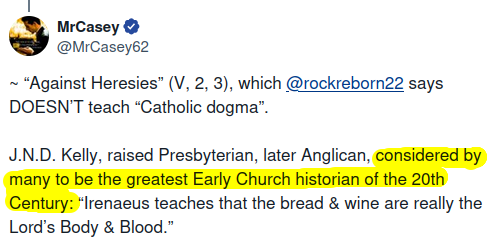
In this short, two-part series, we are going to demonstrate how meaningless it can be to have a PhD in Theology or to have numerous academic publications. This will serve as a practical example of why formal appeals to authority in religion are close to meaningless.
Introduction
Ryan Haecker graduated from Cambridge University with a Doctor of Philosophy (PhD) in Theology and Religious Studies. He is now faculty there, teaching undergraduates, graduates, and postgraduates. His academia page lists 32 papers, 8 book reviews, and 13 conference presentations. This appears to be a significant undercounting of the work on his C.V.. He is a member of the European Academy of Religion.
If you are the kind of person intrigued by (fallacious) appeals to authority, this is very high up on what credentialed expertise can get you. If you are the kind of person who asks “where did you get your degree?” or “Where did you learn that?” when someone challenges your beliefs, you’re probably the kind of person who would respect or be persuaded by Haecker’s views on the basis of his prestige.
Most notably, Haecker did his PhD dissertation on Origen (c.185 – c.254 AD). The dissertation focuses on the relationship between logic, ontology, theology, and trinitarianism. Keep this in mind as you read the following:
Although the phrase ‘Real Presence’ was not introduced until St. Ambrose, the historian J.N.D. Kelly has described Origen as part of a consensus of the early Church Fathers, who held an “unquestioningly realist” view of Christ in the Eucharist.
These authorities include:
Ignatius of Antioch who explicitly called the Eucharist the “flesh of our Savior”; Justin Martyr who described a “change” or “transmutation” in the food to become Christ’s flesh and blood; and Tertullian who argued that the “flesh feeds upon Christ’s body” so the soul may be filled with God.In Part 2, we are going to focus on the flaws in the part highlighted in yellow. But, the other references (highlighted in magenta) have serious problems as well, so let’s go over them here in part 1.
The Early Writers
Ignatius
The reference to Ignatius is a familiar one. It comes from “Epistle to the Smyrnaeans.” ¶6-7. We first discussed it “The Eucharist, Part 4: Ignatius of Antioch” (back in 2024) and, more recently, in “The Eucharist, Redux #8: Misquotations” (in July, 2026).
In quick summary, Haecker takes the quotation badly out of context…
…by excluding the part in yellow and only referencing the part in magenta. This serves to hide the fact that the “eucharist” was the sacricial offering of tithes and gifts for those in need. Doing so forces Ignatius to hold to a view that he did not hold to (and could not have held, due to it be an anachronism): that the early church sacrificially offered consecrated bread and wine that was Jesus’ literal flesh and blood.
This is not a good start for our PhD-level historian.
It’s not exactly surprising that Haecker holds the view he does. What is notable is that it doesn’t take any scholarship or knowledge of history to make these claims. All one has to do is take a single sentence from an online quote mine and blindly repeat it in whole or in part. One doesn’t even need to know anything about Ignatius or what he wrote.
Despite his advanced scholarship and accolades, Haecker is repeating talking points that can be found by anyone with a keyboard. What does this say about the value of higher education that not even the experts can be distinguished from the ignorant and uneducated?
Justin Martyr
The reference by Justin Martyr to “transmutation” comes from First Apology, Chapter 66.[1] This particular paraphrase, however, is a serious misreading of the original.
When you read Haecker’s statement (emphasis added) a specific word immediately leaps to mind: “transubstantiation.” But that’s not the word that Justin Martyr used. He used the word “transmutation,” which, despite its superficial similarity to “transubstantiation,” is a completely different word that—in this context—simply refers to digestion or nourishment: the biological process of converting the food into human flesh, not into to the flesh of Christ.
To match what Justin Martyr said, this is what Haecker should have said:
Haecker is (if I’m being generous) reporting what he thinks Justin Martyr meant, not reporting what he actually said:
Chapter 66
…we been taught that the food which is blessed by the prayer of His word, and from which our blood and flesh by transmutation are nourished , is the flesh and blood of that Jesus who was made flesh.
I’ll let Timothy F. Kauffman explain:
Notably, Justin did not say consecrated bread & wine become Jesus’ “flesh and blood” by transmutation but rather that “our blood and flesh” are nourished by transmutation (μεταβολην) with food that has been consecrated. That’s a big difference.
Justin elsewhere uses the term to describe a change of mind, of seasons & of face, but here, his obvious focus is on bread & wine changing into our flesh & blood through the digestive process. He cannot be pressed into service to fabricate ancient proof of transubstantiation.
A big difference indeed. This kind of fundamental error is almost trivial to avoid making. This is not an error that a credentialed historian of Haecker’s vaunted status should ever make.
But, here is a little ‘secret’: Kauffman wasn’t even responding to Haecker. This talking point is so common that it doesn’t even have to be addressed to anyone in particular! I could just plop Kauffman’s explanation down here and it’s as if he personally addressed it to Haecker.
But, what about the Protestant J.N.D. Kelly, whose authority Haecker is resting upon? Kelly actually quotes this exact passage from Justin Martyr in his book:
Justin actually refers to the change.
J.N.D. Kelly places the “transmutation” (i.e. “assimilation”) phrase in parentheses, clearly separating it—and distinguishing it—from Justin Martyr’s statement about being the flesh and blood of Jesus. What Haecker left out of Kelly’s so-called “‘unquestioningly realist’ view of Christ in the Eucharist” is that Kelly didn’t actually espouse Haecker‘s framing of the change that Justin Martyr described!
Kelly clearly viewed the transmutation of food as a process of nourishing our physical flesh and blood, not as a description of transubstantiation. With the parenthetical phrase removed…
…the remaining grammatically correct text retains the consecratory change of the “food which has been eucharistized” into “the flesh and blood of the incarnate Jesus,” but no longer has even a hint of transmutation. Indeed, the use of the verbal adjective ‘eucharistized’ (with an aorist aspect) shows that the bread had already been sacrificed prior to the consecration into the flesh of Jesus.
This level of academic and intellectual error—falsely implying affirmative support by cited sources—is a sign of things to come.
Tertullian
As with Justin Martyr above, it is important to disclose (at the outset) what Tertullian actually said, rather than what Haecker thinks (or wishes) Tertullian meant. Let’s compare Haecker’s paraphrase (and, despite his misleading use of quotation marks, it is just that) with a quotation from the translation at New Advent (a Catholic site):
The difference, once again, is quite notable, with ‘fatten’—a vibrant, visceral, physical-sounding kind of word—being replaced by the rather tame, unremarkable, and spiritual-sounding word ‘filled’. This, rather obviously, masks Tertullian’s use of a graphic figure-of-speech. Considering the Catholic view presupposes a literal interpretation of eating the flesh, this does not look like a neutral editorial choice. It’s certainly not something you would expect from an highly proficient and accomplished academic.
This is not the first time that we’ve examined these claims. Back in 2024, I wrote about Chapter 8 of “On the Resurrection of the Flesh” in the article “The Eucharist, Part 9: Tertullian.” Let’s look at the text of that chapter:
And since the soul is, in consequence of its salvation, chosen to the service of God, it is the flesh which actually renders it capable of such service. The flesh, indeed, is washed, in order that the soul may be cleansed; the flesh is anointed, that the soul may be consecrated; the flesh is signed (with the cross), that the soul too may be fortified; the flesh is shadowed with the imposition of hands, that the soul also maybe illuminated by the Spirit ; the flesh feeds on the body and blood of Christ , that the soul likewise may fatten on its God . They cannot then be separated in their recompense, when they are united in their service. Those sacrifices, moreover, which are acceptable to God — I mean conflicts of the soul, fastings, and abstinences, and the humiliations which are annexed to such duty — it is the flesh which performs again and again to its own special suffering.
Tertullian gives a consecutive list of acts with physical and spiritual realities:
flesh is washed ; soul is cleansed
flesh is anointed ; soul is consecrated
flesh is signed ; soul is fortified
flesh is shadowed ; soul is illuminated
flesh feeds ; soul is fattened
It is very easy to see how Tertullian deftly and freely weaves figures-of-speech throughout his descriptions. Are these literal?
• The fortification of the soul
• The illumination of the soul
• The fat of the soul
Of course not. What about these?
• Is baptism taking a bath?
• Is the the sign about waving hands or the cross wood?
• Is laying on hands about giving shade?
• Is the feeding on literal flesh of Christ?
Obviously these are meant as figures, things bearing hearty significance.
Here are more examples from the same work, this time regarding the Bread of Life discourse:
Chapter 37
He says, it is true, that the flesh profits nothing; John 6:63 but then, as in the former case, the meaning must be regulated by the subject which is spoken of. Now, because they thought His discourse was harsh and intolerable, supposing that He had really and literally enjoined on them to eat his flesh , He, with the view of ordering the state of salvation as a spiritual thing, set out with the principle, It is the spirit that quickens; and then added, The flesh profits nothing,— meaning, of course, to the giving of life. He also goes on to explain what He would have us to understand by spirit: The words that I speak unto you , they are spirit, and they are life. In a like sense He had previously said: He that hears my words, and believes in Him that sent me, has everlasting life, and shall not come into condemnation, but shall pass from death unto life. John 5:24 Constituting, therefore, His word as the life-giving principle, because that word is spirit and life, He likewise called His flesh by the same appellation; because, too, the Word had become flesh , John 1:14 we ought therefore to desire Him in order that we may have life, and to devour Him with the ear, and to ruminate on Him with the understanding, and to digest Him by faith . Now, just before (the passage in hand), He had declared His flesh to be the bread which comes down from heaven, John 6:51 impressing on (His hearers) constantly under the figure of necessary food the memory of their forefathers , who had preferred the bread and flesh of Egypt to their divine calling.
…and…
Chapter 63
If you will only draw water from His fountains , you will never thirst for other doctrine : no feverish craving after subtle questions will again consume you ; but by drinking in evermore the resurrection of the flesh , you will be satisfied with the refreshing draughts .
Are these things—all grouped together—literal?
• Devour him with the ear
• Ruminate on him with understanding
• Digest him by faith
Or are these—all contained in one sentence—literal?
• Water from His fountains
• Thirst for doctrine
• Questions that consume you
• Drinking the resurrection
• Satisfied with refreshing draughts
Of course not.
To feed upon Christ’s flesh is the same kind of figure-of-speech as devouring him with the ear, or digesting him by faith, or drawing water from His fountains, or thirsting for doctrine. Tertullian likes to use figures-of-speech regarding eating, drinking, and consuming as a vehicle to speedily convey spiritual insights by his words.
Let’s drive the point home. Do you read these as literal or figurative?
…or…
Or, if you heard Tertullian speak of the crowd’s response to Christ’s discourse…
…would you conclude that the bread was “really and literally” the flesh of Jesus or would you conclude that it was “a spiritual thing?”
The answers to these questions are obvious. Tertullian loves to use richly figurative language, just as he did throughout the earlier section where he says the flesh eats the body and blood of Christ. All scholars of Tertullian know this.
Now, let’s look at Tertullian’s use of figure explicitly. We can see it elsewhere in his writing:
When He so earnestly expressed His desire to eat the passover, He considered it His own feast; for it would have been unworthy of God to desire to partake of what was not His own. Then, having taken the bread and given it to His disciples, He made it His own body, by saying, This is my body, that is, the figure of my body. A figure, however, there could not have been, unless there were first a veritable body. An empty thing, or phantom, is incapable of a figure. If, however, (as Marcion might say,) He pretended the bread was His body, because He lacked the truth of bodily substance, it follows that He must have given bread for us. It would contribute very well to the support of Marcion’s theory of a phantom body, that bread should have been crucified! But why call His body bread, and not rather (some other edible thing, say) a melon, which Marcion must have had in lieu of a heart! He did not understand how ancient was this figure of the body of Christ , who said Himself by Jeremiah: I was like a lamb or an ox that is brought to the slaughter, and I knew not that they devised a device against me, saying, Let us cast the tree upon His bread, which means, of course, the cross upon His body . And thus, casting light, as He always did, upon the ancient prophecies, He declared plainly enough what He meant by the bread, when He called the bread His own body. He likewise, when mentioning the cup and making the new testament to be sealed in His blood, Luke 22:20 affirms the reality of His body. For no blood can belong to a body which is not a body of flesh.
Citation: Tertullian of Carthage. “Against Marcion, Book 4.” §40
As you probably know, the literal and figurative often take exactly the same canonical form:
X is Y
Here is one example of this:
This is my body
How do you know if this is literal or figurative? Since both options look identical, typically only the context determines if such a statement is to be taken literally or figuratively. Only rarely does an author actually say when he is speaking figuratively. Yet, of all of the early writers, Tertullian is, by far, the most explicit.[2] He explains that these words spoken by Jesus are to be taken figuratively:
“This is my body” means “This is the figure of my body.” Yes, the former is, ironically, a literal figure of speech for the latter. And, no, I’m not misusing the word “literally” as an informal intensifier. In this case, “This is my body” is exactly, truly, factually, and strictly speaking a figure of speech.
The point, of course, is that a scholar of Haecker’s caliber is well aware that Tertullian loved to use figurative language. He’s aware of how Tertullian explained that he was using figures of speech. He’s aware the Tertullian contrasted the real and literal with the figurative. And, he’s well aware that the context of the citation he gave…
…is overflowing with figures of speech.
Summary
In all three examples—Ignatius, Justin Martyr, and Tertullian—Haecker sets aside scholarship and historical analysis for the promotion of a common talking point. Those talking points are each erroneous precisely because they don’t factor in the context, something that scholarly scholars and academics are supposed to do.
For Ignatius, it involves simply reading the important context found in the immediately previous sentence of the source material. For Justin Martyr, it involves simply reading what he actually wrote: that the ‘transmutation’ is said to nourish the flesh and blood of the person who eats it, not to transmute into Christ’s flesh and blood. For Tertullian, it involves the simple process of identifying the many figures of speech that make up the context, as well as being aware that he explicitly called the bread a “figure of the body.”
None of this is complex. The irony is that none of it requires an advanced degrees or credentials. But it also shows that an extensive education is no guarantee of actual expertise. Yet, as clear as these examples are, they are, I think, minor compared to what is to come in Part 2. It’s one thing to repeat talking points made by others and simply fail to apply scholarship. It is quite another thing for one to erroneously apply actual scholarship.
Footnotes
[1] This was first discussed in “The Eucharist, Part 3: Justin Martyr.” For a more recent, detailed analysis of the various attempts to translate this part of Justin Martyr, see “Translations of Justin Martyr, First Apology, Chapter 66.”
[2] Tertullian clearly understands the difference between literal and figurative. See Chapter 20: “Figurative Senses Have Their Foundation in Literal Fact. Besides, the Allegorical Style is by No Means the Only One Found in the Prophetic Scriptures, as Alleged by the Heretics.”
I think these people just read the headings in their translation and not the text. For instance Irenaeus Book V Chapter 2 the translation on New Advent has the heading “When Christ visited us in His grace, He did not come to what did not belong to Him: also, by shedding His true blood for us, and exhibiting to us His true flesh in the Eucharist, He conferred upon our flesh the capacity of salvation.”
But Irenaeus does not actually say the Eucharist is Christ’s True Flesh. His argument is that those who deny a physical reaurrection and say the soul alone is saved are refuted by Christ having actual flesh and by the eucharist commemorating that Christ had actual flesh.
Of course he’s much more bombastic and verbose, so stupid people will get confused. But I don’t think these guys get beyond the headings added by editors. And this is essentially what a doctorate degree teaches you to do, to trust a one line or one paragraph summary from a supposed “scholar” rather than bother actually reading the text.
On Ignatius, the comments on the Eucharist are in the letter to the Smyrnaeans if I remember correctly, and one recension says something that might sound like he is saying the eucharist is literally the flesh of Christ, but the other recension, in the same paragraph, has him criticizing those who deny Jesus had flesh at all and thus deny the crucifixion. So its the same situation, namely the eucharist commemorating Christ’s flesh points to Christ having actual flesh as the proper belief. But these guys buy some “scholarly” maxim that “the middle recension is the best one” so ignore the longer recension which is why they become clueless on his meaning. They also undoubtedly have not read much actual scholarship on Ignatius or they would know all Greek manuscripts are a mix of the middle and longer recensions. Meaning there is no manuscript with only middle or only long readings. So you do have to look at both recensions to read the text properly. Schaff Volume 1 presents both recensions translated into English in two columns, so these guys are just lazy.
Jeff,
I agree with much of what you said. It’s an insightful comment.
As for the recensions, I’ve never mentioned them. I am, of course, aware that they exist and that they have some significant differences. And if I were trying to derive my doctrines from Ignatius, I’d probably pay a lot more attention to them.
What is striking is that I have never had a Catholic mention them. For all I can tell, most don’t know the recensions even exist. They just cite English translations as proof of their doctrine. Even here in the OP we have a highly educated man calling them “authorities,” but making no reference to the issue of their authenticity.
Peace,
DR
Years ago, I was in a Starbucks (Fresno) and I was on my laptop. Surfing the net. Anyway, next to me the local bigshot Presbyterian Minister from the local church was with one of the Deacons or Elders . Coffee. A meeting.
I stayed out of the convo and ignored them. Bug when I did overhear one part of the discussion, well……I did not inject, and I did keep my thought to myself, but I did realize “modern church”
The minister was a handsome younger man, probably mid 30s. The Deacon or Elder was about the same age, good looking man.
They were talking about “what it means to come to their church” and how they could further the message to get more people (men in particular) to come.
Not one mention of Christ was said. What was said? Oh, they both went on and on about education level, community, fellowship, where people worked, how do we get men with good educations to come to our church? “We’re Presbyterians, education is what we are all about!” and high fives after.
Church as a social club.
And I knew where this church was, in downtown in one of the more gentrified areas, up and coming…but a church still in a community that had mostly very poor people, working class people, and people who did not even speak English.
Science and “education” level and academic ability worked very hard, centuries in some cases to finally earn the respect and place to be taken seriously in modern discourse. In a generation it seems to be tossing it out and having a title, a degree to mean you are educated. Zero humility.
Jesus even said he would use the foolish to shame the wise……..and since these two “churchmen” didnt even quote Jesus in their discussion…..
well
Lastmod,
Absolutely. A degree used to actually mean something. Being an expert in something used to be worthy of respect. It also meant you worked hard and earned it. These days people are flashing their degrees, as if calling them Dr. So-and-So is super important. It’s more of a status signal than anything else.
With AI, it is only going to get worse.
Peace,
DR