
This is part of a series on Roman Catholicism and the eucharist. See this index.
Since I wrote my (now 48-part) series on the Eucharist, I’ve since interacted with dozens of Roman Catholics and read many Catholic apologists defending the Eucharist of the Roman Catholic Church. While there are a wide range of topics discussed, there are three that are most common. They are so common that I have predicted them with the most basic of prediction:
This is how it usually goes:
Justin Martyr: <English quotation that excludes the ‘eucharisted’ (past tense) food>
Ignatius: <English quotation that excludes the previous sentence of context>
Irenaeus: <English quotation based on the Latin, which differs from the earlier Greek>
A unreasonably large proportion of the defense of the Eucharist of the Roman Catholic Church from the earliest church writers can be categorized, summarized, and refuted with these three sentences. That’s how shallow and repetitive Catholic apologetics are.
Now, let’s go over what these are.
Justin Martyr
Here is one example that I found from one Catholic apologist:
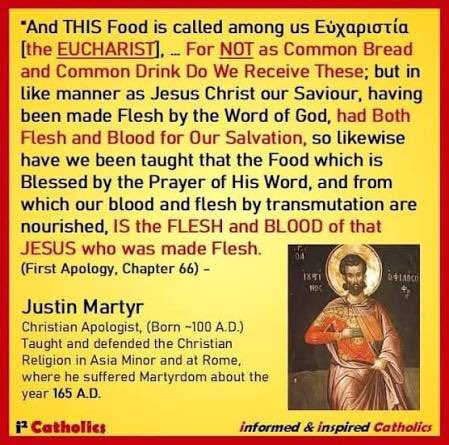
Notice how the apologist’s meme adds a Greek word and a gloss (“[The EUCHARIST]”) as well as capitalizing a bunch of words as if to say that this is an open and shut case. The irony is that this quotation leaves out a very important word. Let’s look at the version found in Roman Catholic J.P. Migne’s Patrologia Graeca (published from 1857–1866) in vol VI, cols 428-429:
…by the prayer of His word (δι’ εὐχῆς λόγου τοῦ παρ’ αὐτοῦ)…
…the eucharisted food (εὐχαριστηθείσαν τροφήν) …
…is the flesh and blood of that Jesus who was made flesh…
Now compare this to the quote above:
…the Food which is blessed…
…by the Prayer of His Word…
…is the flesh and blood of that Jesus who was made flesh…
(Note: It is common for different English translations to switch up the order of the first two sub-phrases)
Do you see it? The apologist’s translation does not include the word εὐχαριστηθείσαν (‘eucharisted’) either in Greek or in English. That’s because calling the food eucharisted—in the past tense—changes how the text must be understood.
The “Prayer of His Word” is understood by most scholars to refer to the consecratory words “This is my body…this is my blood.” By using the present tense “food which is blessed by the Prayer of His Word” it reads as if by these words of Jesus they are making the eucharist the eucharist. But if the food is already eucharisted prior, then those later words are only consecrating the previously existing eucharist, not turning it into the eucharist: it isn’t the words themselves by which the food becomes the eucharist.
In all my years, I have never once seen a Catholic apologist use an English translation which literally translates the underlying Greek. Never. I have also never interacted with a single Catholic who has ever admitted that the translation they are using has this problem. However, I have interacted with Catholics who continue to use this “proof” long after I pointed out their error.
For more information, see “Part 3: Justin Martyr” and “Translations of Ignatius, Letter to the Smyrnaeans, Chapters 6 and 7.”
Ignatius
Here is another example:
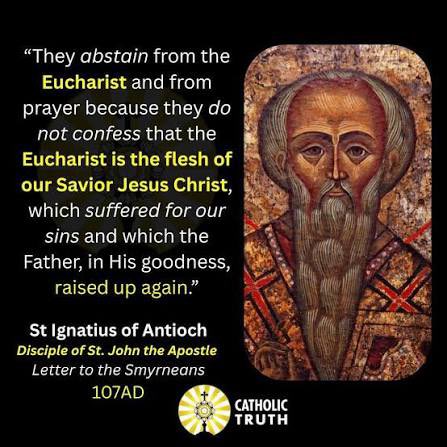
This quotation comes in various forms. Sometimes it includes earlier portions of the document separated by an ellipsis, but it invariably excludes the previous sentence of context:
It is here that Ignatius identifies the early church’s “eucharist” (literally: thanksgiving) as the giving of tithes and offerings in the thanks-offering of the church. The Gnostics showed no regard for the needy by refusing to offer their tithes out of which then came the bread and wine used in the celebration of the Lord’s Supper.
Ignatius says “they have no regard for love; no care for the widow, or the orphan, or the oppressed; of the bond, or of the free; of the hungry, or of the thirsty” immediately preceding “They abstain from the Eucharist.” These two are intrinsically linked: they are two ways of saying the same thing.
The Roman Catholic has to come up with a contrived explanation for why Ignatius is talking about helping the poor in the context of the Eucharist. The Protestant need only say “these are the same thing”: the eucharist is, fundamentally, about helping the poor and those in need.
In all my years of debating online, I have never once seen a Catholic apologist quote this by including the previous sentence. Never. I have also never interacted with a single Catholic who has ever admitted that this is a problem. However, I have interacted with Catholics who continue to use this “proof” long after I pointed out their error.
For more information, see “Part 4, Ignatius of Antioch.”
Irenaeus
The history of Irenaeus’ Against Heresies is an interesting one. Irenaeus wrote in Greek, but for much of history, we only had access to copies written in Latin. These Latin translations are of dubious quality too. For example, translators would often try to translate from the Latin back into the Greek in order to figure out (from the Greek) what Against Heresies actually said. Here is how Phillip Schaff described it (emphasis added):
Citation: Phillip Schaff, “The Apostolic Fathers.” Introductory Note to Irenaeus Against Heresies
We only had access to the Latin version until the Greek manuscript was discovered in 1743.
As you might expect, there are significant deviations between the two texts. Normally scholars favor the text written in the original language, especially when the secondary translation is known to be of dubious quality.
Despite that standard practice, Catholic apologists heavily rely on English translations from the Latin text. Nearly every time a Catholic cites Irenaeus to support the Eucharist of the Roman Catholic Church, they do so using an English translation that favors the Latin source.
The reason is straightforward: the original Greek does not contain the Eucharist of the Roman Catholic Church.
Here is one example:
…the bread, which is produced from the earth, when it receives the invocation [epiclesin] of God, is no longer common bread, but the Eucharist…
…the bread, which is produced from the earth, when it receives the summons [ecclesin] of God, is no longer common bread, but the Eucharist…
Here is another example:
When, therefore, the mingled cup and the manufactured bread receives the Word of God, … the Eucharist is made…
When, therefore, the mingled cup and the manufactured bread receives the Word of God, … the Eucharist of the blood and the body of Christ is made…
Can you figure out which is which? Take the full quiz here.
I have never once seen a Catholic apologist use an English translation which literally translates the underlying Greek. Never. It is always based on the Latin. I have also never interacted with a single Catholic who has ever admitted that the translation they are using has this problem. However, I have interacted with Catholics who continue to use this “proof” long after I pointed out their error.
For more information, see “Part 6: Irenaeus of Lyons” and “Part 36: Irenaeus, Revisted.”
DEREK,
i watched this youtube video on my TV last night and while i have NEVER believed in the generic (or non-generic) system of the Archons, Sophia and the demiurge that MOST classified Gnostics thought was true(i don’t have to be in such churchian bubbles of the fake news of GOPFOX news or DEMCNN channels or even the blackish ”redpill” Manosphere (that can’t be sustained in popularity whenever it is blessed by MOSES,JESUS & GBFM) by ”genius” ”redpill” ”leaders” to NOT be demoralized or avoid believing in BS as MOSES,JESUS & GBFM fear (like cowardly ”genius” ”redpill” ”leaders”) NOT the TRUTH nor worldly lies) BUT this Gnostic talk guy does bring up a important point where the Catholic church itself e.g. those in charge AKA administration, didn’t directly accuse the Gnostics of various sins in decrees as they just tried to suppress them instead of listing how they were wrong item by item(which is similar to how they deal with any questions about the Eucharist).
https://www.youtube.com/watch?v=jOzWDATtojY
This Is The Last Video You’ll EVER Need About The Archons — no bs
PS: My comment is really meant to encourage DEREK to do a series of posts based on various Gnostic sects and how they might have been innocent of charges of sin against them(like he seemed to be hinting at with Bruce Charlton, so many months back).
I don’t know enough about the Gnostic sects to write about them in any meaningful way. For now, I’m content with what I have written in the past.