
Over the last few years, I have had an extended back-and-forth conversation with a Roman Catholic on Twitter. Our conversation spanned a number of long threads, focusing on the liturgical evidence of eucharist found in some of the earliest major sources:
The Didache (c.90)
Ignatius (d.c.108)
Justin Martyr (d.c.165)
Irenaeus (d.c.202)
Cyprian (d.c.258)
This is Part 9. The topic is the Didache. See the index here.
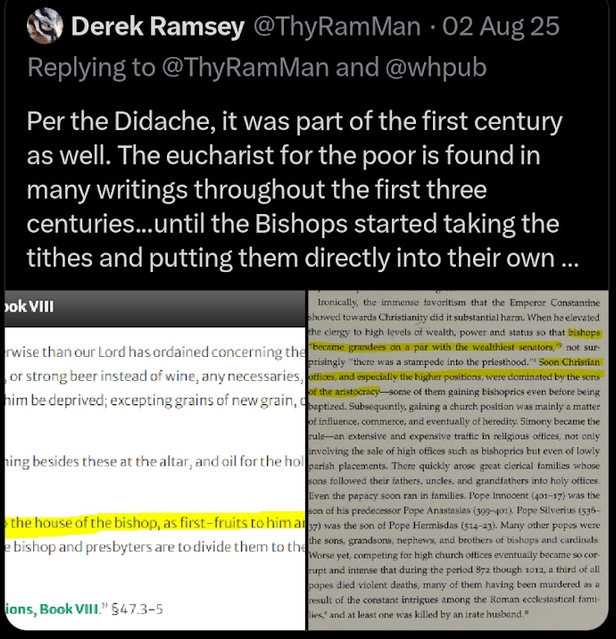
Now let’s examine his argument here. What he is showing in the Didache isn’t an agape meal. An agape meal may have involved giving to the poor (depending upon the local custom), but as the historian I cited notes, it was primarily a communal meal of fellowship. Nothing in Didache Chapter 13 describes a communal meal.
Derek is entire redefining what an agape meal is here, and is then arguing that I’m arguing from authority because I’m citing a historian, yet that isn’t what an argument from authority is.
Alas, I am missing the context of this argument. I doubt that CE committed an argument from authority simply because he cited an historian. It is much more likely that the source of his position is the historical authority, rather than the text of the Didache. It is also much more likely that the source of his position is citing recent history in order to interpreted older history. In other words, the only reason to draw some conclusion is because the authority said so, not because ancient history says so. But I have no way to verify that this is the case.
As for the agape meal, I refer you to this Roman Catholic, writing of the practices of the late 2nd and early 3rd century in his discussion of Hippolytus:
This blessing at the eucharist of food other than the bread and wine is a remnant of the primitive custom when the rite included a meal
— Burton Scott Easton, “The Apostolic Tradition of Hippolytus.” Cambridge University Press, 1934. p74.
In the Didache (likely written in the 1st century) there is a meal of food and drink, but it is not limited to bread and wine. The Didache makes reference to an offering of first-fruits, wine, grain products (including dough), meat, oil, and even silver and clothing for those in need. The Didache is explicit that the giving of thanks goes with the sharing of a meal (to “gather yourselves together” and “break bread” found in Chapter 14) as part of this sacrifice:
But every Lord’s day gather yourselves together, and break bread, and give thanksgiving after having confessed your transgressions , that your sacrifice may be pure.
According to the Didache, the people confessed their sins, then they offered their gifts and thanksgiving as sacrifice and ate a communal meal together. This early in church history, when Christians gathered together, they had a communal meal. This was driven, in part, by the fact that fasting on Sunday was frowned upon and due to the time required to prepare meals. Keep in mind that this was long before formal houses of worship and eating a token wafer before going home to eat in individual homes.
Nowhere in the Didache is the Lord’s Supper even mentioned. It is why many Catholic scholars and apologists don’t consider the Didache when they discuss the Catholic Eucharist. For that reason, I’m always suspicious of any apologist who does cite it. It usually indicates that they don’t know what they are talking about.
According to Chapter 8 of the Didache, the early church fasted on Wednesday and Friday. Sunday was reserved as a kind of mini Easter feast day. The agape meal solved the problem of allowing an extended gathering without requiring meals to be skipped, especially for those who were too poor to afford a meal. Given what we know of the early church, I don’t understand how CE can claim that the Didache doesn’t describe an agape meal. Here is the text in question:
But let not your fasts be with the hypocrites; Matthew 6:16 for they fast on the second and fifth day of the week; but fast on the fourth day and the Preparation . Neither pray as the hypocrites; but as the Lord commanded in His Gospel, thus pray: Our Father who art in heaven, hallowed be Your name. Your kingdom come. Your will be done, as in heaven, so on earth. Give us today our daily bread, and forgive us our debt as we also forgive our debtors. And bring us not into temptation, but deliver us from the evil one; for Yours is the power and the glory forever. Thrice in the day thus pray.
Now concerning the thanksgiving, thus give thanks. First, concerning the cup: We thank you, our Father, for the holy vine of David Your servant, which You made known to us through Jesus Your Servant; to You be the glory forever. And concerning the broken bread: We thank You , our Father, for the life and knowledge which You made known to us through Jesus Your Servant; to You be the glory forever. Even as this broken bread was scattered over the hills, and was gathered together and became one, so let Your Church be gathered together from the ends of the earth into Your kingdom; for Yours is the glory and the power through Jesus Christ forever. But let no one eat or drink of your thanksgiving, but they who have been baptized into the name of the Lord ; for concerning this also the Lord has said, Give not that which is holy to the dogs. Matthew 7:6
But after you are filled, thus give thanks : We thank You, holy Father, for Your holy name which You caused to tabernacle in our hearts, and for the knowledge and faith and immortality, which You made known to us through Jesus Your Servant; to You be the glory forever…Notice how the Didache gives instructions about when to fast and when not to fast and then follows it up with eating the thanksgiving as a meal. Scholars have noticed that all of their prayers are of thanks and there is no prayer of consecration (“This is my body…this is my blood”) that would be present if this were the Lord’s Supper. The meal is also eaten until the participants are full. This is why scholars posit, from the context, that this is an agape meal.
If you were reading the Didache and you didn’t know about the Lord’s Supper, you would conclude the they ate a communal meal of fellowship.
But, as we have seen throughout this series, CE has a propensity to import (to borrow the Catholic term) a Eucharistic sense onto the sources he cites. He can read the Didache, see how there is no mention of the Lord’s Supper, see how a communal meal of fellowship is eaten until everyone is full, and then deny that there is such a communal meal.
The fact is, this is the earliest extra-biblical source that mentions the thanksgiving of the church and it doesn’t mention the Lord’s Supper at all. Instead, it mentions a meal (which came to be known as the agape meal).