
During my research on J.N.D. Kelly for “Eucharist, Redux #10: AI Misquotations,” I came across an especially egregious example of misquotation. But, before we talk about that, I highly suggest reading that article first, or else you’re likely to be confused by this one or frustrated by the lack of the substantiated claims found in the other post.
In “The Early Church was the Catholic Church,” Roman Catholic Joe Heschmeyer says this:
…
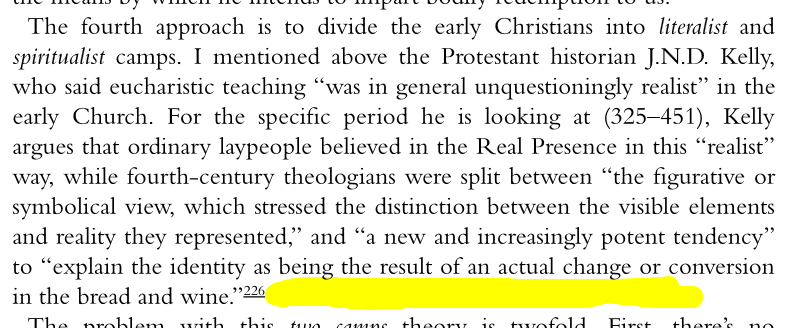
The fourth approach is to divide the early Christians into literalist and spiritualist camps. I mentioned above the Protestant historian J.N.D. Kelly, who said eucharistic teaching “was in general unquestioningly realist” in the early Church. For the specific period he is looking at (325–451), Kelly argues that ordinary laypeople believed in the Real Presence in this “realist” way, while fourth-century theologians were split between
and
We’re not going to primarily be discussing the theological positions contained in Heschmeyer’s book. What we’re going to be talking about is his scholarship, particularly as regards his use of J.N.D. Kelly on pages 59-60 and 80-81 (and the corresponding footnotes) of his 169-page book. Thus, we are not going to be looking at the different five approaches and evaluating their merits or demerits. If anyone is interested in a discussion of that topic at a later point, let me know.
In terms of the latter topic—scholarship—it is anti-intellectual “scholarship” like that found in this snippet above that gives so many Catholic apologists a well-deserved black mark. Like all other Catholics, Heschmeyer’s quotations of J.N.D. Kelly leave out the important, clarifying context, leading to Heschmeyer creating a strawman of Kelly’s position.
One
First, Heschmeyer effectively misquotes Kelly by replacing two extremely important words—the subject’s verb and a subject-modifying adjective—with an implied ellipsis. This…
…becomes this:
Critical context was removed.
Excising these two words leaves out Kelly’s explicitly stated belief that the conversion doctrine was not observable prior to the late 4th century. As we discussed last time, Kelly sets the early threshold at c.350AD with Cyril of Jerusalem in the very next paragraph. Thus, no matter what Kelly thinks the observable “realist” view was in the early church, and regardless of what Kelly thinks the laypersons and theologians believed, we know for sure that Kelly didn’t think it was the Roman Catholic view (prior to the late 4th century).
Heschmeyer simply needed to keep on reading[1] to have seen this. But, the fact that he cut out these two words at all strongly suggests that he knew exactly what he was doing. He was not pressed for space (to insert just two words) and I can’t think of any legitimate reason anyone would want to leave them out, rather than do this…
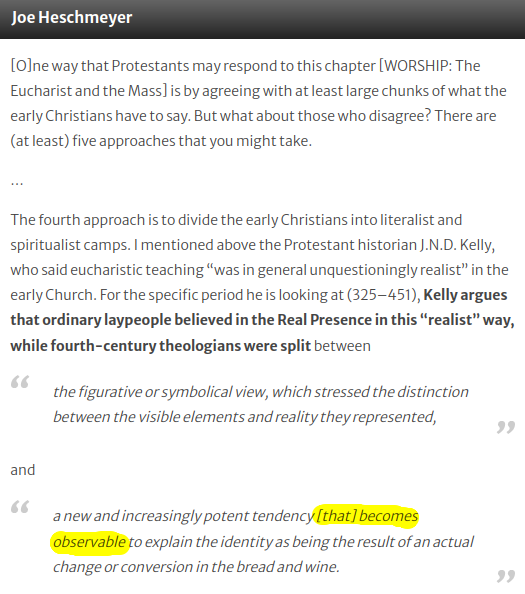
…and avoid the problem entirely. If anyone ever gets the chance, please ask Heschmeyer if he intended to deceive his readers, because unless a reader checks the source, they are going to be mislead.
Per Kelly’s presentation of the historical record, only the conversion doctrine “becomes observable” some time during the late the 4th century. Meanwhile, Kelly identifies the figurative symbolic view as being clearly visible in the early 3rd century. There is a strong incentive for Heschmeyer to leave that out.[1]
Two
Second, just like every other Catholic, Heschmeyer leaves out the “however” sentence that immediately follows the “unquestioningly realist” sentence, skipping forward to the “symbolical view” sentence. Here is the sentence that he did not include:
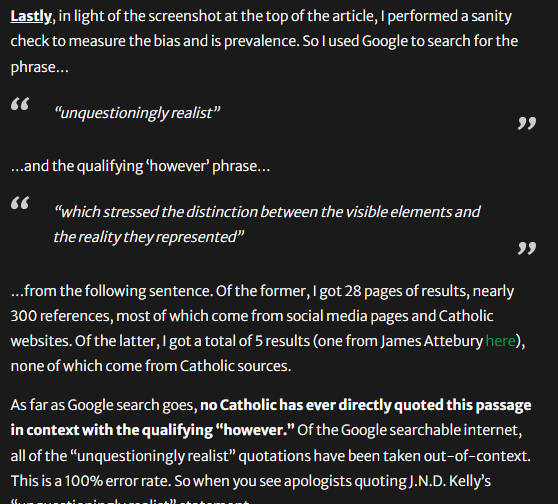
When he finally does quote a fragment of this sentence (the second highlight), the context in which it comes from is lost and the meaning distorted. But, we’ll talk about the second highlight in the next section. For now, we want to know, “what is ‘this identity’ that Kelly speaks of?” It is the “unquestioningly realist” ‘Eucharistic teaching’ that:
Paragraph 1
…the consecrated bread and wine were taken to be, and were treated and designated as, the Saviour’s body and blood.
According to Kelly, all theologians believed that the body and blood—the identity represented by the bread and wine—were unquestioningly real, including those who understood the bread to be solely a figurative symbol of the body. They simply disagreed on how to interpret it. After all, the Gospel accounts record that the bread and wine were taken to be, treated as, designated and identified as the body and blood. This is true even for the figurative symbolic view.
There is no question at all that, for Kelly, ‘this identity’—the unquestioningly realist Eucharistic teaching that the consecrated bread and wine were taken to be, and were treated and designated as, the Saviour’s body and blood—had two different interpretations, only one of which was literal:
Paragraph 1
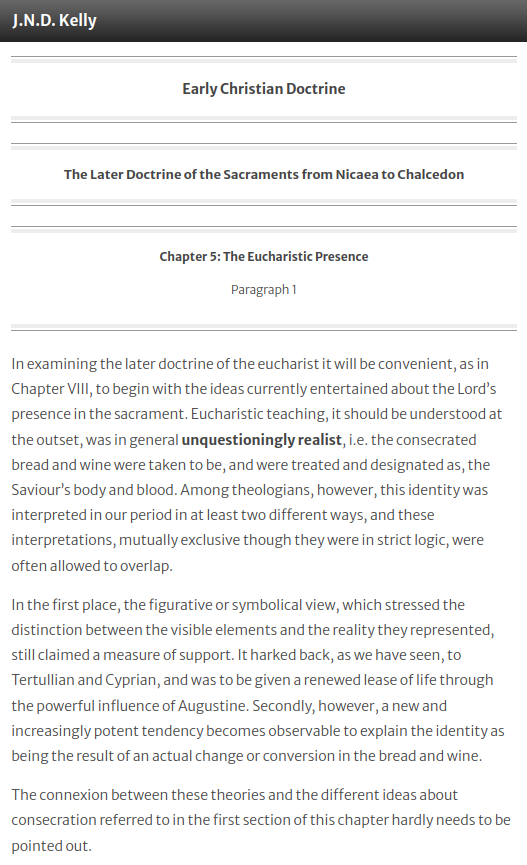
Among theologians, however, this identity was interpreted in our period in at least two different ways, and these interpretations, mutually exclusive though they were in strict logic, were often allowed to overlap.
In the first place, the figurative or symbolical view, which stressed the distinction between the visible elements and the reality they represented, still claimed a measure of support. It harked back, as we have seen, to Tertullian and Cyprian, and was to be given a renewed lease of life through the powerful influence of Augustine.
Secondly, however, a new and increasingly potent tendency becomes observable to explain the identity as being the result of an actual change or conversion in the bread and wine.
This requires a repetition for emphasis.
As a matter of history,[2] all Christians in the early church, just like all Christians today, believed that the body and blood of Christ were unquestioningly real. Even those who held to a purely symbolic view of the elements still believed that Christ’s flesh and blood were real. They still recited “This is my body…this is my blood,” just the same as everyone else, because Jesus had a real body and he had real blood. Christians, after all, are not Gnostics.[3]
What they disagreed with was the interpretation of how the consecrated[4] bread and wine “were taken to be, and were treated and designated as”—an unquestioningly realist identity of—the real body and blood of Jesus. The early church thought this realist identity was figurative symbolism, while others would one day think it was literal conversion.
Three
Third, Heschmeyer cuts his quotation short:
During this time period (325AD to 451AD), the newly emerging and developing conversion doctrine began to replace the symbolic view, but the symbolic view took more than a century to lose the battle (and it’s not been shown that it ever truly disappeared). Many writers throughout this period continued to use the older figurative language simultaneously mixed alongside newer developing conversion language.
Now, let’s look at that second highlight above that we temporarily skipped over the discussion about. Here it is again:
Neither “mutually exclusive” nor “often” are understatements by Kelly. The two interpretations are, indeed, logically incompatible, but they were often held collectively by the church as one belief.
Now we get to the most curious part of our analysis. Here is what Heschmeyer wrote in the next paragraph:
The problem with this two camps theory is twofold. First, there’s no apparent fighting over eucharistic theology between these two “camps.” But second, the same author will speak of the Eucharist at one moment using “literal” language and at another moment using “spiritual” language (for instance, calling the Eucharist the “figure” or “type” or “similitude” of Christ’s body and blood).
It is almost too incredible to believe that Heschmeyer wrote this. He excluded the phrases that completely invalidate his spin on Kelly (that there were competing spiritualist and literalist camps). All Heschmeyer had to do is keep reading and quoting what Kelly wrote[1] and he would have had everything he needed to realize his error and to, instead, accurately describe what Kelly believed.
Perhaps he saw Kelly write “mutually exclusive [in strict logic]” and assumed that this meant that [in strict logic] there must have been warring factions bitterly divided over their irreconcilable differences. But, Kelly never said this (and it doesn’t logically follow). Functionally, Heschmeyer set up a strawman of Kelly’s position and then, unsurprisingly, easily knocks it down.
He continues:
Kelly offers an unsatisfying solution to this problem, saying simply that “these interpretations, mutually exclusive though they were in strict logic, were often allowed to overlap.” But anyone familiar with the great theologians of the early Church should realize at once how unlikely it is that there was such a glaring logical contradiction in their theology and that none of them noticed it.
I, like Kelly and Heschmeyer, have examined the writings from the 4th century. We’re all looking at the same source material.
Prior to c.350AD, the ancient liturgy was highly uniform. There was no hint of a literal conversion doctrine. There were two separate liturgical acts:
(1) thanksgiving (eucharist) tithe sacrifice, offering, and oblation
…followed by…
(2) epiclesis, invocation, consecration, institution, and celebration of the Lord’s Supper.
In this period, the relationship between the consecrated bread and wine and the body and blood was universally figurative, metaphorical, and symbolic.
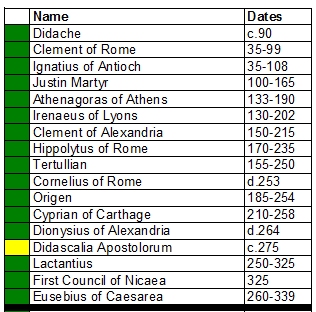
Starting in c.350AD, the earliest version of the conversion doctrine was introduced. There began a change from a purely figurative symbolic view towards a literal conversion view, which was simply allowed to happen slowly with overlap. Like Kelly, I found it impossible to find a logically coherent ‘catholic’ (universal) belief in this period because of the overlapping logically mutually exclusive nature of their stated beliefs. There was neither coherency within many individual writers nor coherency within the church as a whole. Not even the “conversion doctrine” was yet described in terms of a full, actual conversion without any figurative or symbolic sense.
The duality, however, was unmistakable. Even Heschmeyer recognizes it…
…though, of course, he has a different theology that rationalizes it. The point, though, is that we all can see—as a matter of scholarship—that the apparent duality clearly exists in the writings of the late 4th century.
In “Part 40: Conclusion” (May, 2024), I identified this dichotomy as a transitional liturgy:
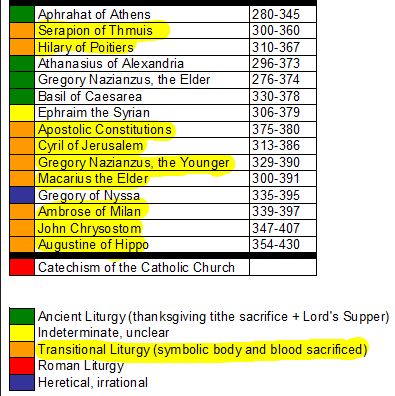
This dichotomy arose in the late 4th century, where the duality facilitated a transition from one to the other.
Kelly, of course, agrees completely. Here he is noting how Cyril, the pioneer of the literalist conversion doctrine, remained—to borrow Heschmeyer’s term—a spiritualist.
Paragraph 2
Even the pioneer of the conversion doctrine, Cyril of Jerusalem, is careful to indicate that the elements remain bread and wine to sensible perception, and to call them ‘the antitype’ of Christ’s body and blood:
Cyril held two logically mutually exclusive positions at the same time.
Go re-read Kelly’s paragraph (which was quoted incompletely by Heschmeyer) and you’ll see that he doesn’t use the term “debate” or indicate that there was any conflict at all. He simply observes that there were two mutually exclusive liturgical positions that occurred at the same time. Kelly never perpetuated a “two camps theory” of “fighting over eucharistic theology.” Heschmeyer made this up by selectively highlighting only a few sentences and sentence fragments that were taken from just a single paragraph.[1]
In my own research, I saw very little—if any—signs of doctrinal debate between the two interpretations. I don’t recall even a single writer who mentioned a conflict. Thus, I agree with Kelly’s actual view (not the strawman): it is clear that there was a dominate hybrid approach by theologians who were trying to balance the older and newer doctrines at the same time, not an either-or approach by competing factions as Heschmeyer’s strawman claimed.
Heschmeyer’s objection (“…how unlikely it is…”) is an Argument from Incredulity. He can’t imagine how they could have let a giant, glaring logical contradiction into their theology. But there is no logical or rational reason why they could not have:[5] the church of the late 4th century was not particularly rational. It’s not hard to envision this.[6]
Kelly is writing about the period in which the doctrine of the Trinity was formally developed, a doctrine that the Catholic Catechism says is non-rational:
“But his inmost Being as Holy Trinity is a mystery that is inaccessible to reason alone or even to Israel’s faith before the Incarnation of God’s Son and the sending of the Holy Spirit.”
The church of the late 4th century believed something that is, in strict purely logical terms, irrational. It is a mystery.
Not coincidentally, the late 4th century is also when Roman Catholicism and the Papacy arose and a veritable flood of doctrinal error was introduced,[7] including the various errors propagated with publication of the Latin Vulgate and the new association of “mystery” with “sacrament” (where ‘mystery’ was used to rationalize new or illogical positions). The fact is, the church of the late-4th century was not particularly logical as a matter of the documented historical record.
Four
Fourth, so eager is Heschmeyer to read his theology into Kelly’s words, that he thinks Kelly is claiming that laypersons generally believed in the conversion doctrine:
Paragraph 1
Eucharistic teaching, it should be understood at the outset, was in general unquestioningly realist, i.e. the consecrated bread and wine were taken to be, and were treated and designated as, the Saviour’s body and blood. Among theologians, however, this identity was interpreted in our period in at least two different ways…
Kelly does not even mention laypersons,[8] but I suppose if you squint real hard and don’t read the surrounding context, you might be able to hallucinate it.
My best guess is that when Heschmeyer read “Among theologians, however, ….” (which he didn’t quote), he thought that the first sentence was about laypersons and the second sentence was about theologians, even though Kelly says no such thing and it makes much more sense that the theologians were all realist but disagreed on interpretation. This is, after all, what Kelly actually says:
According to Kelly, there was, generally speaking, one realist teaching and (at least) two (mutually exclusive but coexisting) interpretations of that realist teaching, only one of which was literal. Even if Heschmeyer disagreed with Kelly’s analysis—which he very clearly does—it is unambiguous that this is what Kelly himself believed. Kelly is clearly not contrasting (one one hand) realist laypersons—who solely believe in a literal view—with (on the other hand) two camps of theologians who are fighting over literal and figurative interpretations.
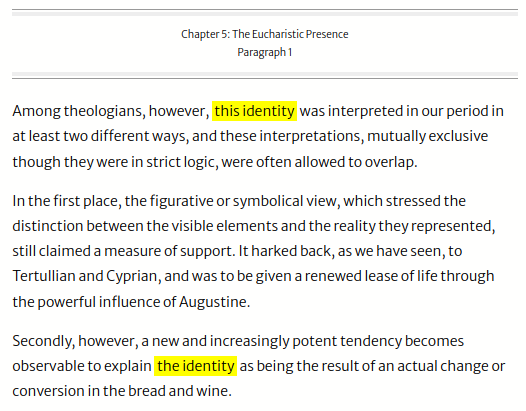
Of course as noted above, if you simply read what Kelly has written (e.g. “a new and increasingly potent tendency becomes observable”), you simply cannot find Heschmeyer’s strawman in what Kelly wrote.
Furthermore, Heschmeyer’s “layperson” strawman doesn’t even pass a common sense sanity check: we do not have any documented evidence of what laypersons believed in general from that period. All the writings we have come from a very narrow selection of theologians and our inferences come from them.
Since Kelly explicitly notes that the conversion doctrine wasn’t even observable in the early church, it is impossible for him to have rationally argued that laypersons believed in it. The argument requires observable evidence, and there is none. Historians and scholars do not—and may not—recklessly and fallaciously[9] speculate about what we don’t have evidence for.
Heschmeyer’s insertion—onto Kelly’s lips—of a discussion of laypersons is out of place in a scholarly discussion.[8] As an apologist and scholar, it is difficult to explain how he could have come to such a conclusion, other than eisegetical bias: he hallucinated what he wanted to see. It’s certainly not a conclusion that can be derived from scholarship.
Heschmeyer—reading through his own doctrinal lens—thought that Kelly’s figurative, symbolic, or spiritualist view was not a realist view. But it very clearly was, and Kelly makes this perfectly clear! This is even more clear if you take the time to read what Kelly wrote about “realism” in the 2nd and 3rd centuries. It’s hard to read the early writers as they battled Docetism and Gnosticism and not conclude—even though they held to a figurative view of the bread as the body—that they asserted that the body was decidedly real. But, if Heschmeyer were to accept this unquestioning reality of what Kelly describes, he wouldn’t be Catholic anymore.
Footnotes
[1] There is strong evidence that Heschmeyer cherry-picked quotes from J.N.D. Kelly. I checked Heschmeyer’s references to Kelly contained in the footnotes of his book:
226 Kelly, p. 440 .
228 Kelly, p. 440 .
This is actually quite revealing, because it contains an erroneous citation.
I do not own a physical copy of J.N.D. Kelly’s Early Christian Doctrines. I use the digitized version of the Fourth Edition found on the Internet Archive, which itself comes from a PDF that doesn’t seem to be available anymore. The two page numbers that Heschmeyer cites from (p.452 and p.440) actually refer to the same page. The lower number (p.440) is Kelly’s printed page number and the higher number (p.452) is the page number of the digitized document. Heschmeyer is also using a digitized version of the same edition.
Heschmeyer was not careful and precise when he made his citation. This is, of course, a rather minor error, but we’re not talking about a social media post here. It is a citation error in a formally published and immutable for-sale work by a scholar and apologist. It is a sloppy handling of source material.
It also reveals a much more significant problem: he only took quotes from a single paragraph of Kelly’s 500-page book. Here are some relevant sections from Kelly’s book (w/ digital page numbers and links) where he discusses what he means by the realist view.
n205-n211: “Early views of the sacraments” (Pre-Nicean Theology)
n223-n228: “Progress in Eucharistic Doctrine” (Pre-Nicean Theology)
n452-n461: “The Eucharistic Presence” (Nicaea to Chalcedon)
The paragraph Heschmeyer quoted from is found in the opening paragraph on n452. There is no evidence that Heschmeyer even read more than that single paragraph, and—given Heschmeyer’s demonstrably out-of-context quotations and misunderstanding of Kelly’s use of ‘realist’ and ‘realism’ (and its association with platonism)—this constitutes strong evidence of biased copy-and-paste cherry-picking.
Even the reference highlighted in yellow above—“he traces this history of eucharistic realism to a yet earlier period“—is just a reference to the same paragraph:
Paragraph 1
In the first place, the figurative or symbolical view , which stressed the distinction between the visible elements and the reality they represented, still claimed a measure of support. It harked back, as we have seen, to Tertullian [c.160-240] and Cyprian [c.210-258], and was to be given a renewed lease of life through the powerful influence of Augustine [c.354-430].
Secondly, however, a new and increasingly potent tendency becomes observable to explain the identity as being the result of an actual change or conversion in the bread and wine .
When speaking hearkening back, Kelly is clearly and unambiguously talking about the symbolic view of the identity. Heschmeyer’s spin makes it seem as if it is the conversion view of the identity that goes back to an earlier period, which it very clearly does not.
Let’s review Kelly’s timeline. The realist figurative symbolic view was seen in the early-3rd century. Then, more than a century later, the realist literal conversion doctrine was first observed in the late-4th, when it overtook the realist figurative symbolic view. Then, the realist figurative symbolic view roared back to life with Augustine in the early 5th century.
Now, with this in mind, let’s look at where Heschmeyer adds the footnote:
The Protestant scholar of Church history J.N.D. Kelly summarizes what we might call the “big picture” of early Christian belief:
“eucharistic teaching, it should be understood at the outset, was in general unquestioningly realist, i.e., the consecrated bread and wine were taken to be, and were treated and designated as, the Savior’s body and blood.” 141
The only conclusion I can come to is that this is extremely dishonest. I would very much like to hear an explanation from Heschmeyer. If he sends me one, I’ll be sure to share it.
[2] Kelly spends relatively little time discussing the realist view of the eucharist in his lengthy book, so I don’t intend to put words in his mouth. He clearly sees differences in the way the writers describe it throughout the centuries. He is much more tentative in his handling of the realism found in the first and second centuries. This is a suitable discussion for another time.
[3] One of the earliest references makes this distinction:
Citation: Ignatius of Antioch. “Epistle to the Smyrnaeans.” ¶6-7 (c.110AD)
Those who denied that Jesus had a real body would not do two things. First, they would not give their eucharist tithes for those in need. Second, they would not consecrate[4] the eucharist—that had been offered for those in need—to be the flesh and blood of Jesus, by doing as the gospels record. They couldn’t say “This is my body…this is my blood” because they didn’t think he really did.
NOTE: The second sentence is popularly quoted—without the first sentence—by Catholics trying to make it seem like the thanksgiving sacrifice (the eucharist) and the consecration (by the “words of institution”) are one-in-the-same thing, but the context (i.e. tithes for those in need) does not allow for this.
[4] It is extremely important to note this qualification.
The unconsecrated elements of eucharist—the liturgically, sacrificially offered thanksgiving tithes—were never called the body or blood of Christ in the first 300 years of the church. These tithes of food were simply called “the eucharist” (before, during, and after the actual act of eucharist, the liturgical sacrificial act of giving of thanks and prayers).
Only already sacrificed bread and wine (which were still called “the eucharist”) were consecrated, through a second, subsequent liturgical act involving the “words of institution.” Prior to consecration, they were never called the body or blood of Christ. This is quite evident in the earliest writings, which is why Kelly must qualify that the “unquestioningly realist” view pertains to the identity of the “consecrated bread and wine.” It would be false to say that the “unquestioningly realist” view pertains to the unqualified “bread and wine” and of the eucharist.
[5] It is not terribly difficult to steelman a somewhat logical argument for the hybrid approach. A contradiction it may be, but it is not difficult to rationalize the contradiction away. In terms of history and sociology, this type of religious rationalization is quite common.
[6] For the better part of half a century now, a number of Protestant denominations in America have been dominated by feelings-based irrationality. Long-term and widespread irrationality in religion is not difficult at all to fathom. I would argue that it is the default state of worldwide religious practice for thousands of years. Very few religions emphasize strict logical consistency, including Roman Catholicism.
[7] Here is a partial, abridged list of Roman Catholic doctrines that had their true beginning during or after the late 4th century:
Roman and Papal primacy
Papal infallibility
Priestly celibacy
Elevation of virginity and fasting over marriage
Mariology (immaculate conception, perpetual virginity, assumption of Mary, Mother of the Church, Queen of Heaven)
Kneeling on the Lord’s Day and during Pentecost
Incense and candles
Veneration of relics, images, the cross, and the dead
Baptismal regeneration
Intercession of the saints
Unification of church and state (The title of Pontifex Maximus, Ex communicare replaced by ex civitate, Taking up the civil sword to persecute and kill the faithful, Civil taxes flowing through the Bishops and priestly wealth acquisition)
Church holidays (Palm Sunday, Maundy Thursday, Good Friday)
Vestments
The system of sacraments
Eucharistic alterations (including the liturgical order, transubstantiation, the Real Presence, the sacrifice of the Mass, Eucharistic Adoration, communion on the tongue, the liturgical mixing of water with wine)
Time and space do not allow us to discuss them all now.
[8] Kelly uses the word “lay”—referring to the status of a layperson—once in “Early Christian Doctrines,” four pages earlier (on page 436) during the preceding discussion of the “Sacrament of Penance.” So we know that Kelly uses the word to refer to a layperson, and he does so very close to the section we are discussing, but he never mentions laypersons in the next section on the “Sacrament of the Eucharist” (on page 440).
[9] For example, using an Argument from Silence
Ignatius of Antioch
Epistle to the Smyrnaeans, ¶6-7
[The Gnostic Heretics] have no regard for love; no care for the widow, or the orphan, or the oppressed; of the bond, or of the free; of the hungry, or of the thirsty. They abstain from the Eucharist and from prayer, because they confess not the Eucharist to be the flesh of our Saviour Jesus Christ, which suffered for our sins, and which the Father, of His goodness, raised up again.
Those who denied that Jesus had a real body would not do two things. First, they would not give their eucharist tithes for those in need. Second, they would not consecrate[4] the eucharist—that had been offered for those in need—to be the flesh and blood of Jesus, by doing as the gospels record. They couldn’t say “This is my body…this is my blood” because they didn’t think he really did.
NOTE: The second sentence is popularly quoted—without the first sentence—by Catholics trying to make it seem like the thanksgiving sacrifice (the eucharist) and the consecration (by the “words of institution”) are one-in-the-same thing, but the context (i.e. tithes for those in need) does not allow for this.
[4] It is extremely important to note this qualification.
This reminds i of the ”redpill” Gnostics, who don’t even understand that the ”redpill”( AKA ROISSY/Heartiste’s GAME),that they supposedly believe in is actually based on ROISSY/Heartiste’s GAME,NOT Rollo’s (they mainly believe it is because he was at Dalrock’s blog from 2011 to the end in January 2020-mainly to buildup his own audience of desperate betafactory CHRISTian beta’s or bravos as Vox call’s them to cheer them up)and they think ”redpill” AKA ROISSY/Heartiste’s GAME can overcome reality easily in relationships and marriage even though that’s NOT exactly what he says in this overlooked post from 2011. https://heartiste.org/2011/10/24/more-science-confirming-game-concepts-long-term-relationships-can-bring-out-the-worst-in-couples/
More Science Confirming Game Concepts: Long-Term Relationships Can Bring Out The Worst In Couples
Oct 24th, 2011 by Heartiste
Digging through the archives of the Chateau Heartiste library, we find a post about the hazards of LTRs and marriage.
Now you can’t do anything without her, and she you. In the beginning, this is a necessary process to build the level of trust and bonding that distinguishes the LTR from any run of the mill fling. But it morphs into a hermetic pair-bond cocoon, a soft escapable prison that shields from the outside world more than it protects. Increasingly consanguineous, the LTR alienates friends and slackens ambitions.
Scary stuff. Science has something to say about the deleterious effects of marriage on the female body, as well:
•Women in their teens and early 20s who continued to date but didn’t cohabitate gained an average of 15 pounds over five years; their male counterparts added about 24 pounds.
•Newly married women in that age group packed on 24 pounds in five years; newly married men gained 30 pounds.
That degree of gain wasn’t seen in couples who were living together but not married. Women gained 3 pounds more than their single peers — 18 pounds — and men gained 24 pounds.
When you see photos of the groom stuffing the bride’s mouth full of wedding cake as she licks down every last ounce of sloppy creamed filling, you may as well be watching the groom disposing of his sex and love life down her maw. But as we all know, men get very, very stupid about marrying the first semi-decent p@ssy who comes along.
The latest from the scientific front presents more CH-confirming evidence that LTRs and marriage have negative consequences for their practitioners.
For better or for worse, in sickness and in health – there’s a long line of research that associates marriage with reducing unhealthy habits such as smoking, and promoting better health habits such as regular checkups. However, new research is emerging that suggests married straight couples and cohabiting gay and lesbian couples in long-term intimate relationships may pick up each other’s unhealthy habits as well. […]
Corinne Reczek, a UC assistant professor of sociology, reports three distinct findings into how unhealthy habits were promoted through these long-term, intimate relationships: through the direct bad influence of one partner, through health habit synchronicity and through the notion of personal responsibility.
Reczek reports that gay, lesbian and straight couples all described the “bad influence” theme, while in straight partnerships, men were nearly always viewed as the “bad influence.” [ed: there go women again, abdicating all reason and accountability.]
[…] “Third, respondents utilized a discourse of personal responsibility to describe how even when they observe their partner partaking in an unhealthy habit, they do not attempt to change the habit, indicating that they were complicit in sustaining their partner’s unhealthy habits. The final theme was described primarily by straight men and women,” says Reczek.
So if your partner has unhealthy habits, (smoking, drinking to excess, overeating, underexercising, staying up late to watch Modern Family recordings or Jon Stewart smugly sing to the SWPL choir), you will likely pick up those bad habits. And thus we see how the fat acceptance movement gets its steam — osmotic inevitability. (In related news, according to the Red Cross, there are more obese than there are hungry in the world. We’ve entered the era of globulization.)
Of particular interest in the above study is the evidence that women, and presumably their lapdog betab!tchboys, placed the blame for being a bad influence squarely on the men’s shoulders. It’s obvious to those in the know that this blame-shifting is complete bulls#!t, since (just to pick an easily discernible example at random) there are innumerable couples where the woman has gotten fat while the man stayed slim. Nothing will kill a man’s desire to please his woman in every way faster than the disfigurement of her body caused by bloating up from bellying up to the buffet.
Is there an enterprise in existence where women will blame themselves for something bad they did? To ask the question is to laugh at female absurdity. The rationalization hamster is a cosmic force on par with dark matter; you can’t see the little bugger, but g-damn is he everywhere, redirecting galactic phenomena at will.
Also interesting is the last line quoted above from the study. Partners are complicit in sustaining their SO’s bad habits because they don’t call them out on it. I think we can figure out who is most responsible for this dereliction of duty: sackless beta males who are afraid of the divorce raping and/or sex withholding they will assuredly receive if they displease their queen sovereigns by timidly mentioning in squeaky-voiced passing their increasing girth. Women, for their part, don’t attempt to change their partners’ bad habits for a different reason: they don’t have a clue how to articulate what is wrong with their beta boyfriends and hubbies.
This post, and others like it, is a helpful reminder to the “marriage is best” crowd that marriage — and, similarly, LTRs — hold special dangers for the man who allows himself to become ensnared. An LTR is a beautiful thing with the right woman and undertaken with the right alpha attitude, but it isn’t a panacea for all psychological, emotional or sexual needs, and it isn’t without its own problems that men who serially date don’t experience. When you commit to a woman with the intent of remaining monogamous, you acquire new obstacles to navigate and problems to avoid. Failure to recognize those LTR-inherent deficiencies and counteract them will lead to exile in betaville, where begging for blowjobs once per year and praying you don’t get reamed in court if she gets bored become part of the wonderful fabric of life.
See all the parts that seem eerily familiar if one has read Anonymous Commenter various comments at Spawnys and elsewhere?
Even though i called certain CHRISTianistic ”redpillers” above Gnostics their really miracle- demanding Cosmic Bellhopists that don’t even know that Roissy/Heartiste and the Enigma of Enigmas GREAT BOOKS FOR MEN put the Manosphere(really the ROISSYosphere),GAME & MENS Rights(AKA PATRIARCHY,MRAS AND MGTOW) on the societal(& internet wide)map between 2005/’06(ROISSY/Heatriste was the most popular commenter in ”PUAGAME” sites history @DC Bachelor) & 2015 (especially) while they( miracle- demanding Cosmic Bellhopists)tried to prop up themselves through Dalrock(& sometimes MattPerkins AKA bgr AKA troll of trolls to the Manosphere(really the ROISSYosphere( & soon to be GBFMosphere)
For more on Dieism, this video is pretty complete.
https://www.youtube.com/watch?v=ANSkYeMmfnk
What ever happened to deism?
& for Miracle-commanding CHRISTianistic ”redpill” Cosmic Bellhopists, here’s a video for you’re moralistic ”redpill” therapy Dieism(MTRD):
https://www.youtube.com/watch?v=5eHYMzanOvs
The forgotten history of Moralistic Therapeutic Deism
Conclusion? Bruce Carlton is definitely right that modern MAN or modernists like you’re average Miracle-commanding CHRISTianistic ”redpill” Cosmic Bellhopists(especially) doesn’t want what JESUS offered everyone e.g. Eternal Life they just want their ”higher pupose” feel-good drug AKA women (sex) now!!