
This is part of a series on Roman Catholicism and the eucharist. See this index.
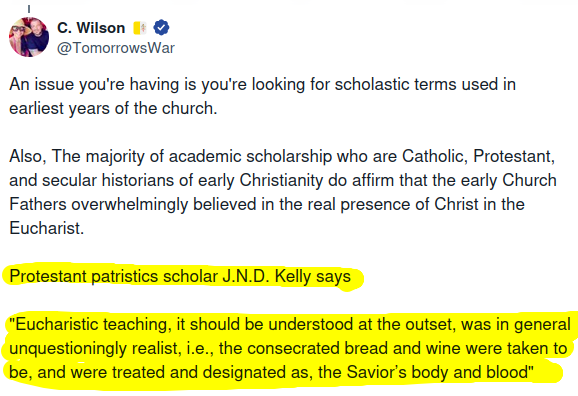
I recently had someone ask Grok AI a question about the Catholic doctrine of the Real Presence. Here is the response:
Yes. Early Christian writers treated the Eucharist as Christ’s actual body and blood, not mere symbols.
Ignatius of Antioch (c. 110): heretics “abstain from the Eucharist… because they confess not the Eucharist to be the flesh of our Saviour Jesus Christ.”
Justin Martyr (c. 150): “not as common bread and common drink… [but] the flesh and blood of that Jesus who was made flesh.”
Irenaeus (c. 180) and others used the same realist language. Protestant historian J.N.D. Kelly summarized it as “unquestioningly realist.”
For readers who read last week’s post, this will sound extremely familiar:
This is how it usually goes:
Justin Martyr: <English quotation that excludes the ‘eucharisted’ (past tense) food>
Ignatius: <English quotation that excludes the previous sentence of context>
Irenaeus: <English quotation based on the Latin, which differs from the earlier Greek>
You know it’s a memorable trope when even AI is committed to the bit.
I’m not going to repeat my analysis of the common misquotations of Justin Martyr, Ignatius, and Irenaeus. You can just read last week’s post. No, today we are going to talk about this little claim:
Protestant historian J.N.D. Kelly summarized it as “unquestioningly realist.”
J.N.D. Kelly (b.1909; d.1997) was an influential British theologian. A member of the Church of England, he specialized in early writings of the Christian church and other aspects of church history, including that of the Roman Catholic papacy.
Did J.N.D. Kelly declare that the Roman Catholic Real Presence was “unquestionably realist” in the first 3 centuries of the church? As Kelly was such a notable historian of early church history, this would be (as they say) ‘Big If True.’
Well, not only is it not true, but it is repudiated by the very text out of which that two word quotation has been sliced and diced. But, so common is this excised trope that even AI blindly repeats it. After all, a LLM is designed to give the most probable response to any given question, not a response which is objectively true.
J.N.D. Kelly absolutely used the two words “unquestionably realist” in a sentence. But the context of that sentence is of critical importance. The ‘quotation’ (though I hesitate even to give it that much credence) comes from his famous work “Early Christian Doctrines,” which is available to read on the Internet Archive here.
Paragraph 1
In examining the later doctrine of the eucharist it will be convenient, as in Chapter VIII, to begin with the ideas currently entertained about the Lord’s presence in the sacrament. Eucharistic teaching, it should be understood at the outset, was in general unquestioningly realist, i.e. the consecrated bread and wine were taken to be, and were treated and designated as, the Saviour’s body and blood. Among theologians, however, this identity was interpreted in our period in at least two different ways, and these interpretations, mutually exclusive though they were in strict logic, were often allowed to overlap.
In the first place, the figurative or symbolical view, which stressed the distinction between the visible elements and the reality they represented, still claimed a measure of support. It harked back, as we have seen, to Tertullian and Cyprian, and was to be given a renewed lease of life through the powerful influence of Augustine. Secondly, however, a new and increasingly potent tendency becomes observable to explain the identity as being the result of an actual change or conversion in the bread and wine.
The connexion between these theories and the different ideas about consecration referred to in the first section of this chapter hardly needs to be pointed out.
First, while this quote comes from the book “Early Christian Doctrine,” it specifically comes from section of his book covering the period of the early church from the Council of Nicaea to the Council of Chalcedon (i.e. from 325AD to 451AD). The question under debate was whether the Roman Catholic Real Presence was found in the first 300 years of the church, not the period thereafter. J.N.D. Kelly’s statement does not apply.
Second, while this quote comes from the book “Early Christian Doctrine,” it specifically comes from the portion pertaining to the “Later Doctrine of the Sacraments.” Kelly understood this ‘unquestioningly realist’ stance to be a later sacramental development, not one which was original to the church.
Third, we can immediately see a hint of Kelly’s true stance in the qualifying sentence that follows his famous “unquestioningly realist” statement:
There were—during the late 4th and early 5th centuries—two logically mutually exclusive interpretations coexisting within the church at the same time.
Fourth, Kelly identifies the figurative/symbolic view in the 3rd through 5th centuries. He does not call it new. By contrast, he calls the conversion doctrine—actual change—”new and increasingly potent,” saying that it “becomes observable” in this period.
Fifth, the next paragraph makes this unambiguous:
Paragraph 2
As an example of the former tendency we may cite the Apostolical Constitutions, which describes the mysteries as
and speaks of commemorating Christ’s death
In the liturgy we give thanks for the precious blood and for the body,
Yet at the same time the formula at communion is ‘the body of Christ’ and ‘the blood of Christ’. Serapion, while referring to the elements as ‘the body and the blood’, speaks of ‘offering this bread’ as
and ‘offering the cup’ as
The theologians use the same language as the liturgies. So Eusebius of Caesarea, while declaring that
states that Christians daily commemorate Jesus’s sacrifice
and that He instructed His disciples to make
and to employ bread as its symbol.
His contemporary, Eustathius of Antioch, commenting on Prov. 9, 5, says that
Even the pioneer of the conversion doctrine, Cyril of Jerusalem, is careful to indicate that the elements remain bread and wine to sensible perception, and to call them ‘the antitype’ of Christ’s body and blood:
Gregory of Nazianzus, who of course accepts the current realism, exhorting his hearers to
similarly describes his sister as mingling her tears with the ‘antitypes’ of Christ’s precious body and blood treasured in her hands; while Macarius of Egypt speaks of bread and wine as being offered in the Church as
Athanasius, too, while not employing such terms as ‘symbol’ or ‘antitype’, clearly distinguishes the visible bread and wine from the spiritual nourishment they convey.
Here Kelly sets a hard earliest threshold in c.350AD with Cyril of Jerusalem, who he rightly calls “the pioneer of the conversion doctrine.” Why you can certainly find Protestants here and there who will agree with Catholics that the Catholic Real Presence is found earlier than that, Kelly is not one of them.
Interestingly, without having previously read this declaration by Kelly, I independently came to the same conclusion after examining the historical record. Here is what I said back in 2024 in “The Eucharist, Part 24: Cyril of Jerusalem“:
What Cyril has done is moved the consecration of the bread and wine forward into the oblation without altering the order of the ancient liturgy itself. The invocation over the tithe—the oblation—is now considered to be a consecration. To the best of my knowledge, Cyril, writing in 350, is the first writer to move the consecration from the epiclesis into the eucharist and oblation.
Out of all the sources I examined, Cyril’s was the earliest one I could find that hinted at the Roman Catholic conversion doctrine. In fact, the thesis of this series…
…relies greatly upon the accuracy and veracity of this historical claim. To date, no Catholic has ever been able to refute this central premise. Oh, they’ll object loud and hard, but it’s all just unsubstantiated noise. No example exists earlier than the latter half of the fourth century.
Lastly, in light of the screenshot at the top of the article, I performed a sanity check to measure the bias and is prevalence. So I used Google to search for the phrase…
…and the qualifying ‘however’ phrase…
…from the following sentence. Of the former, I got 28 pages of results, nearly 300 references, most of which come from social media pages and Catholic websites. Of the latter, I got a total of 5 results (one from James Attebury here), none of which come from Catholic sources.
As far as Google search goes, no Catholic has ever directly quoted this passage in context with the qualifying “however.” Of the Google searchable internet, all of the “unquestioningly realist” quotations have been taken out-of-context. This is a 100% error rate. So when you see apologists quoting J.N.D. Kelly’s “unquestioningly realist” statement…
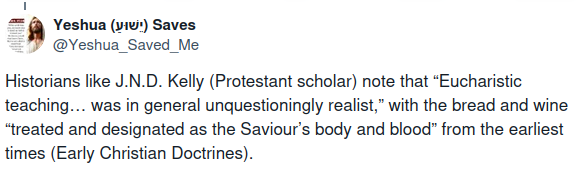
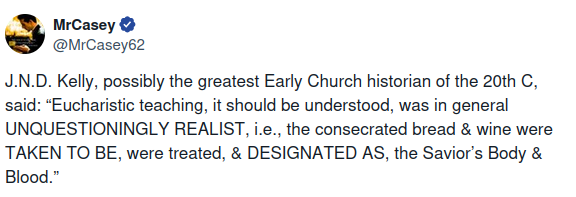
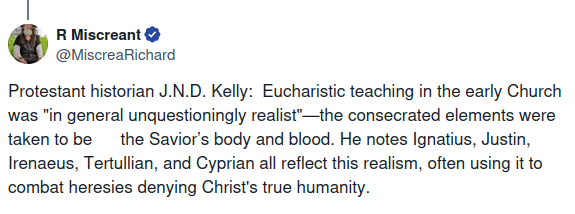
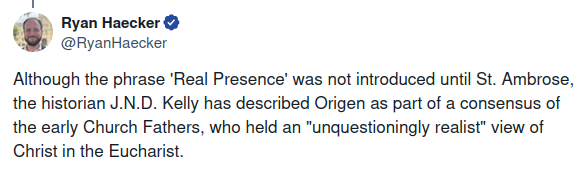
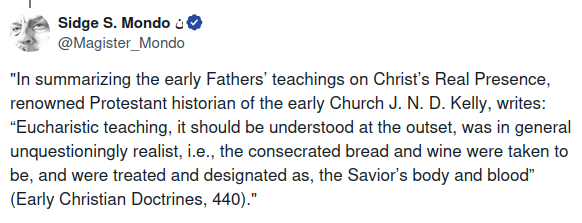
…they always leave out the next sentence.
I also searched for the phrase…
…and got only “6” results, three from Catholic Dave Armstrong and one from Catholic Pat Selwood. Notably, somehow these Catholics fail to see that even Cyril is an “example of the former tendency,” failing to see that Cyril is contradicting himself because the two positions are logically mutually exclusive.
If you want to know why AI, an LLM, responds the way it does to these questions, it’s because its outputs are only as good as its inputs. When the discussion is as biased as this one is, AI can only produce incorrect, extremely biased results.
NOTE: I have rewritten and moved the section on Joe Heschmeyer to another article here.
Perhaps I am waaaaayyyyy off here since I didnt study Greek or Hebrew or study with “the best of them” in Seminary, nor was I linguist which hair-splits every word like a lawyer would (Remember President Bill Clinton debating the definition of the word “is” and what it means or that lawyer that billed a client for more than 24hrs in a day, and actually won)
Wasnt the Lords Holy Supper “in rememberence of me” (meaning Jesus) and what was to become of him? “My blood, shed, for you” and “My body, broken for you”
A way of “remembering” what He did for all of us. A way for a fellowship of believers to help comprehend His sacrifice for us. “When two or more are gathered…I AM there….” and this Last Supper tradition, that he started sets the stage for all who “trust and believe” and “blessed are those who have not seen, but believe!”
So, when The last Supper happened, and its one of the most beautiful and humbling areas of Scripture to read about, because His love for the disciples was really beautiful. He called them friends.
When he poured the wine, was that his actual blood? Was the bread his actual body?
No.
So why are to believe as such now that the actual “ceremony” of the Lords Supper is indeed Jesus’s actual blood, and body. No, its wine and bread. A symbol that He himself set fourth. It all ties beautifully together. Why make it more than what it really is?
Too many Believers today try to reinvent the wheel on everything.
I myself do not partake in the Lords Supper probably because of my Salvation Army background. They view “your life” as a Sacrament. Though they are not against anyone in that church taking The Lords Supper.
I have met so many Christians in my life who believe that you cannot get into heaven unless you take it, and weekly. Jesus never said “weekly”
Only “In rememberance of me”
Speaking of Clinton, I’m one of the few who don’t mock him for wanted to clarify what “is” meant, as I said in “It Depends…” His opponents were asking him loaded questions in order to trap him into making a false confession. Only much later would I realize that such rhetorical techniques are common on social media.
As for the Supper, I completely agree with you.