
This is part of a series on Roman Catholicism and the eucharist. See this index.
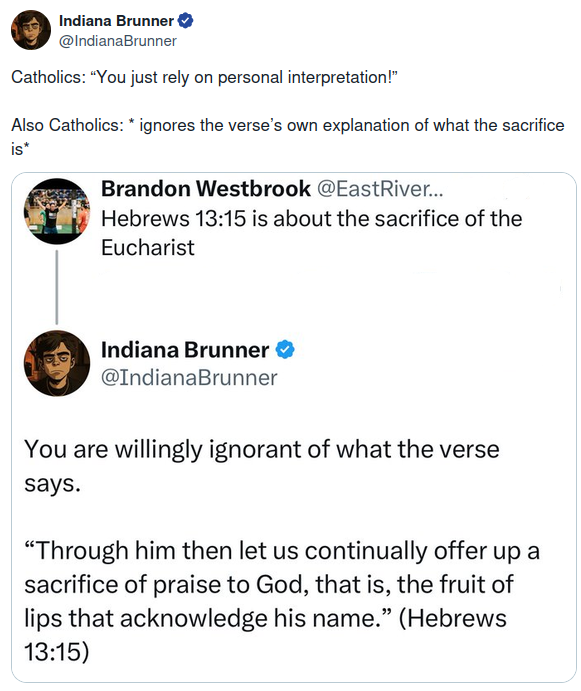
In “Eucharist, Redux #2” we defined the eucharist of the early church and provided a 10-item list of things that the church offered in its sacrificial thanks-offering. Inspired by the interaction in the screenshot above, let’s further ground the early church’s practices in scripture itself:
Therefore, through him let us continually offer up a sacrifice of praise to God —the fruit of lips that confess his name. Do not neglect to do good and to share what you have , for such sacrifices are pleasing to God.
Many early writers in the first 300 years of the church attested to the eucharist in various ways. Here is a non-exhaustive list of what they included in their thanksgiving sacrifice:
- giving of thanks
- gratitude
- prayers
- praise
- hymns
- firstfruits and tithes
- blessings
- a pure and contrite heart and mind
- service
- glory to God
All of these were offered to God during the thanksgiving sacrifice during each gathering of believers for worship.
The error the Catholic has made is mistaking eisegesis (inserting into the text what he believes) for exegesis (believing what is extracted from the text).
The verse says that sacrifice is of praise, service, and possessions. The Sacrifice of the Eucharist of the Roman Catholic Church—even to the extent that it includes some of these things—is not mentioned.
This is an error of reasoning known as Affirming the Consequent:
Premise 1: If you have a whole pizza, then you have a slice of pizza.
Premise 2: You have a slice of pizza
Incorrect Conclusion: Therefore, you have a whole pizza
Explanation: Having a part does not mean you have the whole.
In this case, if the pizza is “the Sacrifice of the Eucharist of the Roman Catholic Church” and the slice of pizza is “the sacrifice described in Hebrews 13:15-16,” then the conclusion does not logically follow.
Or, to put it in the simple terms of basic reading comprehension, “the verses do not mention the Sacrifice of the Eucharist of the Roman Catholic Church. It isn’t discussing what it doesn’t discuss.” This is trivially true.
Here is another example of the exact same Catholic error:
We believe everything Indiana said. We believe the Eucharist is perfect worship and praise and service. We offer ourselves to Jesus and he offers himself to us in the form of bread and wine. This is why I don’t engage in Bible verse warfare. It doesn’t matter what you or Indiana think a Bible verse says.
This commenter is focused on what he and his church believe. He’s asserting that what is described in Hebrews 13:15-16 is what he believes. In terms of the analogy above, his full belief includes this slice of pizza.
He then goes on to describe what his whole pizza includes (“he offers himself to us in the form of bread and wine”). But, of course, Hebrews 13:15-16 doesn’t discuss that. Hebrews 13:15-16 isn’t talking about his whole pizza (“the Sacrifice of the Eucharist of the Roman Catholic Church”).
It’s just a repetition of Affirming the Consequent. To wit:
This isn’t about “verse warfare.” It’s about simple reading comprehension: what the verse says, not what the verse means. The Catholics insist that the verse means “the Sacrifice of the Eucharist of the Roman Catholic Church” (a subjective interpretation) while the non-Catholics insist that the verse does not say this (an objective observation).
There is no “verse warfare” because these—interpretation and observation—are two different categories. In this case, interpretation involves what a person subjectively thinks, while observation involves what the text objectively says. The latter doesn’t involve any personal opinion. It stands independently and solely upon the contents of the text itself. Meanwhile, the subjective interpretation relies on things outside of the text itself: it is not an independent, standalone claim.