
In “Translations of Justin Martyr, First Apology, Chapter 66,” I noted that lengths that translators will go to make an early church writer express the theology of the translators. One of the most common ways this is done is, ironically, by choosing not to translate a term for which there exists a well-understood and well-established standard translation.
When translating a Greek word or phrase, translators will almost always choose an English word or phrase from the preexisting language. Transliteration, by contrast, is rarely done in translation, because it requires the translator to artificially create a new word in English. This is not easy to accomplish.
Here are some of those rare cases:[1][2]
| English | Greek | Citation | Part of Speech | Source |
|---|---|---|---|---|
| Iota | ἰῶτα | Matthew 5:18 | Noun | Greek |
| Raca | ῥακά | Matthew 5:22 | Noun (vocative) | Aramaic |
| Amen | ἀμήν | Matthew 6:13 | Interjection | Hebrew |
| Mammon | μαμωνᾶς | Matthew 6:24 | Noun | Aramaic |
| Hosanna | ὡσαννά | Matthew 21:9 | Interjection | Hebrew |
| Corban | κορβᾶν | Mark 7:11 | Noun | Aramaic |
| Abba | Ἀββᾶ | Mark 14:36 | Noun (vocative) | Aramaic |
| Maranatha | μαράνα θά | 1 Corinthians 16:22 | Exclamation | Aramaic |
| Alleluia | Ἀλληλούϊα | Revelation 19:1 | Interjection | Hebrew |
Here is an example translation of Justin Martyr that uses transliteration:
Transliterated language was used or acknowledged by Thomas B. Falls (c.1948), Cyril C. Richardson (1953), William A. Jurgens (1970), Leslie William Bernard (1997), and Denis Minns and Paul Parvis (2009). You have to go back to the 1800s to find translations that don’t use transliterations.
“What’s the big deal?” you might ask. I’m glad you asked! I’ll give you six reasons.
First, most of the transliterations in the table above are transliterated because they are not native Greek terms: they were “transliterated” from Hebrew or Aramaic by the original authors, not translators, to an audience that included those who understood the terms natively. It is odd for translators to take on the role of the author in this manner.
Second, translators almost never choose to transliterate words. Doing so is unusual, as their primary job is to communicate via translation into the target language, not leave things untranslated and unclear. The fact that so many translators of Justin Martyr are willing to transliterate the term sticks out as quite strange and inappropriate.
Third, it would be one thing if translators did not know what the word meant, and so left it untranslated. If you don’t know what a word means, transliterating it leaves it undefined. It would be a statement of “I don’t know what it means.” Here is one such example from scripture that shows how it is supposed to be done:
Make an ark of gopher wood. You are to make rooms in the ark and cover it inside and outside with pitch.
“gopher wood.” The identity of gopher wood (“gopher” is transliterated directly from the Hebrew text) is unknown, although guesses and suppositions about exactly what kind of wood it is have been made. Since we do not know all the kinds of trees that existed before the Flood, and do not have Noah’s ark from which we could examine a sample, it is best to just leave the text “gopher wood.”
But that is clearly not what it happening with the Justin Martyr translations: the meaning of the term for ‘eucharist’ in Greek is well-known. Translators are explicitly avoiding using the well-known definition because they think “I do know what it means.”
This is not the standard way that translators use transliteration. If a translator knows what a word means, they translate it! It is wildly inappropriate to transliterate a term for which you already have a well-known translation. In fact, the term it is now transliterated specifically because the translators want you to understand its meaning in precise relation to the high-level, later developed concept of “The Eucharist”—a proper noun—while avoiding acknowledging that a translation exists. Translators know what it means, but most of them don’t want you to know.
This is how they want you to understand it:
But, of course, this is a wildly speculative loose paraphrase, not a translation at all. And that’s the point. Why—starting in the 20th century—did English translators take a term that they knew what it meant and transliterate it rather than translate it? The answer is severe theological bias.
Fourth, eucharistized is a transitive verb. In the Bible, it is almost always nouns (including titles and names[1]) that are transliterated. Other parts of speech (e.g. interjections) are relatively rare. In particular, verbal transliterations are quite rare due to the linguistic and grammatical requirement that verbs be conjugated. For this reason, if a verb isn’t translated, it is usually incorporated wholesale into English as a loanword (e.g. “baptize“[2]) rather than being merely transliterated.
The difficulty of coherently conjugating transliterations is why transliterating verbs just isn’t done. That is why eucharist (a noun) is common and well-understood in English, but eucharistized (a verb) is not. Consider what happens when you Google the term:
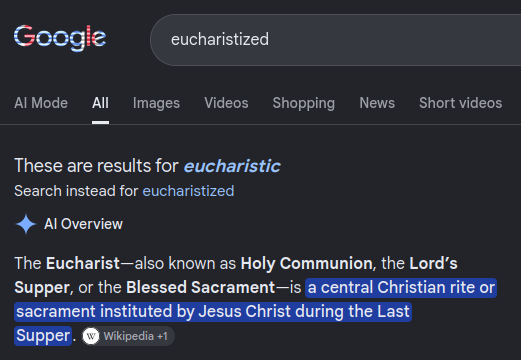
Notice how it thinks you made a typo for “eucharistic” (adjective; a noun modifier) or that you actually meant “Eucharist” (a proper noun). This is not an accident. Translators transliterate because they want you to mentally associate the verb with the proper noun, rather than understanding the verb as a verb. The response by AI—being an averaging engine—merely reflects the general reality. The reason AI sees “eucharistized” and thinks “The Eucharist” is because that matches the data it was trained on.
Fifth, the term arises very late in the church. The contrivance of the term itself can be traced to around the early 1700s:
(page 117)
Note, that for the expressing this transitive sense of the Greek word, some have contrived , not improperly, the English word eucharistize , importing thanksgiving towards God, but so as at the same time to express the benediction imparted to the elements in the same act.
Waterland—an Anglican—describes the struggle to transliterate the word ‘eucharist’ as a transliterated verb. The sense of the original word (as a Greek verb in aorist aspect translated as an English transitive verb) is not easily conveyed by a simple transliteration. This is, of course, why most English translations of Justin Martyr in that era did not use a transliteration, choosing to translate it instead. It is well-understood that transliterating verbs is generally a bad idea.
Waterland implicitly acknowledges that using a verbal transliteration creates a need for the creation of a neologism. But, it wasn’t until the 1900s that transliterating the verb really caught on in scholarly circles. And yet, most people I interact with have little or no idea what “eucharistized” is supposed to mean, despite routinely using the term ‘eucharist.’ It remains an alien term. This leads us to ask “Why are modern translators so intent on transliterating the verb?” We can see, from Waterland, exactly why:
That’s right. The reason is theological, not linguistic, syntactic, or grammatical. Translators want Justin Martyr to be talking about sacrificing and consecrating the communion elements in a single liturgical act. Transliterating is the most forceful way this to accomplish this “lumping together” in modern English. Translators do not want to literally translate Justin Martyr, because it would have him talking about giving thanks, which occurred prior to—and separate from—consecration (something Justin never mentions!). Transliteration reduces nuance and thus forces a simplistic, unicausal explanation.
Of course, Justin does not describe the giving of thanks in terms of consecration and communion, nor does he refer to the whole thing as a solitary liturgical act. In other words, translators want to insert their theology onto Justin Martyr’s lips.
Sixth, while English translations of early church writers often contain transliterations of the Greek terms for ‘eucharist,’ the terms are never transliterated into English in any Bible translations, despite being used more than 50 different times. It is always translated using related words like thanks or gratitude.
It is extremely odd that translators of Justin Martyr choose transliteration over a literal translation, as I do here:
“…the—[already] having been thanked by the prayer of his word—food (from which our blood and flesh are nourished by transformation), we have been taught [it] to be flesh and blood of that same Jesus who was made flesh.”
This reads naturally. It needs no special justification or rationalization.
It is methodologically inconsistent—a double standard—to translate every instance of eucharist in the Bible, but transliterate eucharist in the early writings. There is no linguistic, syntactic, or grammatical reason to transliterate the term. Each instance should be translated.
However, without the transliteration, translators won’t be able to find their Anglican or Catholic theology in Justin Martyr: translating the text naturally removes the translator’s theology from consideration. Thus, the decision to transliterate the verb is nothing more than an abuse of their station by the translators who deeply want—or need—to find their theology there.
Footnotes
[1] Titles and names of people and places are excluded, as it often doesn’t make sense to translate these. For example, when we speak of “Philadelphia,” we don’t typically translate it. The meaning of the term isn’t “brotherly love,” it is a specific location.
[2] Loanwords, like baptize (‘βαπτίζω’) and legion (‘λεγιών’) are excluded.