
Over the last few years, I have had an extended back-and-forth conversation with a Roman Catholic on Twitter. Our conversation spanned a number of long threads, focusing on the liturgical evidence of eucharist found in some of the earliest major sources:
The Didache (c.90)
Ignatius (d.c.108)
Justin Martyr (d.c.165)
Irenaeus (d.c.202)
Cyprian (d.c.258)
This is Part 5. The topic is Irenaeus. See the index here.
However, there is another point to be made here. St. Irenaeus is not making a single argument here, but a twofold argument. Tim correctly identifies its first aspect, that Christ identifies himself with created matter, which indicates that matter cannot be evil.
However, another argument is made here. Take note where St. Irenaeus states:
What is important here?
2. But vain in every respect are they who despise the entire dispensation of God, and disallow the salvation of the flesh, and treat with contempt its regeneration, maintaining that it is not capable of incorruption. But if this indeed do not attain salvation, then neither did the Lord redeem us with His blood, nor is the cup of the Eucharist the communion of His blood, nor the bread which we break the communion of His body. 1 Corinthians 10:16 For blood can only come from veins and flesh, and whatsoever else makes up the substance of man, such as the Word of God was actually made. By His own blood he redeemed us , as also His apostle declares,
“In whom we have redemption through His blood, even the remission of sins.” Colossians 1:14
And as we are His members, we are also nourished by means of the creation (and He Himself grants the creation to us, for He causes His sun to rise, and sends rain when He wills Matthew 5:45). He has acknowledged the cup (which is a part of the creation) as His own blood, from which He bedews our blood ; and the bread (also a part of the creation) He has established as His own body, from which He gives increase to our bodies.
St. Irenaeus explains that the cup is acknowledged by Christ as his blood, an undeniable nod to the Last Supper and the Eucharist , and he then explains that through this cup Christ bedews (to cover or sprinkle with a liquid) our blood.
Earlier in the text we see St. Irenaeus quote Colossians 1:14, which explains that we are redeemed through the blood of Christ. So, St. Ireaneus explains that it is the blood of Christ that redeems us (with St. Irenaeus using the analogous language of covering or sprinkling us). This is only possible if, of course, the communion cup is actually the blood of Christ, or at the very least possesses it in some way.
Now, while this doesn’t prove transubstantiation outright, it does demonstrate a belief in the substantial presence of Christ in the Eucharist . Considering the scholastic distinctions of transubstantiation, consubstantiation, and the sacramental union has yet to be made, this kind of articulation of the substantial presence of Christ in the Eucharist we’d expect to see in the 2nd century. This also safely rules out the Reformed view of Christ only having a spiritual presence.
( orange ) I won’t belabor the point again, but merely remind readers that the use of the proper noun ‘Eucharist’ to mean ‘Holy Communion’ begs the question.
( yellow ) This is the specific claim that only one explanation is possible. But this is easily rejected by the simple observation that if Irenaeus was speaking figuratively, then the communion cup need not actually be the literal blood of Christ to make sense of this paragraph. Thus, we see that if Irenaeus was speaking literally, then the wine must be literally blood, but if Ireneaus was speaking figuratively, then the wine must be figuratively blood. This is tautological.
( magenta ) Thus, CE is simply begging the question of the very thing under debate.
NOTE: If you, Dear Reader, are convinced that CE has begged-the-question, then you may choose to stop reading. The rest of this article discusses CE’s argument from the word ‘bedews.’ This argument is only matters if you ignore the fact that he begged-the-question, as everything follows from that single assumption. But if you with to grant him, for sake of argument, his presumption, then you’ll want to keep reading.
( pink ) CE’s argument from the word ‘bedews’ appears to be somewhat novel among Catholic writers. After a cursory search, I couldn’t find anyone else making these kinds of theology claims. This is a big red flag, and had CE been a bit less credulous, he might have avoided making this argument.
CE’s claim contains a key unfounded assumption. It hinges on a specific answer to the question, “what is the antecedent of “from which he bedews our blood?” Is it “the cup” as CE states, or is it the immediately preceding “his own blood.” If we apply Occam’s Razor here, the latter is, by far, the preferred reading, as (using CE’s definition of ‘bedews’) “Christ’s blood is what sprinkles us” is a straightforward exegesis of scripture: everyone agrees that Christ’s shed blood redeems us, a point Irenaeus had just made explicitly only two sentences earlier. By contrast, there is no precedent in the immediate context of Irenaeus work, or in the greater context of the early church, to say “The cup [which is Jesus’ blood] sprinkles our blood.”
In this framing, we are simply back to the standard debate over whether acknowledging the bread to be flesh and the wine to be blood is a figure-of-speech or not. The usage of the term ‘bedews’ (to mean ‘sprinkles’) sheds no light on that question. Moreover, we cannot underestimate the importance of whether this is to be taken literally or figuratively. For example, if he whole thing is figurative, then even if Irenaeus meant “the cup is what bedews our blood,” this still isn’t transubstantiation or even a substantial presence. So even if CE can somehow justify his novelty, the interpretation still begs the question.
I bring all of this up because it shows that CE’s methodology is inherently flawed. The way he is approaching exegesis is incorrect. He is making assumption upon assumption in order to draw his predetermined conclusion, even going so far as to create novel explanations.
However, there is another factor which might turn all of this into a moot point. Take a step back for a moment and ask yourself if this translation even makes sense with any theology, even the Catholic one:
Where—throughout the entire history of Christianity—has our salvific redemption through Jesus’ shed blood ever been said to by through the application—or mingling—of his blood onto our blood? I’m serious, when has this—whether figurative or literal—ever been a position put forth by anyone? It certainly isn’t found in scripture, and I’m not aware of it being a part of any theological conversation outside of the (possible!) exception of Irenaeus. It is a completely novel idea.
Contextual Note: After citing Colossians, the subject changed from redemption by the blood of Jesus to nourishment of the already-redeemed through creation. CE appears to have conflated these two.
There are no ancient Hebrew parallels in the Old or New Testament for this concept of salvation through the application of blood to blood. So absurd is this concept that this is why, I believe, CE suggests, instead, that “bedew” must mean “to sprinkle or cover” instead of using the standard meaning of the word:
BEDEW, verb transitive: To moisten, as with dew; to moisten in a gentle manner with any liquid; as, tears bedew her face.
Unlike ‘moisten’, ‘sprinkle or cover’ would vaguely harken to the Old Testament concept of atonement. Unfortunately, this suggestion simply cannot survive examination.
The problem we have here is that Against Heresies exists in two major forms: a complete Latin family and a fragmentary Greek family. Neither use any words that mean “to sprinkle or cover.” Let’s look at each one in turn, starting with the Greek since Irenaeus originally wrote in Greek.
When we examine the Greek in Migne’s Patrologiae Graeca, here is what we find on col. 1125 in the section on Against Heresies, Book V, Chapter 2:
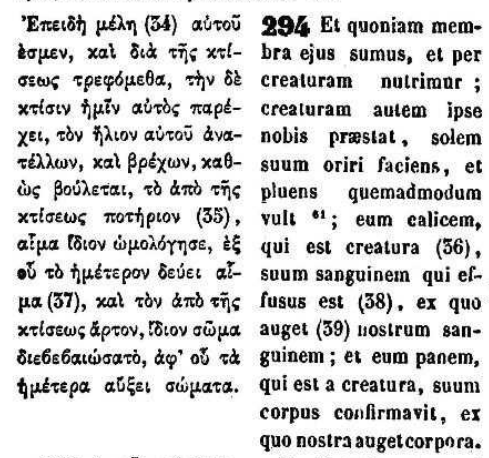
There are two verbs used in Greek text (δεύει and αὔξει), but only one used in Latin text (auget): δεύει is paired with blood and αὔξει is paired with bread; auget is paired with both. The meaning of δεύει is closer to drenching and soaking (in its ancient use), while “sprinkling or covering” is a very poor and inaccurate definition.
In Patrologiae Graeca, the Latin auget (“increases”) is used over the Greek (“wets”). But, for illustration purposes, let’s follow Migne’s footnote 39 instead, which reads “Auget. Graec., perfundit.” indicating that the direct translation of the Greek-sourced “δεύει” is the Latin “perfundit”:
| Subject | Greek | Latin Translation | Meaning | Target |
|---|---|---|---|---|
| Cup | δεύει | perfundit | drench, wet, moisten, bedew | Blood |
| Bread | αὔξει | auget | increases | Body |
Now let’s compare this to the text in Latin:
Edited by W. Wigan Harvey (1857)
Et quoniam membra ejus sumus, et per creaturam nutrimur; creaturam autem ipse nobis præstat, solem suum oriri faciens, et pluens quemadmodum vult, eum calicem qui est creatura, suum sanguinem qui effusus est, ex quo auget nostrum sanguinem; et eum panem qui est a creatura, suum corpus confirmavit, ex quo nostra auget corpora.
(from chatgpt)
And because we are His members, and are nourished through creation, and He Himself provides us with creation, causing His sun to rise and sending rain as He wills, He has acknowledged that cup, which is part of creation, as His own shed blood, from which He increases our blood; and that bread, which is part of creation, He has established as His own body, from which He increases our bodies.
The Latin does not have the distinction found in the Greek. The same word auget (“increases”) is used to describe both the cup and the bread, creating a parallel construction:
| Element | Description | Figure | Result |
|---|---|---|---|
| cup | part of creation | acknowledged as His blood | from which our blood increases |
| bread | part of creation | established as His body | from which increases our bodies |
This is incredibly straightforward, which is almost certainly why many translators have preferred it. The cup and the bread, both part of creation, produce material increases in our body. The whole point of this discussion is that Jesus called created things—things that sustain the flesh—his body and blood (see Tim Kauffman’s explanation).
Now compare this to the translation that CE used:
| Element | Figure | Action |
|---|---|---|
| Created cup | His blood | Bedews our blood |
| Created bread | His body | Increases our bodies |
Here I highlighted the natural antecedent of each bolded action if Irenaeus is speaking literally. This is the tabular form our what we already discussed above. Notice that the natural parallels that we saw in the Latin are not present in the Greek. Notably, the antecedent of each action does not naturally refer to the associated parallel concept.
Of course Irenaeus could have done this. There is no rule that states that he was required to write with such a high level of skill, so he could have “mixed up his metaphors” as it were. This is a thing that happens in real life all the time, where real language is ambiguous and messy.
I think CE saw that there was supposed to be a parallel here. Instead of treating this mixing as a potential problem (e.g. with the original text) and questioning his translation, he simply assumed that the parallel existed…
| Element | Figure | Action |
|---|---|---|
| Created cup | His blood | Bedews our blood |
| Created bread | His body | Increases our bodies |
…and forced the interpretation to conform to his explanation. Thus, through a series of assumptions, CE arrived at the claim that the cup redemptively bedews our blood.
Keep in mind that if you are going to force parallels, you have other options besides the one CE has chosen. You could, alternatively, choose to force the meaning of “increases” onto “bedews” (as you find in the traditional Latin passed on by Catholics). We’ll discuss that option some more in a bit (three paragraphs down).
CE does not explain why he chose one forced parallel over the other. If he went with the only possible set of assumptions that led to a pro-Catholic explanation, that isn’t a valid exegetical approach.
It is true that the English translation that CE cited uses the underlying Greek phrasing. The translator is certainly allowed to do this. After all, Ireaneus wrote in Greek, not Latin, so the Greek is always compelling. But, and this is key, the English translator is not interpreting the antecedents, he is only translating. He leaves it undetermined whether “bedews our blood” refers to the ‘created cup’ or ‘His blood.’ He also leaves it undetermined whether to understand it literally or figuratively. There is simply no obligation to interpret the text the way that CE has chosen to interpreted it, nor any obligation to draw the conclusions that CE has chosen to make.
Notably, if you understand the Greek-based text figuratively—rejecting the idea of a substantial presence—then the passage becomes a natural parallel as-is:
| Element | Figure | Action |
|---|---|---|
| Created cup | His blood | Bedews our blood |
| Created bread | His body | Increases our bodies |
When taken figuratively, “the cup bedews our blood” is a figuratively synonymous way to say “the cup increases our blood.” In fact, had CE not begged-the-question, the perceived necessity for a parallel structure would have led us to reject any kind of substantial presence by concluding, instead, that Irenaeus was speaking figuratively.
Taking Irenaeus figuratively also has the side benefit of completely eliminating the perceived semantic conflict between the Greek and Latin versions. Only if you take Irenaeus literally is there a perceived conflict between the Latin and Greek versions. So, we ask: what has led CE to conclude that the Latin version is unreliable? And we ask: what led him—earlier—to favor the Latin over the Greek?
But, ultimately, CE’s explanation creates a meaning that, frankly, makes no sense at all. There is simply no historical precedent anywhere—ritual or otherwise—for blood to be “sprinkled” onto another’s blood for the redemption of sins. Even being as charitable as I can be, CE’s suggestion is very close to nonsensical when interpreted literally (as CE does). Even if I granted all of his assumptions (for sake of argument), I would still conclude that this reading fails to support transubstantiation or any other kind of substantial presence. But I wouldn’t grant his many different assumptions. I would—and have—questioned his approach at many steps along the way.
Ultimately, there is uncertainty in the correct way to interpret Irenaeus here, but the novel explanation CE has given would be far down the list of possibilities. Perhaps he will address these concerns and/or provide another source for this idea. I’d certainly be interested in reading that.
Let’s continue with CE’s argument.
Now, to round this off, what is the second aspect of the argument I was speaking of? So far I’ve only demonstrated a material articulation of substantial presence . Well, to understand this, we need to look to paragraph 3.
As we saw above, the “material articulation of substantial presence” was based on flawed reasoning and a number of other problems.
3. When, therefore, the mingled cup and the manufactured bread receives the Word of God, and the Eucharist of the blood and the body of Christ is made, from which things the substance of our flesh is increased and supported , how can they affirm that the flesh is incapable of receiving the gift of God, which is life eternal, which [flesh] is nourished from the body and blood of the Lord, and is a member of Him?— even as the blessed Paul declares in his Epistle to the Ephesians, that we are members of His body, of His flesh, and of His bones. Ephesians 5:30 He does not speak these words of some spiritual and invisible man, for a spirit has not bones nor flesh; Luke 24:39 but [he refers to] that dispensation [by which the Lord became] an actual man, consisting of flesh, and nerves, and bones — that [flesh] which is nourished by the cup which is His blood, and receives increase from the bread which is His body. And just as a cutting from the vine planted in the ground fructifies in its season, or as a grain of wheat falling into the earth and becoming decomposed, rises with manifold increase by the Spirit of God, who contains all things, and then, through the wisdom of God, serves for the use of men, and having received the Word of God, becomes the Eucharist, which is the body and blood of Christ; so also our bodies, being nourished by it…
( magenta ) This is actually a much bigger concession that you might realize. When you factor in that this is a decidedly pro-Catholic translation that—ironically—isn’t faithful to the Greek, it is that much more noteworthy that the altered text still isn’t enough to establish the Catholic view, even after the redactions and manipulations by translators and editors to try to insert Catholic doctrine.
( yellow ) Above, CE cited a translation that used the fragmentary Greek in order to push a pro-Catholic doctrine. But here he is using the same translation that used the complete Latin to push a pro-Catholic doctrine. Here is the translators note that explains the latter:
The Greek text, of which a considerable portion remains here, would give, “and the Eucharist becomes the body of Christ.”
Well, now, isn’t that interesting. Let’s compare:
When, therefore, the mingled cup and the manufactured bread receives the Word of God, and the Eucharist of the blood and the body of Christ is made , from which things the substance of our flesh is increased and supported…
When, therefore, the mingled cup and the manufactured bread receives the Word of God, and the eucharist becomes the body of Christ , from which things the substance of our flesh is increased and supported…
Here we have Irenaeus explicitly stating, in Irenaeus’ native Greek, that the thanksgiving (‘eucharist’) of wine and bread becomes the body of Christ only during the consecration (‘receives the Word of God’) after it is already called the eucharist. This explicit statement by Irenaeus constitutes a direct, unambiguous proof of my argument!
In Greek, the bread and wine used in communion were called “the eucharist” prior to communion! By contrast, the Latin says that the eucharist (albeit qualified by a preposition) is made by the consecration, such that Irenaeus has the church making the ‘eucharist’ (albeit qualified by a preposition) in ‘holy communion.’
Can you guess which choice Catholics prefer?
Should we be surprised that the Catholic prefers the Greek when only the Greek supports the Catholic position and prefers the Latin when only the Latin supports the Catholic position? Yet, ultimately, only the Catholic position relies on making specific, arbitrary choices. Only the Catholic is begging-the-question.
Due to the qualification of eucharist by the prepositional phrase in the Latin, the non-Catholic position works with either source language. Consider how, in the Greek, the eucharist (of the tithe) being made into the eucharist of the blood and body indicates that it was the eucharist before communion, before it was of the blood and body. This is equivalent to what the Latin says when it claims that the eucharist (of the tithe) becomes the body of Christ (in communion). Thus, the Catholic position is tenuous precisely because only the Catholic position relies on mixing-and-matching Greek and Latin to support Catholic doctrine, while the non-Catholic position requires no such commitments.
However, what’s important here is what St. Ireaneus outlined in the previous paragraph. The blood of Christ (which per St. Ireaneus and St. Paul is what redeems us) is administered via the Eucharist , as the Eucharistic cup is how it is bedewed upon us. So, the established belief in the text here is that the Eucharist nourishes us both physically (refuting the Gnostics) and also spiritually, whereby our flesh is redeemed.
Remember also that St. Ireaneus explained how the blood of Christ in the Eucharist is bedewed into our blood, he is specifically teaching an administering of Christ unto the flesh for spiritual profit.
So to summarize, the twofold argument that St. Irenaeus makes here is that firstly, Christ identifies himself with created matter, which refutes the Gnostics, and secondly, it is through the Eucharist that Christ both physically and spiritually nourishes us. The physical nourishment provided by the Eucharist is a sign that God will redeem our flesh at the resurrection, and the spiritual nourishment is demonstrative that Christ wishes to redeem our flesh.
This refutes the Gnostics in both sense, but the second aspect of the argument can only be made if Christ is substantially in the Eucharist .
The ‘eucharist’ in the early church refers to the sacrificial thanks offering: bringing gifts to the gatherings for the distribution to those in need. From out of this offering of gifts, the bread and wine for communion were sourced. The ‘eucharist’ up through the early church referred to the tithe offering, as is attested over and over again. By contrast, there exists no clear reference—not a single one—to ‘eucharist’ referring to communion itself, nor to the communion liturgy. Prior to the late 4th century, the ‘eucharist’ is never the ‘Eucharist.’
( orange ) The fact that ‘eucharist’ is never ‘Eucharist’ is why I continue to strenuously object to how aggressively CE begs-the-question.
( yellow ) I have to disagree. Having read the cited Chapters 2 and 3 (as quoted above), Irenaeus does not mention “spiritual nourishment” nor does he indicate that he has this topic in mind. He’s concerned, quite specifically, with the created reality of both the elements and of Jesus’ body. Notably, the topic of resurrection (what he is talking about) does not require Irenaeus to espouse a view of transubstantiation or any other kind of substantial presence in order to refute the Gnostics.
Now that we’ve got this very long exegesis out of the way, we can move onto the rest of the thread.
I’m not sure it can be called exegesis, given the question begging.
We will continue in Part 6.