
Over the last few years, I have had an extended back-and-forth conversation with a Roman Catholic on Twitter. Our conversation spanned a number of long threads, focusing on the liturgical evidence of eucharist found in some of the earliest major sources: the Didache (c.90), Ignatius (d.c.108), Justin Martyr (d.c.165), Irenaeus (d.c.202), and Cyprian (d.c.258).
This is Part 4. The topic is Irenaeus. See the index here.
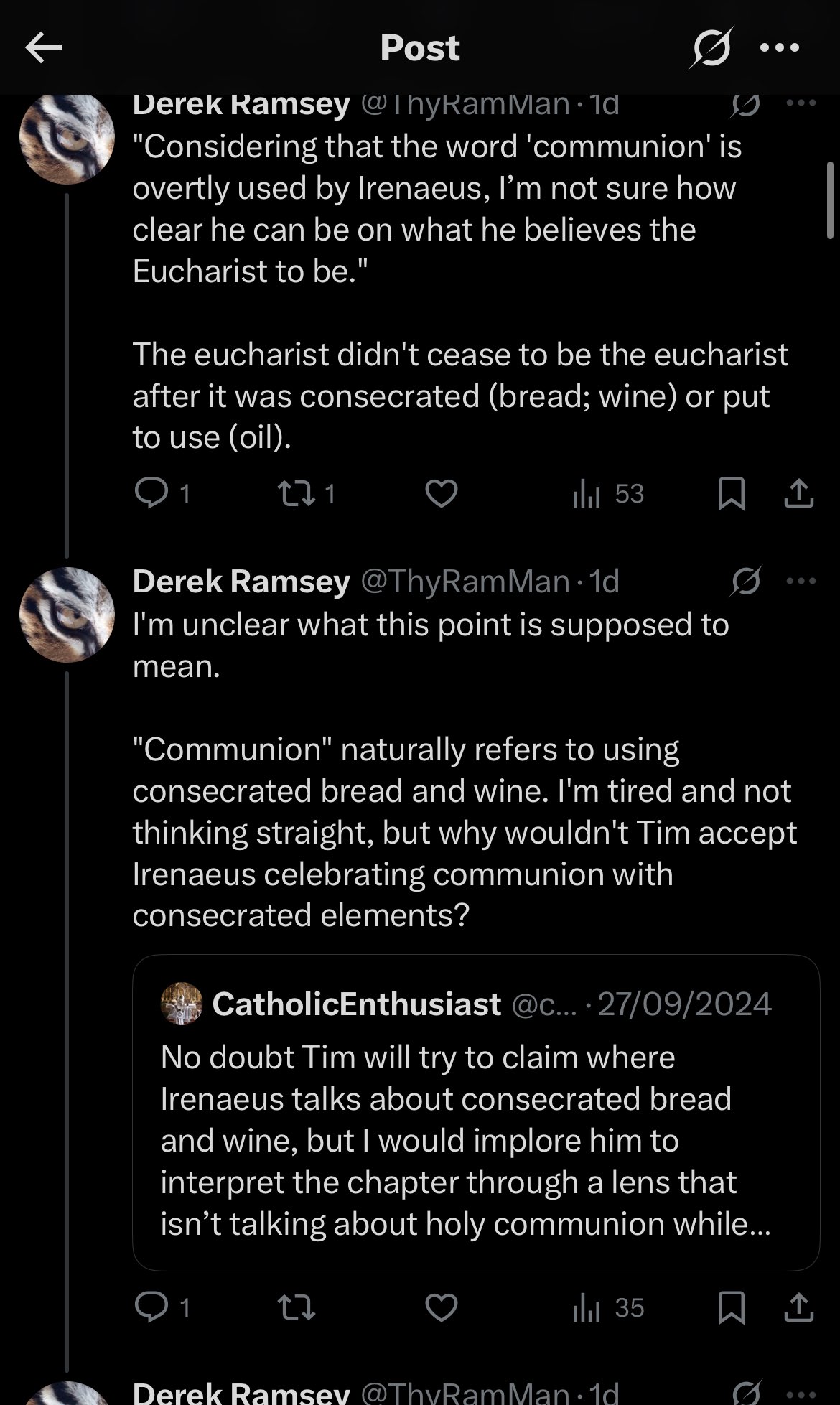
Concerning this part of the thread, I think I need to make clear what Tim was contending. As I understood it, Tim was contending that the Eucharist refers to not just holy communion as we understand it today, but the offering of various gifts unto God.
My contention was that since St. Irenaeus was talking of the cup being the communion of his blood, the Eucharist in the context of this chapter specifically refers to the Holy Communion, bread and wine. It is good we agree that communion naturally refers to using consecrated bread and wine.
Let’s continue right where we left off in Part 3. Recall that the bread and wine of the eucharist do not cease to be the eucharist when they are consecrated for communion. Yes, “eucharist” can refer to the offering of prayers, tithes, and gifts in the thanksgiving sacrifice. Yes, “eucharist” can refer to the consecrated bread and wine in the celebration of the Lord’s Supper. Yes, communion—the shared meal—utilized this consecrated bread and wine, but communion was not itself referred to as “eucharist.”
Eucharist is a word that simply means thanksgiving and refers the act of giving thanks. The idea that this refers, like a title, to the entire ritual act of remembrance of the Last Supper—instead of referring to the elements of communion—did not arise until many centuries after the Last Supper itself.
Tim did not believe that bread and wine of the offering of various gifts was different bread and wine from the consecrated elements. Both were one eucharist, a eucharist that was (during the thanks offering) sacrificed-but-not-consecrated and then was (during communion) consecrated-but-not-sacrificed.
Now, let’s hone in on the key point.
The fact that the bread and wine were used in a communion context, that is, that they were consecrated, does not say anything at all about the identification or peculiarity of the thanksgiving—the eucharist—itself. Sometimes ‘eucharist’ refers to the unconsecrated bread and wine of the thanks offering. Sometimes ‘eucharist’ refers to the consecrated bread and wine of communion. But, ‘eucharist’ does not refer to communion itself.
Irenaeus speaks, in the most natural way possible, of the bread and wine of the eucharist preceding communion.
Consider:
Against Heresies — Book V, Chapter 2
…nor is the cup of the Eucharist the communion of His blood…
Here Irenaeus talks about the cup of eucharist (literally: cup of thanksgiving). It is the cup—the communal drinking of consecrated wine—that is communion, not the thanksgiving (eucharist) offering itself. Of course drinking wine taken from the thanks offering is the communion. Nothing else could be, as the thanks offering is where the wine was sourced for communion.
Consider:
Against Heresies — Book V, Chapter 3
When, therefore, the mingled cup and the manufactured bread receives the Word of God, and the eucharist becomes the body of Christ , from which things the substance of our flesh is increased and supported, how can they affirm that the flesh is incapable of receiving the gift of God, which is life eternal, which [flesh] is nourished from the body and blood of the Lord, and is a member of Him?
Here we have Irenaeus explicitly stating, in his native Greek, that the thanksgiving (‘eucharist’) of wine and bread becomes the body of Christ during the consecration (‘receives the Word of God’).
Let’s pause to emphasize this point: the eucharist, already being the eucharist, then becomes the body of Christ only after it is consecrated.
The bread and wine used in communion were called “the eucharist” prior to communion! But, of course they were! The ‘eucharist’ refers to the sacrificial thanks offering, when the early church brought their gifts to the congregation for the distribution to those in need. It is from out of this offering of gifts that the bread and wine for communion were sourced. ‘Eucharist’ up through the early church referred to the tithe offering. It never directly referred to the communion itself, nor to the communion liturgy.
In the early church, the elements of communion went through two separate liturgical acts. First, during the thanks offering, they were sacrificed-but-not-consecrated. Second, during communion, they were consecrated-but-not-sacrificed.
Catholics—other than CatholicEnthusiast—insist that the “two” eucharists are actually one simultaneous act of eucharist. But, this is plainly an anachronistic claim, completely unsupported by the early writers. Since the historical account is logically mutually exclusive with Catholic dogma, Catholics fight aggressively to establish retroactive continuity with the early writers, a task that they must ultimately fail to perform.
Before we move along, I want to make one thing clear. Here is CE’s statement again:
I am not claiming that Irenaeus is talking about the actual sacrificial offering of the thanks offering (i.e. the ‘eucharist’ proper). There is no doubt that Against Heresies, Book V, Chapters 2 and 3 is clearly and unambiguously discussing the Lord’s Supper. I simply deny that the context of this passage is communion simply because Irenaeus used the word ‘thanksgiving’ (‘eucharist’). The context is communion because communion is what is being discussed, not because he invoked the word “Eucharist” like some kind of magic spell.
I reject the anachronistic use of ‘Eucharist’ as a title for communion. This is Catholic begging the question. During this time in history, no such title existed. The Catholic is applying it this way retroactively, a point I made in Part 1 when I noted:
Retconning ‘eucharist’ into a proper noun ‘Eucharist’ meaning ‘Holy Communion’ is one of the most successful theological frauds ever perpetuated, so much so that Catholics will not only beg-the-question by repeatedly using the term ‘Eucharist’ in discussions of the early writers, but will redact the early writings themselves to make it seem as if the original authors held the same view. This is such a high level of systemic dishonesty, that it is sometimes hard to fathom how it can rope in so many people.
I’m sure that you, Dear Reader, have noticed my very low regard for Catholic scholarship, translations, editorializations, and apologetics. This is one of the major reasons why. Those who participate in this fraud should be ashamed.
We will continue in Part 5.