
Over the last few years, I have had an extended back-and-forth conversation with a Roman Catholic on Twitter. This was before I was banned from Twitter for no reason at all. I’ve been wanting to respond for some time, but I have no choice except to do it here. Thanks to rampant censorship, I won’t be able to interact with him directly, but at least I’ll be able to respond.
I’ll try to avoid making this confusing, but since much of it has been deleted by Twitter, it may be a little hard to follow. I do think it will reveal a bit about the typical online debate.
This is Part 1.
The Argument
It’s important to first define what a formal presentation of a doctrine is and what a material presentation of a doctrine is. When a doctrine is formally presented, such as the divinity of Christ in John 1:1, it is explicitly outlined, whereas when it is materially presented, the doctrine is implicit in what is said.
Tim [Kauffman’]s interpretation isn’t wrong in any particular regard, he is correct in noting that St. Irenaeus was outlining how in the words of consecration, Christ had become a part of creation, refuting the gnostics.
However, it’s a false dilemma to argue that St. Irenaeus cannot be teaching transubstantiation if he is teaching that Christ outlined how, in the words of consecration, he became part of creation.
Now it’s important to first note that at the beginning of the chapter, St. Irenaeus begins with the statement :
So, in the words of St. Irenaeus, Christ exhibited upon us his true flesh. While this doesn’t prove transubstantiation outright, it indicates St. Irenaeus believes in some kind of presence to the degree that we can try say that Christ’s flesh is exhibited in the Eucharist.
It’s also worth noting that the Latin version of exhibit (exhibere) and the Greek version (ἐπιδείκνυμι) mean “to present” or “to show.” We are presenting Christ’s flesh in the Eucharist.
CE is referring to the argument put forth by Tim Kauffman. We’re not going to concern ourselves with the nature or details of that argument for one very important reason: CE’s attempted refutation is flatly erroneous.
Fraudulent Translations
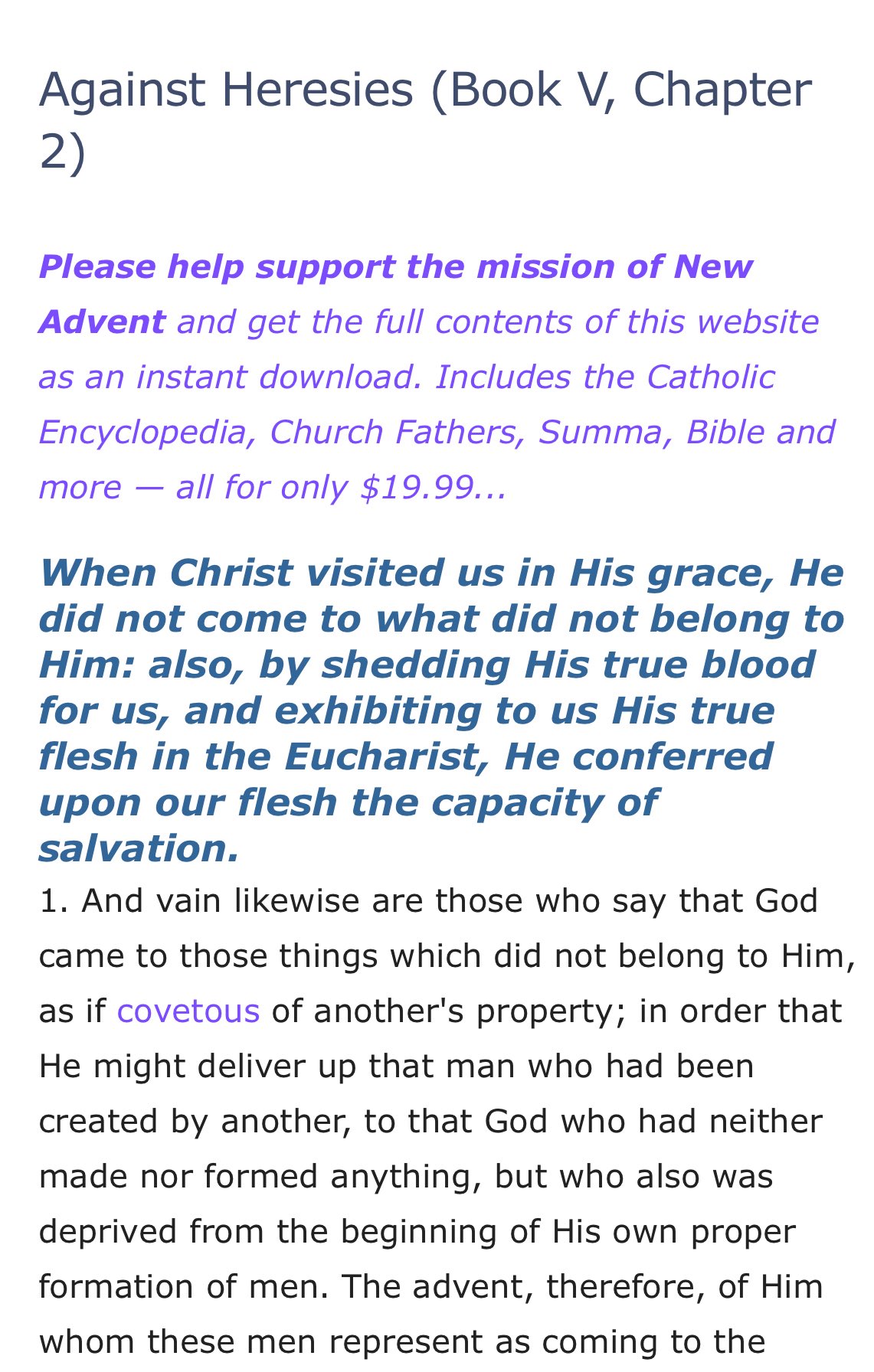
CE cites “Against Heresies (Book V, Chapter 2)” from the Catholic-run repository at New Advent. The problem? The part he attributes to Irenaeus was not actually written by Irenaeus.
The portion that CE quoted is actually a summary gloss written by the editors of the chapter. You can see from the screenshot that the summary uses a separate color and font from the actual text of Irenaeus’ work. It (to me at least) rather obviously differs from the text in style, tone, and vocabulary. So biased is the commentary that even calling it a summary is a huge stretch.
It bothers me that translators and websites are so reckless in presenting the material of the ancient writers. There is no direct indication that the chapter summary was not written by Irenaeus. You just have to know or recognize that fact, otherwise you’ll be duped.
This is a good example of how translators and commentators just can’t help themselves: they feel that they must insert their own theology onto the text, because they can’t allow the original author to speak for himself. Does all this sound familiar? It should:
Citation: Bernard Orchard, “A Catholic Commentary on Holy Scripture.” (1953) p.11
The fact is, it is by design that translations are translated in such as way as to promulgate current doctrines onto the the ancient past. For centuries we’ve found redactions to ancient texts being transmitted as if they were authentic. We know the Bible is authentic only because we have so many disparate copies, making it easier to catch individual instances of fraud. This does not apply to the less attested early writings of the church, where fraud slips through easily.
As I wrote in “Adventures in Translation” Part 1 and Part 2, translators of ancient writers are not to be trusted and being credulous is a recipe for being deceived. If you are a Catholic and you can find your theology prior to the late 4th century, there is a very high probability that someone has duped you. But, since Catholics are trained to believe that their faith is “Apostolic” and that rejecting the Church’s authority is forbidden, they are routinely duped.
Making Mistakes
One of the reasons I appreciated my back-and-forth conversation with CE is that he’s intellectually capable. The vast majority of online Catholic apologists are, frankly, not intellectually equipped to defend the faith. Many don’t even know what the faith is.
However, CE cited a source containing an editorial gloss as if it were written by the author himself. This shows that he isn’t adequately familiar with the work he is citing authoritatively. I’m sure it’s a legitimate mistake: he probably really didn’t know and wouldn’t have cited if he did know. But, this does mean that his argument is invalid and so I can’t make a more substantive reply to his points.
It is more than a simple accident, though. CE’s comments strongly reflect the systemic bias inherent to all Catholic scholarship, so much so that we can’t simply pass it off as a mere mistake. Throughout this series, as you will read the responses by CE, pay attention to a few things.
First, notice how he refers to the early writers by the designation “Saint.” Doing so implicitly assumes that they are Saints, i.e. that Catholic theology is true. There is simply no academic reason to refer to the writers—in a debate!—with flowery titles that beg the Catholic position.
Second, notice how he capitalizes Catholic terms-of-art, such as “Eucharist” or “Holy Communion.” In the translations, these are as much editorial glosses as the editors adding their own summaries in the title. CE cites these terms-of-art as if they were authentic even when he quotes sources that could not possibly have done this. This is important because using words like “Eucharist” as proper nouns begs-the-question. It presumes Catholic theology. It also presumes that, in the author’s own words, the counterargument—the one I am presenting—is explicitly wrong (see below).
These are not neutral, unbiased presentations. CE is fallaciously framing the argument with the presumption of the conclusion that his view is true before he even presents his argument. This is circular reasoning. Thus, these errors and mistakes that the stumbles into are, strictly speaking, not even mistakes. He has systematically created a framing that ensures that these errors logically must occur. In other words, not only is he not trying to identify the mistakes or avoid making them, but he is actively making choices that make it more likely that he commits those errors.
Now, let’s look at an example where he quotes one of the early writers as a Saint and then makes it seem as if they used the term ‘eucharist’ as a proper noun:
Then, in paragraph 3, near the beginning, St. Irenaeus talks about how the “manufactured” bread receives the “Word of God” (the words of consecration), after which the…
This, frankly, constitutes a misquotation.
So while CE is more-or-less intellectually capable, he’s no fair-and-unbiased academic. And, because he chooses to be so credulous and uncritical regarding pro-Catholic sources, his mistakes are, at least in part, not accidents.
Consequences
I bring all this up because I’ve found these kind of systemic and systematic defects in most (all?) Catholic apologists. Many believe that what they are taught today is the same as what was taught all the way back to the apostles in an unbroken chain of shared belief. But this is simply untrue. Catholicism is a novelty that developed starting in the late 4th century or later. It’s very nearly impossible to find Catholic novelties earlier than that, and claims otherwise almost always suffer from avoidable errors.
If CE or other apologists were operating under the premise that their deeply held beliefs were false, then they would have been protected from making these kinds of errors. Of course, it’s extremely difficult to get Catholics to accept that most of what they believe is actually a lie. After all, it has been hundreds of years since the Protestant Reformation, and Catholicism is still more-or-less thriving: presenting the facts isn’t getting it done.
There is no way to tell if Catholicism is wrong without honestly questioning it. On a surface level, Catholicism sounds fine. It even sounds Christian, more-so than Mormonism (for example). But, seriously questioning their faith is the one thing that Catholics can never do. Sure, they can ask questions about Catholicism, but they can’t truly doubt it. They can’t be as skeptical as they need to be to probe it for its many errors. They are too invested in the outcome.
Catholics are trapped in a bind. What they believe is downright false, but they are coerced to accept it by authority on threat of damnation. It’s not about what is right or wrong, it’s about what the leadership declares. To facilitate this, their church encourages accepting “mysteries” as true on the basis of blind faith. Additionally, in many cases, Catholics would face social or familial ostracization if they rejected the lies. There is a way out, but it is a narrow path and few find it.
I know no easy way around this problem. The best I can do is point out how their blind faith leads them astray and hope that they use this to question their deeply-held beliefs. It’s the most I can do. I expect that most will, ultimately, be lost on the basis of their own free choice.