
This is part of a series on Roman Catholicism and the eucharist. See this index.
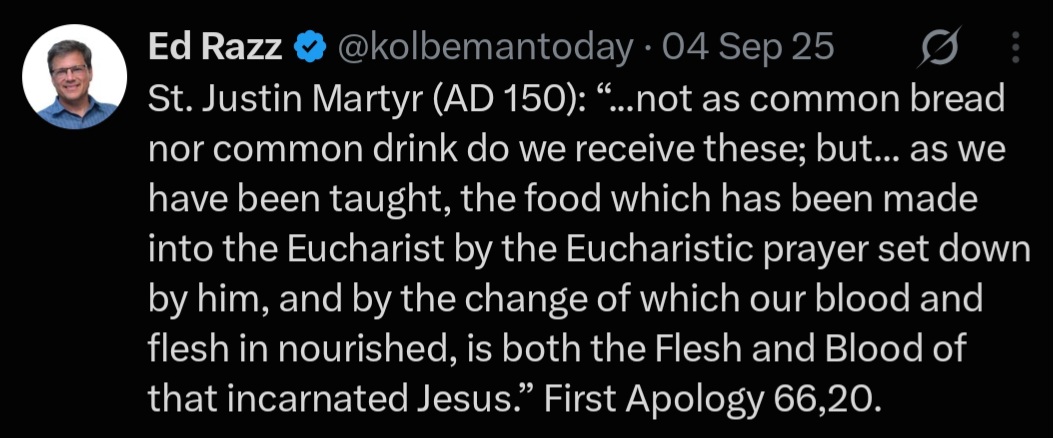
Conversations with Catholics will invariably result in a defense of what they call “the Eucharist” (also called “the Sacrifice of the Mass”). Catholics will insist that the “Real Presence” and “Transubstantiated” Eucharist can be found throughout the entirety of church history. So, what better proof could there be besides one of the earliest church fathers close to the apostles?
Among these references, the most common is Justin Martyr, First Apology, Chapter 66 (from the mid-2nd century) in which Justin is alleged to say that the bread and wine become “the Eucharist”: the real, actual, literal, substantial flesh and blood of Jesus. This is the core Catholic belief.
These are big claims. So, to check their veracity, let’s perform a comparison of the different English translations of the most cited clause of Justin Martyr’s First Apology, Chapter 66. We’ll look at a dozen different expert translations.
Critical Text
Let’s start by looking at the critical text, the one everyone is translating from. I didn’t find any indication of disagreements over the authenticity of this text. This represents the scholarly consensus of what Justin Martyr really wrote.
Here is a very literal translation that I made for comparison with the ones made by the others. It’s clunky, but it’s a good reference point for a literal translation.
This will give you a better idea of what the underlying Greek sounds like. It shows a few key features that will help you evaluate the other translations.
( Yellow ) First, in Greek, ‘ eucharisted food ‘ (εὐχαριστηθεῖσαν [τροφήν]) is a verbal adjective that literally means “ having been thanked food ” because the giving of thanks—(‘eucharist’ means thanksgiving)—for the food had (already) taken place. The word “having been thanked,” functioning as an adjective, serves as a qualifier of the noun ‘food’.
( Yellow ) Second, in Greek (and, thanks to the emdash, in my literal English translation also) you can clearly see that the clauses “by the prayer of the word of him” and “eucharisted” are sandwiched between “the…food.”[1] This tells us that the prepositional phrase and the verb (technically it is an ‘aorist passive participle’) function as adjectival qualifiers of the food. No other translation keeps this explicit.
( Magenta ) Third, the phrase about the food nourishing our physical flesh and blood refers back to the the “eucharisted food,” not forward to the body and blood of Christ. Together, this forms the subject of the sentence:
In other words, the subject of the sentence is food intended for eating and nourishment (or digestion) over which a prayer of thanksgiving (originating with Jesus) was previously prayed.
( Cyan ) Fourth, in the final clause, the subject is what is referred to by “[it]” (implied by the ‘to be’ verb). Thus…
In other words, it is a simple recounting of the Last Supper contained in the gospels. In fact, this is exactly what we see when we read the very next sentence in First Apology, Chapter 66:
For the apostles, in the memoirs composed by them, which are called Gospels, have thus delivered unto us what was enjoined upon them; that Jesus…
…and that, after the same manner, having taken the cup and given thanks, He said, “This is My blood;” and gave it to them alone.
First, Jesus gave thanks for the bread (and wine) with a prayer of thanksgiving. Second, after the first was finished, he called it his flesh (and blood).
( Yellow , Cyan ) Fifth, since the prepositional phrase “by the prayer of his word” qualifies the noun ‘food’ as part of the subject of the sentence, it cannot qualify the main verb or the predicate of the sentence. A number of translations change the Greek word ordering, breaking the grammar by implying that the food (subject; noun) is or becomes (verb) the body and blood of Christ (predicate) by the prayer of his word (prepositional phrase, modifying the verb + predicate). The final English ‘translation’ discussed below explicitly does so.
The reason translators do this is to have Justin Martyr “say” that the “prayer of his word” is the “Words of Institution” (“This is my body…this is my blood”) instead of the prayer of thanksgiving that Jesus offered over the food.
Now, let’s see how well the official translations do.
1600s and 1700s
Edited by John Kaye (b.1783 – d.1853)
This is exceptional for being an extremely early English translation and not having any of the doctrinal presumptions found in later translations. It uses the general term “prayer and thanksgiving” that was very common in early writings of the church to describe the sacrificial tithe offering (see here). It also specifically avoids making doctrinal claims (e.g. “…in some sense…”) that Justin Martyr wasn’t clearly stating.
In John Kaye’s commentary[2], he includes the following translation by Hamon L’estrange…
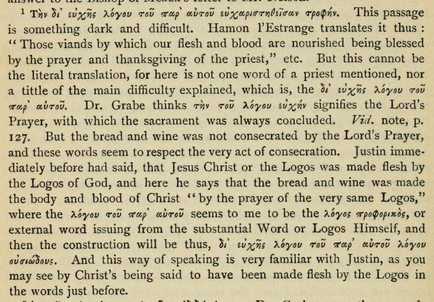
…which he says “cannot be the literal translation” because Justin Martyr identifies Jesus as the source and does not mention a priest. In stark contrast to Reeves’ translation, this is a clear example of the lengths translators will go to blatantly insert their doctrine. Unfortunately, we will see much more of that.
To give you an idea how people thought in the 1800s and earlier, Kaye believed the “word” spoken was the Logos spoken of in John 1 (and earlier in Justin Martyr’s sentence) and Kaye noted that Dr. John Ernest Grabe (1666–1711) thought that the “prayer of his word” signified the Lord’s Prayer, which always concluded (and, thus, could not continue into the communion).
Both refer to being blessed by prayer and thanksgiving. However, this language was soon dropped.
1800s
Edited by Kevin Knight of New Advent (c. 2013)
Chevallier’s description of the food in 1830s is similar to the ones later provided by G.J. Davies and by Dods and Reith in the 1860s. These translations from the 1800s translate eucharisted (literally, “having been thanked”) with “which is blessed by the prayer…”
Gone are the references to being “blessed by thanksgiving” found in the earlier translations of the 1600s and 1700s. In the translations of the 1800s, thanksgiving was removed from the eucharist (a word meaning ‘thanksgiving’). The consequences of this were profound, as we will see.
1900s and 2000s
I’ll start with this translation from Anglican J.N.D. Kelly.
It is not clear if J.N.D. Kelly translated it himself or if he got it from another source, but I suspect he translated it himself. This translation is somewhat similar to the older style translations, as well as the translation that I made, which is why I mention it first. It is a pretty literal translation, which clearly separates it from the less literal translations that can be found in the 1800s, 1900s, and 2000s.
However, the most notable feature of Kelly’s translation is that he only semi-translated the otherwise transliterated ‘eucharistized’. He decided to not choose any English word to translate “eucharist,” choosing only to add the English past tense suffix -ed to (somewhat) reflect the underlying aorist passive participle. He is not the only one to do so:
(see the numbered footnote here)
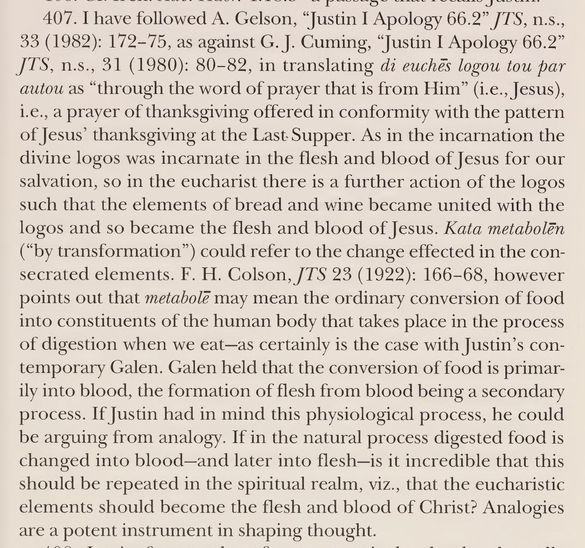
(see the numbered footnotes here)
We would like to know why these translators held themselves back by choosing not to translate the word. Why didn’t they translate it literally (“having been thanked?”) or follow in the footsteps of the past (“prayer and thanksgiving” or simply “prayer”)?
Not everyone showed this kind of restraint:
(see the footnotes here)
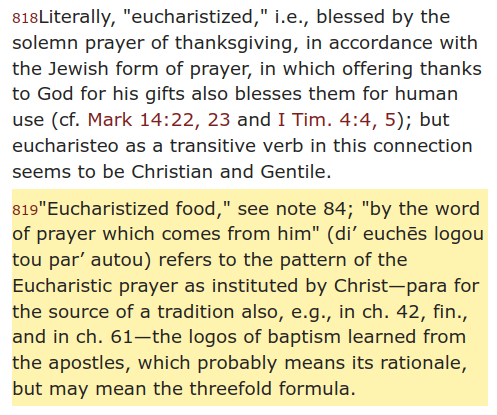
In using the non-literal term ‘consecrated’, Richardson begins what will be a trend by translators away from more literal translation of eucharisted (“thanked” and/or “blessed”) into other words. But it is his footnotes that reveal the answer to the question we posed above. Richardson discloses that he understands what ‘eucharisted food’ means:[3]
818. Literally, “eucharistized,” i.e., blessed by the solemn prayer of thanksgiving, in accordance with the Jewish form of prayer, in which offering thanks to God for his gifts also blesses them for human use (cf. Mark 14:22, 23 and I Tim. 4:4, 5); but eucharisteo as a transitive verb in this connection seems to be Christian and Gentile.
We can see that translators do not want to translate it literally. Their theology forbids them from understanding ‘eucharisted food’ in terms of the thanks-offering described in the Old and New Testaments, with the food ultimately being for human use. So, they leave it untranslated.
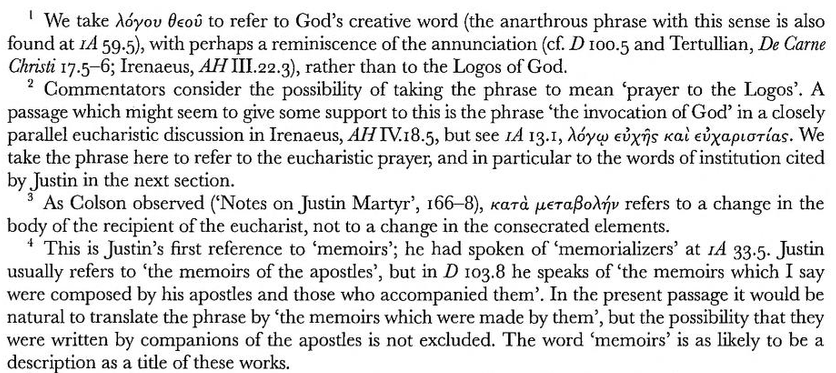
The footnote of Minns’ and Parvis’ translation clearly and unambiguously shows their intention:[4]
2 Commentators consider the possibility of taking the phrase to mean ‘prayer to the Logos’. A passage which might seem to give some support to this is the phrase ‘the invocation of God’ in a closely parallel eucharistic discussion in Irenaeus, AH IV.18.5, but see 1A 13.1, [Transcribed Greek]. We take the phrase here to refer to the eucharistic prayer, and in particular to the words of institution cited by Justin in the next section.
The problem, of course, is that Justin Martyr never says that the bread and wine are ‘eucharisted’ by the words of institution. If the translators had used a literal translation, they would have been unable to support this doctrine.
Biased translators who don’t want to use a literal translation (e.g. “blessed by prayer and thanksgiving”) have two choices remaining. They either cop-out—as did Bernard, Minns & Parvis, and Richardson—by transliterating it (leaving it untranslated), or they non-literally mangle it up, as the following translators do:
…so, we have been taught, the food which has been made the Eucharist by the prayer of His word , and which nourishes our flesh and blood by assimilation, is both the flesh and blood of that Jesus who was made flesh.
These translations are quite terrible, even laughable. They insert doctrinal presuppositions into the translation, rather than letting Justin Martyr speak for himself. They are very non-literal translations.[5]
Pay special note to two things. First, two of the translations translate “thanked” (‘eucharisted’) as “made into the Eucharist,” which horribly begs the question (e.g. adding a verb, adding a definite article, and capitalizing the E) and, frankly, borders on the nonsensical (i.e. “making the giving of thanks”). Second, the yellow highlight in the last translation is chopped up in a way that completely changes the meaning.
It is easy to see that translating the literal…
(“having been thanked food”)
…as…
…or…
…is a gross mistranslation.
Of note, when Roman Catholics cite one of these three non-literal translations as proof of Roman Catholic doctrine—which are so clearly translated by Roman Catholics with the presumption of the Roman Catholic doctrine—they are engaging in circular reasoning. It’s fine to have a non-literal translation or a particular interpretation (re: Justin Martyr), but one can’t then take those and use them to argue for one’s interpretation: an interpretation isn’t evidence, it’s begging-the-question.
Analysis
Having looked at four centuries of translations, there is a very noticeable development over time. Here is what the progression in English looks like visually:
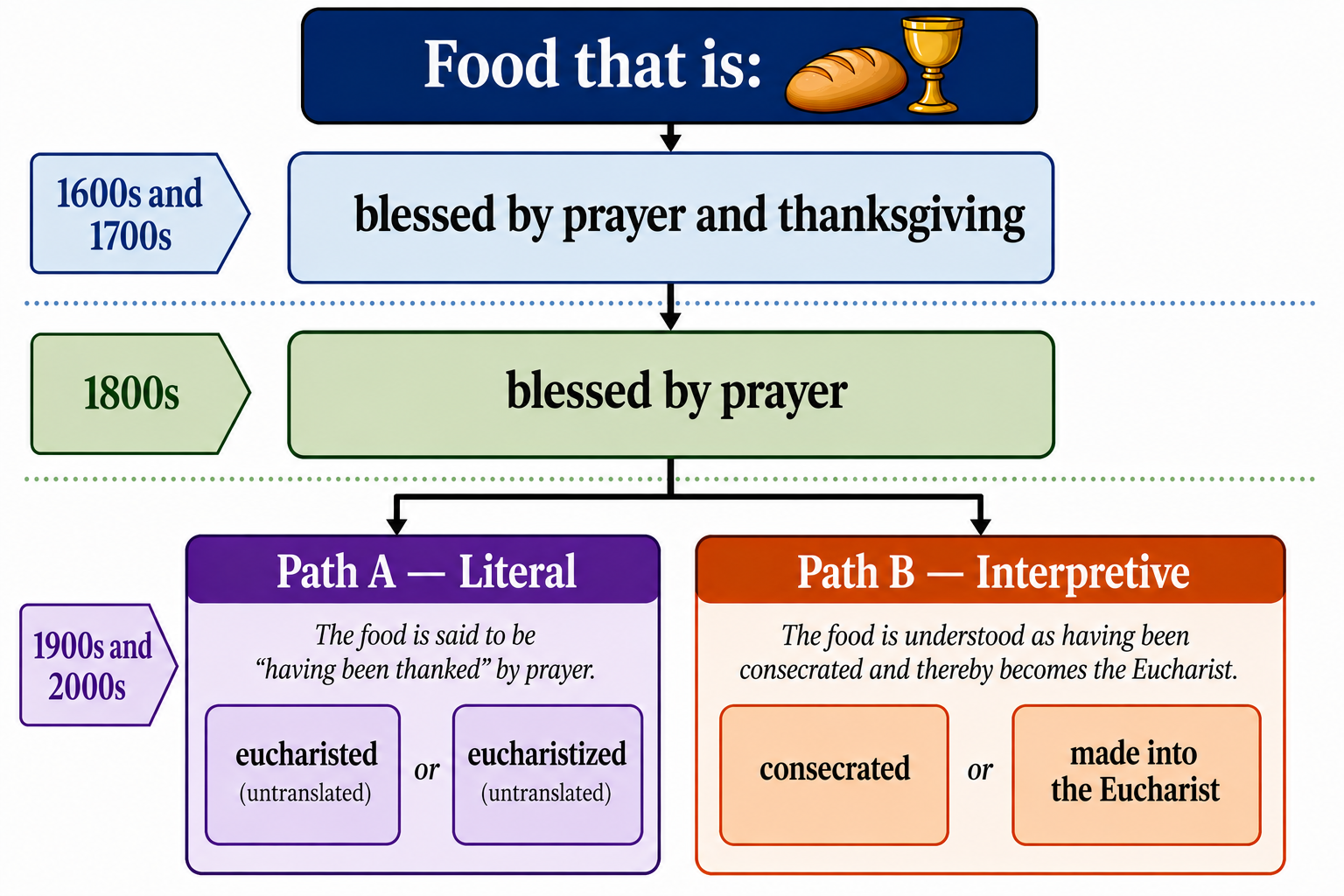
The earliest translators understood Justin to be talking of the food which had blessed by prayer and thanksgiving. Translators would remove the word “thanksgiving,” thus (ironically) removing the eucharist from the eucharist, the thanksgiving from the thanksgiving. Ultimately, this led to using eucharist as an untranslated term-of-art or translating it in a completely non-literal way.
There was also a development in how the Greek aorist passive participle was handled. Translations shifted it away from the past tense towards the present tense. They also lost the sense of being a verbal adjective. A number of translation were translated in such a way to imply that the prayer was the words of institution instead of the prayer of thanksgiving.
Here is a summary of the kinds of modifications that were made:
• Changing the tense from ‘eucharisted’ to the present tense
• Changing the verb ‘is’ to ‘becomes’
• Adding the words like ‘eucharistic’
• Not translating to avoid a literal translation
• Qualifying ‘food with words not found in the original: blesssed, made, or consecrated
• Qualifying the prayer
• Inserting commentary (e.g. “set down”; “power”; “incarnated”)
Ultimately, it’s not hard to see why there has been a recent bias:
| Translator | Date | Affiliation |
|---|---|---|
| Hamon L’Estrange | 1600s | Anglican |
| William Reeves | c.1717 | Anglican |
| John Kaye | 1800s | Anglican |
| Temple Chevallier | c.1833 | Anglican |
| George John Davie | c.1861 | Anglican |
| Dods & Reith | c.1867 | Presbyterian |
| J. N. D. Kelly | c.1958 | Anglican |
| Leslie William Bernard | c.1997 | Anglican |
| Minns and Parvis | c.2009 | Roman Catholic |
| Cyril C. Richardson | c.1953 | Episcopal |
| Thomas B. Falls | c.1948 | Roman Catholic |
| William A. Jurgens | c.1970 | Roman Catholic |
| Daughters of St. Paul | c.1983 | Roman Catholic |
I’ve highlighted the three translators of the most egregious translations. I’ll leave this as an exercise to the reader to figure out what they share in common.
On the Latin
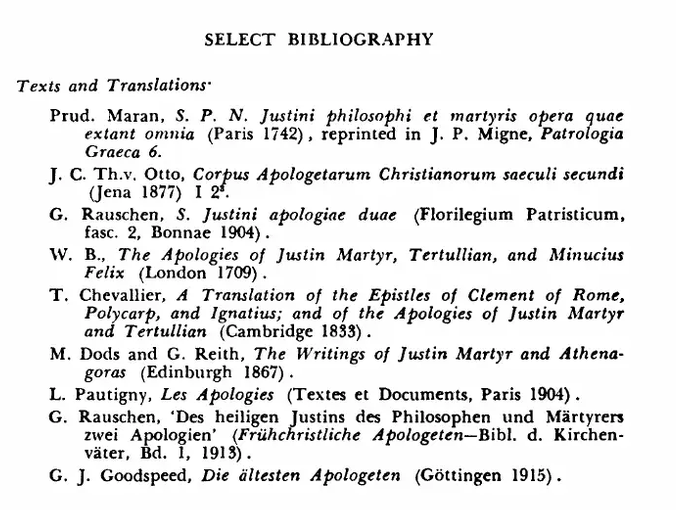
In 1742 in Paris, Prudentius Maran (a Benedictine monk who lived from 1683 to 1762) published “Justini philosophi et martyris opera quae extant omnia,” which contained a Greek critical text (made by Maran) of First Apology and a Latin translation. From 1857 to 1866, Roman Catholic J.P. Migne published his Patrologia Graeca. In volume six, he reprinted Maran’s First Apology (see cols 428–429 for Chapter 66) along with his own commentary.[6]
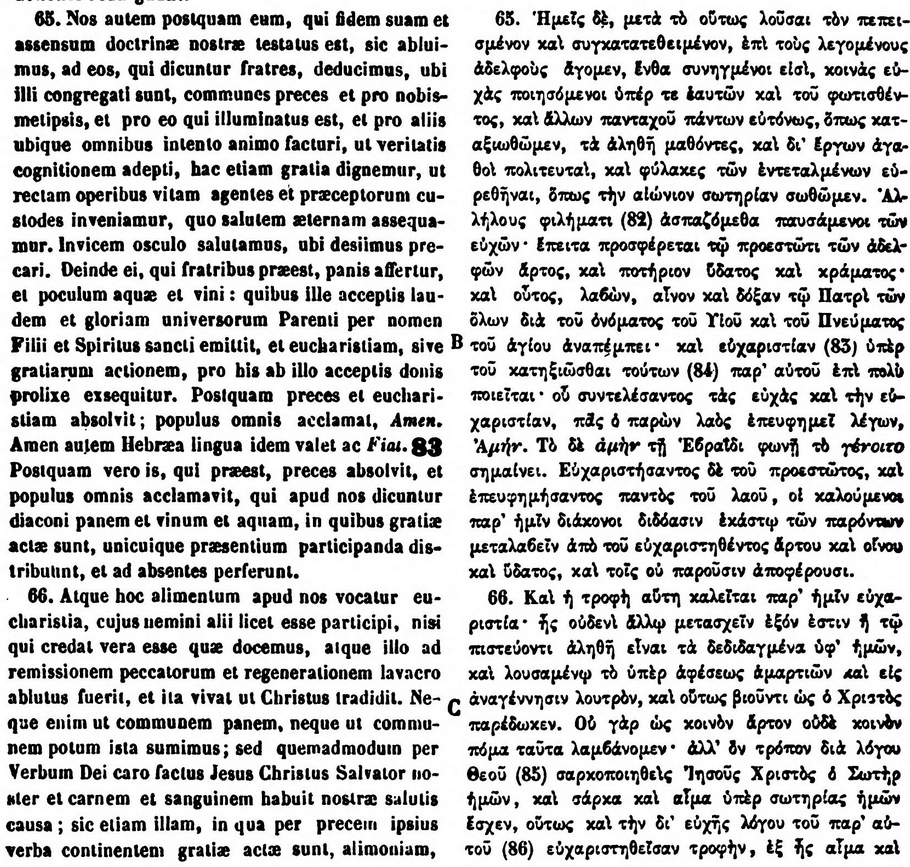
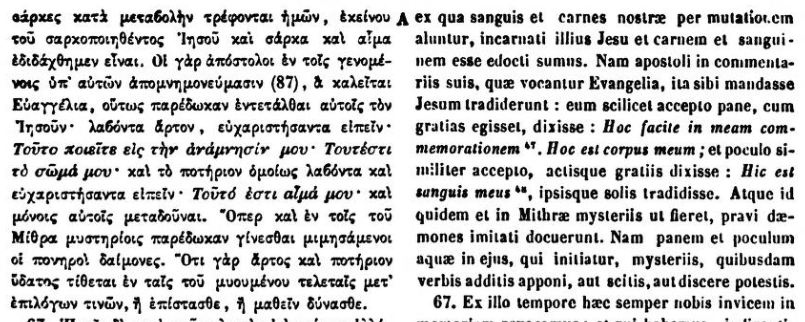
Here is a comparison of the texts with a loose English translation:
Paris, 1742
Prudentius Maran
Reprinted by J.P. Migne
ChatGPT
First, this 18th-century literal translation is nothing at all like the 20th-century non-literal Roman Catholic translations.
Second, this 18th-century literal translation is different from all the Anglican, Episcopal, and Presbyterian translations as well, excepting (I suppose) the ones that leave ‘eucharisted’ untranslated.
Third, the Greek ‘εὐχαριστηθεῖσαν’ ( ‘having been thanked’) is translated as ‘gratiae actae sunt’ (‘thanks have been given’). No modern English translation maintains the sense of the Greek aorist passive participle, especially not in the way the Latin does here. This is one reason why pretty much no English translation is accurate. It’s also why Catholic apologists who cite Justin Martyr are so insufferable: they boldly speak their mind, despite having no idea what they are talking about.
Fourth, Roman Catholic Thomas B. Falls used Maran’s Greek and Latin (in Migne’s PG) and still produced his non-literal translation anyway.
Fifth, this translation is almost identical to the one I provided at the top of this article. The differences are quite minor, considering they are translations from a different language.
Derek Ramsey (2026)
Sixth, what shocks me the most is that I’m using the same basic translation used by Roman Catholics in the 1700s and 1800s. The difference is that Roman Catholics these days call me all sorts of names for doing what Roman Catholics freely did only a couple hundred years ago.
I’ve read the critical texts and you’re either stupid or a liar. Serious critical scholarship doesn’t take your view for a reason.
Justin Martyr’s statement that the food has been eucharistized doesn’t change a thing. 0 Justin scholars agree with your dogmatic apologetical claims.
Modern Catholics, in general, have no idea what their church taught a few hundred years ago.
Footnotes
[1] The qualifiers are sandwiched between “the” and “food.”
See Roman Catholic J.P. Migne’s Patrologia Graeca (published from 1857–1866) in vol VI, cols 428–429.
[2] In his commentary, John Kaye writes:
But that transubstantiation was a thing never dreamed of, is evident from this very passage of Justin, where he says,
which to affirm of the glorified body of Christ is certainly impious blasphemy. Moreover, our Justin in his most excellent Dialogue with Trypho the Jew, tells him that it was foretold by the prophets that the time was coming when they should no longer
And he says, likewise, that the bread and wine in the sacrament was
and that it was generally styled by the ancients,
is too notorious to be denied ; and if so, it is not possible they should conceive it to be the very body and blood of Christ.
[3] Richardson knew exactly what he was doing. Here are his footnotes:
818. Literally, “eucharistized,” i.e., blessed by the solemn prayer of thanksgiving, in accordance with the Jewish form of prayer, in which offering thanks to God for his gifts also blesses them for human use (cf. Mark 14:22, 23 and I Tim. 4:4, 5) ; but eucharisteo as a transitive verb in this connection seems to be Christian and Gentile.
819. “Eucharistized food,” see note 818 ; “by the word of prayer which comes from him” refers to the pattern of the Eucharistic prayer as instituted by Christ—para for the source of a tradition also, e.g., in ch. 42, fin., and in ch. 61—the logos of baptism learned from the apostles, which probably means its rationale, but may mean the threefold formula.
[4] The translators clearly believed in transubstantiation and let this effect their translation:
2 Commentators consider the possibility of taking the phrase to mean ‘prayer to the Logos’. A passage which might seem to give some support to this is the phrase ‘the invocation of God’ in a closely parallel eucharistic discussion in Irenaeus, AH IV.18.5, but see 1A 13.1, [Transcribed Greek]. We take the phrase here to refer to the eucharistic prayer, and in particular to the words of institution cited by Justin in the next section.
3 As Colson observed (‘Notes on Justin Martyr’, 166-8), [Transcribed Greek] refers to a change in the body of the recipient of the eucharist , not to a change in the consecrated elements .
Calling it the eucharist and consecrated elements begs the question.
It is also ironic that the translators freely call it “the eucharist” in their footnotes while carefully avoiding translating the word ‘eucharisted’ in their translation. They speak of ‘the eucharist’ as if everyone knows what that is without any definition required, but they leave ‘eucharistized’ untranslated as if nobody can quite figure out what that means.
[5] There is a version of the Jurgens translation that is a very popular among Catholic copy-and-paste apologists that takes the word “nourished” and replaces it with “nurtured.” The fake quote is found (without attribution) in the quote mines of Catholic Answers (here) and Church Fathers (here), as well as many other Catholic sites. The fake quote can also, quite amusingly and ironically, be found in the academic paper “AI and the Reduction of Truth: A Eucharistic Alternative” by Christopher M. Reilly (2026).
[6] Here is an AI OCR and translation of Migne’s Latin footnotes (here), which should be good enough for our purposes here, but beware of transcription and translations errors. I found a few and edited them out, but I’m sure I missed some.
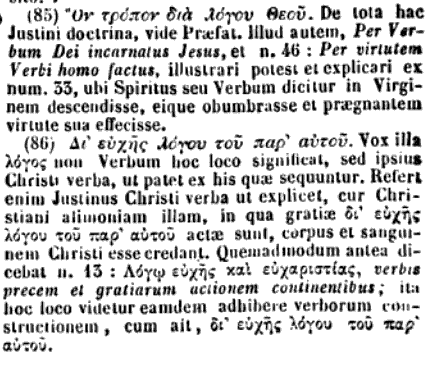
(85) Ὅν τρόπον διὰ λόγου θεοῦ [“In the same manner, through the Word of God”]. Concerning this entire doctrine of Justin, see the Preface. But the statement, “Jesus was incarnate through the Word of God,” and also no. 46, “through the power of the Word he was made man,” can be illuminated and explained from no. 33, where the Spirit, or Word, is said to have descended upon the Virgin, overshadowed her, and by his power caused her to become pregnant.
(86) Δι’ εὐχῆς λόγου τοῦ παρ’ αὐτοῦ [“by the prayer of the word which comes from him”]. The word λόγος here does not signify The Word [transliterated: “Logos”], but the words of Christ himself, as is evident from what follows .
Justin relates the words of Christ to explain why Christians believe that food, over which thanksgiving δι’ εὐχῆς λόγου τοῦ παρ’ αὐτοῦ [“by the prayer of the word which comes from him”] has been given, is the body and blood of Christ.
Just as earlier, in no. 13, he said: Λόγῳ εὐχῆς καὶ εὐχαριστίας [“by a word containing prayer and thanksgiving”] so here he appears to employ the same construction of words when he says, δι’ εὐχῆς λόγου τοῦ παρ’ αὐτοῦ [“by the prayer of the word which comes from him”] .
( yellow ) The immediate context of this phrase is the first half of the sentence that it comes from:
This is why William Reeves translated the “word of prayer” as the Word (or Logos) from the prologue in the Gospel of John. Migne implicitly acknowledges this in Footnote 85.
But Migne, a Roman Catholic, was required to believe that Justin Martyr was talking about the consecratory words of institution (which were recounted by Justin in the next sentence), rather than the Logos discussed in the same sentence. In this, he agrees with the commentary of his fellow Catholics Minns and Parvis[4] and the view found in the translation of Catholic William Jurgens (“…the Eucharistic prayer set down by Him…”).
In short, Migne’s view contains a doctrinal assumption.
It’s not clear what point Migne is making. If Jesus was made flesh by the power of the Word of God and the bread becomes flesh by the power of the words of institution spoke by Jesus, then he seems to be suggesting that Justin Martyr believed that the Logos is the “power of God” rather than God. This would seem to have Justin Martyr implicitly denying the doctrine of the Trinity in the Prologue of John. I think this is why John Kaye, in his commentary[2], said that transubstantiation could not possibly be found in Justin Martyr: it leads to contradiction. Migne’s view is self-refutting.
( magenta ) Migne confirms that Justin Martyr’s construction—”prayer and thanksgiving”—is the same as that used elsewhere (e.g. the William Reeves translation).
[7] Here is an alternative that breaks up the Greek word order a little bit while retaining the subject + verb + predicate distinction.
This is an excellent article. The one thing I would add is I would point out that metabolen (change) here contextually means digestion. The change is not a change of the bread to Christ’s body because he says “the bread which nourishes our flesh by change”….he is emphasizing it is real bread, really eaten, really digested, really nourishes our flesh by digestion. This is probably in contrast to a Gnostic mental eating that involves no actual bread.
Jeff,
Thank you for your feedback.
I’ve noted in the past that ‘transmutation’ means ‘to digest’, but I had intentionally left it out of this discussion. While the MEANING is clearly “digestion” in this context (i.e. “our blood and flesh are nourished by transformation”), the literal translation I was going for should be “transformation.”
But your point is taken. The subject of the sentence…
“the—[already] having been thanked by the prayer of his word—food from which our blood and flesh are nourished by transformation”
…could be stated this way…
“the—[already] having been thanked by the prayer of his word—food from which our blood and flesh are nourished by digestion”
…which would have admittedly been clearer than the purely literal translation.
A key point is that “transformation” and “transubstantiation” are mutually exclusive anyway, as transubstantiation is not, properly speaking, a (full and true) transformation: the “appearance” of the bread is not transformed.
Peace,
DR