
I sometimes read James Attebury’s blog. I find his ideas very interesting. However, since he heavily curates/censors comments to his blog, it’s difficult to engage with his work in a meaningful way. So I’ll comment here where nobody can censor comments that he doesn’t approve of.
Today we’ll be discussing Attebury’s interpretation of Daniel 9.
Messianic Prophecy
Did you know the Old Testament predicts the exact year when the Messiah would die? This incredible prophecy is found in Daniel 9:24-27
The exact year of Jesus’ crucifixion? That would be incredible…if it were true.
Here is the passage in question:
24 Seventy weeks have been decreed on your people and on your holy city, to finish disobedience and to make an end of sins, and to make reconciliation for iniquity, and to bring in everlasting righteousness, and to seal up vision and prophecy, and to anoint the most holy.
25 Know therefore and discern, that from the going forth of the commandment to restore and to build Jerusalem to the Anointed One, the ruler, will be 7 weeks, and 62 weeks; it will be built again, with street and moat, even in troubled times.
26 Then, after the 62 weeks, the Anointed One will be cut off, and will have nothing, and the people of the ruler who will come will destroy the city and the sanctuary; and its end will be with a flood, and even to the end there will be war. Desolations are determined.
27 And he will make a firm covenant with the many for one week, but in the middle of the week he will cause the sacrifice and the offering to cease; And on a wing of the Temple he will set up an abomination that causes desolation; even until a complete destruction, one that is decreed, is poured out on the one who causes desolation.
Like most prophecy, this passage has been subject to much debate. There is a wide range of possible explanations and no clear consensus on which explanation is the correct one. This should raise some red flags regarding Attebury’s unabashed exuberance.
Regardless, the belief that it is a Messianic prophecy is quite popular and it has been the traditional explanation going back many centuries. Sort of. But more on that later.
Here is Attebury’s explanation:
483 years X 360 days in the Persian calendar (the one used at the time of this prophecy) = 173,880 days.
173,880 days / 365.25 days in a modern calendar = 476 years in a modern calendar.
444 BC is the year King Artaxerxes I of Persia sends Nehemiah to rebuild Jerusalem (Nehemiah 2:1 says it was in his 20th year and Artaxerxes I reigned from 465 to 424 so 444 BC would be the 20th year of his reign using the ascension year system of dating).
444 BC – 476 years = 32 AD + 1 year because there is no year zero going from BC to AD = 33 AD (the year of Christ’s crucifixion, “an anointed one shall be cut off”).
Arbitrary Explanations
One of my criticisms of prophecy in general—especially “Numerology“—is how arbitrary it is. You can plug in a bunch of numbers and derive more-or-less any conclusion you want to find. If you conclude that Daniel 9 is a Messianic prophecy, you can play with the numbers until you come up with something that works.
That, obviously, begs-the-question.
Let’s demonstrate this.
As you may recall, I wrote about this same passage in “A Decree to Rebuild.” In his commentary on Daniel 9, Ed Hurst—of Radix Fidem—wrote:
The relevance of this may not be entirely clear, until you bring out your calculator. Take the starting point of 457BC and add the “70 weeks” (or 490 years). Guess where that leads you? 33AD, give or take.
Isn’t it AMAZING that two separate solutions independently come to the same answer? The problem is that they are mutually exclusive. They rely on different starting dates for the “decree to rebuild.” Here are the available options (sorted by date):
- 587 BC: The Decree of God to Jeremiah (Jeremiah 30:18)
- 538 BC: The Decree of Cyrus (Ezra 1:1-4)
- 519 BC: The Decree of Darius (Ezra 5:3-7)
- 457 BC: The Decree of Artaxerxes to Ezra (Ezra 7:11-16)
- 444 BC: The Decree of Artaxerxes to Nehemiah (Nehemiah 2:1-8)
Attebury and Hurst choose different events (and thus dates) for the “decree to rebuild.” Considering that there are no less than five options, one (or both!) must be incorrect. Both men plug in the numbers and come up with the “correct” answer, but at least one of those correct answers must be wrong!
Is it Attebury’s explanation? We can’t tell because Attebury’s explanation is completely ungrounded and arbitrary. He provides no concrete reason—other than his own preference—for why his numbers should be preferred over any other.
Starting with the assumption that Daniel 9 is a Messianic prophecy, there are a lot of variables that you can choose that alter the resulting date calculation. First, you can take the various possible starting dates represented by the five different decrees. Second, you can choose between various key dates of Christ’s life (birth, baptism, temptation, transfiguration, death and resurrection, ascension) where each one can be adjusted by the various theories for when Jesus was born, how long his ministry was, and which day-of-the-week he was crucified. Third, you can take various combinations of 62, 7, and 1 prophetic “weeks” of years in Daniel. After mixing up these various possibilities, you can come up with all sorts of plausible explanations that make sense of the original text.[6]
In fact, there are hundreds—or perhaps thousands—of different mathematical combinations, including multiple mutually exclusive ways to arrive at the same number. The fact that Attebury could find a possible explanation that confirmed his prior theological commitment is almost completely certain given the vast number of possible explanations available. And if that still didn’t work, there are other variables that you can play with, including (but not limited to) uncertainty in calendar systems, corrections for errors in the historical record, and the way that ages were calculated.
Attebury considers such things to be “amazing”—as does Dr. John Oakes of “Evidence for Christianity” here—when in reality finding some calculation that “works” is a completely mundane (and meaningless) occurrence from a statistical standpoint. What would be surprising is if he was unable to find any rationalization at all. Far from being amazing, the fact that multiple explanations come to the same answer actually demonstrates the increased likelihood that the explanation is the result of random chance.[1]
This is a really good example of evidence against the position incorrectly being used as evidence for the position.
All the “prophetic” work being done is by the person doing the math. None of it is letting scripture speak for itself, because the calculations are fully grounded in personal choice (and bias), rather than scripture.
Or, put another way, the calculator isn’t being pulled out after all the exegetical work—including all decisions on how to interpret the passage—has been completed and decided. There is a circular feedback loop where the calculator “checks” whether a particular interpretation is correct and then that interpretation is modified until the numbers work.
What would actually be impressive is if scripture itself was holistically interconnected in a way that gave a complete and less arbitrary explanation. It’s one thing to find some (possibly arbitrary) explanation that just happens to work, it’s quite another when it has so much explanatory power and merit that it rules out—or at least strongly militates against—the alternatives.
Attebury’s explanation provides no justification other than that the math works out. Big deal. A child with a calculator—or an AI—could do that much, and it would probably be a different result from the one Attebury stumbled upon!
The Context of Daniel 9
For an example of using context to provide greater explanatory power and merit, let’s consider the wider context of Daniel 9. There Daniel reading about the 70 weeks of judgment from the book of Jeremiah:
In the first year of his reign, I, Daniel, understood from the sacred writings (according to the word of Yahweh that came to Jeremiah the prophet) the number of the years for the completion of the desolations of Jerusalem, that it was 70 years.
This context is stated quite explicitly. We’d be foolish to disregard its relevance just because you can plug numbers into a calculator and come up with a result that you prefer.
Notice that Daniel is looking to Jeremiah to explain the fall of Jerusalem, the 70 years of punishment, with the hope (in later verses) for an end to punishment and a rebuilding of Jerusalem. Let’s allow Ed Hurst to describe it:
Where in Jeremiah is the information about the seventy weeks and the rebuilding of Jerusalem found? In Jeremiah 25:11-12 and 29:10. Where is the decree of God that the city would be rebuilt? In Jeremiah 30:18, right in the very place in scripture that Daniel had just been reading.
God’s decree through Jeremiah is the immediate context of Daniel 9.
This explanation is grounded in the scripture and its context. It requires no prior commitment to Daniel 9 as a Messianic prophecy (or not), nor any commitment to extra-biblical tradition, nor any commitment to the reader’s theological commitments. It’s pure exegesis without reliance on a calculator-based feedback loop.
Rather simply, we observe that Daniel was reading Jeremiah, and it is from Jeremiah that the very first of the five decrees that Jerusalem would be rebuilt is found. And, as a matter of the historical record, it happened in the year 587 BC.
By contrast, Attebury’s explanation that the decree is the one given by Artaxerxes to Nehemiah in 444 BC is not even hinted at within the context of Daniel. It is ungrounded. It is arbitrary. As we’ll see below, this choice leads to contradiction, and ultimately requires us to reject this explanation.
The Problem of Intercalation
Now let’s go back an examine Attebury’s math. If you are good at math and science, you may be able to spot the problem.
483 years X 360 days in the Persian calendar (the one used at the time of this prophecy) = 173,880 days.
173,880 days / 365.25 days in a modern calendar = 476 years in a modern calendar.
Do you see it? It’s very subtle, but the units in Attebury’s equation do not balance out.

Attenbury’s made a conversion error, because he mishandled what is known as intercalation. Predictably, when I tried to bring this up to him, he deleted my comment. So much for intellectual rigor.
You’re probably quite familiar with the lunar calendar where there are twelve months of 29 or 30 days (since the moon’s cycle is ~29.5 days). The problem, of course, with a lunar calendar is that twelve 29.5-day months is only 354 days in the year. Over the course of a number of ~365.25 day solar year cycles, the months will shift relative to the solar year and the seasons won’t fall on the same dates every year. Eventually, for example, the month of the harvest festivals would take place in the winter. For this reason, few cultures used a purely lunar calendar. Instead, most used a lunisolar calendar, including the Hebrews and the Persians.[2]
Under a lunisolar calendar, the years are based on the solar cycle while the months are based on the lunar cycle. To fix the drift, a 30-day “intercalary” month has to be added periodically to bring the months of the lunar year back into sync with the solar year.
The days in the months of the Hebrew calendar added up to ~355 days per year. Falling ~10 days short, approximately once every three years a 30 day month was added to that year to bring it back into sync. The days in the months of the Persian calendar added up to 360 days per year. Approximately once every six years, a 30 day month had to be added back in.
But what does this have to do with prophecy?
When scripture speaks of days, weeks, months, and years, there are various ways that it can speak of and calculate time intervals. If you were counting in months between two known points in time, you would have to include the intercalary months in your calculation, or else the days elapsed wouldn’t match reality. But if you were speaking of years between two points in time, you would not necessarily have to do this, for a year typically includes intercalation, but a month does not (and cannot).
The Hebrew prophetic year[3] is not 354/355/360 days made up of 12 lunar months. It is a solar year because the Hebrews and Persians measured years by the sun (and thus seasons), not the moon.[2]
So let’s go back and look at the math.
These are solar years, because both the Persians and Hebrews had a lunisolar calendar, not a lunar calendar.
But here Attebury “converts” solar years into days using the lunar year. This is a unit type mismatch and the source of his error.
This error results in too few number of years (483 – 476 = 7). The 483 Persian years were not actually 173,880 days in length, because the Persians added intercalary months. There would be ~80 months, or ~7 years, of extra time due to intercalation over that time period. The problem, of course, is that in the year 40 AD (i.e. 33AD plus the 7 missing years worth of intercalary months), nothing of prophetic significance took place.
Thus has Attebury discredited himself as an authority of prophecy.
Ironically, if Attebury had calculated the numbers correctly, he should then have come to the opposite conclusion than he did. I wonder if he will abandon interpreting Daniel 9 as a Messianic prophesy, or just find another set of numbers that “works?”
Alternative Calendars
Attebury assumes, without argument, a 360-day Persian—not 354/355-day Hebrew—calendar. He must do this in order to come to the 33AD calculation.
Somewhat amusingly, AI asserts that Daniel used the Hebrew calendar. History shows that the Hebrew calendar is derived from the Babylonian calendar during the Babylonian exile, not the Old Persian Calendar. Even the names of the Jewish months are derived from the Babylonian names.
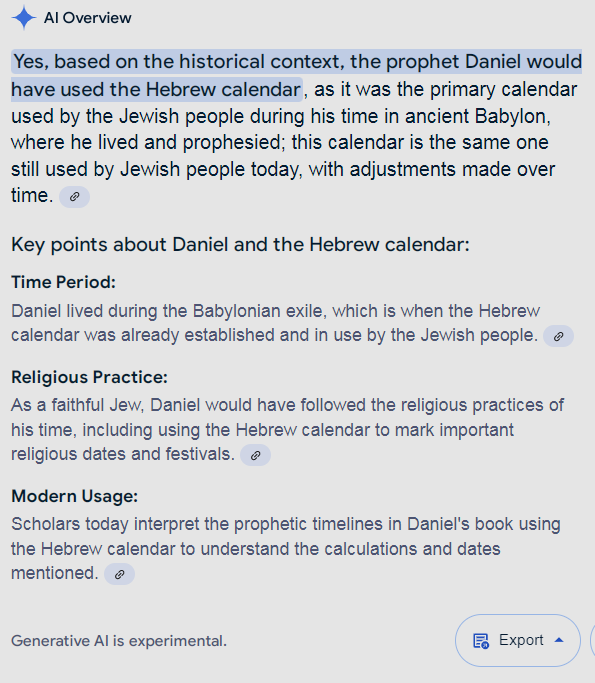
The Babylonians used a ~354 day year. The Hebrews adopted this practice. The Persians, who had been using the 360-day Old Persian Calendar, would also replace their calendar with the Babylonian calendar (at least in the West).
The Hebrews never used the 360-day Persian calendar.
During the period that Attebury is referencing, the Persians used the Babylonian calendar:
As E. J. Bickerman has shown, the Achaemenids used the lunisolar calendar at least until 459 B.C. Between 471 and 401 the Babylonian calendar was still used in Aramaic documents issued by the Persian administration (almost all found at the colony of Elephantine in Egypt).
Before the Achaemenian dynasty, which emerged in the sixth century BC, the intercalation system for adjusting the year with the seasonal changes was as follows.
In eastern Iran, each year had 360 days (12 months, each having 30 days). Then at the end of each period of six years, they inserted one intercalary month to compensate the extra 5 days of the solar year (6 x 5 = 30), and at the end of each period of 120 years, an extra month (actually two months, because 120 is a multiple of 6) was intercalated to compensate for the extra one-quarter of a day (120 x ¼ = 30).
In western Iran, there was a lunisolar calendar influenced by the Babylonian calendar. This calendar had a regular lunar year of 354 or 355 days (12 lunar months) and a leap year of 383 or 384 days.
After Babylon had been captured by the Persian king Cyrus the Great in 539, priestly officials took over. The Chaldaeans now started to look for a standard procedure for the intercalation of months. It was introduced in 503 BCE by Darius I the Great (if not earlier).
As if this was not proof enough, guess when Daniel 9 was written?
1 In the first year of Darius the son of Ahasuerus, of the seed of the Medes, who was made king over the realm of the Chaldeans;
Daniel was made the chief of the astrologers during the reign of Nebuchadnezzar (see Daniel 4:9; 5:11). He would have been in charge of the calendar as part of his duties! Thus, Daniel may well have been instrumental in establishing the Babylonian calendar both among the Hebrews and later among the Persians (since Darius established the new formal version of the 354/355 Babylonian calendar with Daniel as his advisor).
As the head of the astrologers, this goes a long way to explaining why Daniel was so concerned with precisely counting days. It isn’t hard to imagine Daniel first approving the official calendar—with 354/355 day years and well-defined leap months (according to the chart above)—before finally presenting it to Darius to be passed into law.
Had Attebury chosen the 354/355-day Hebrew or Babylonian calendar over the 360-day Persian calendar, he would have landed on a different date and his numbers would not have worked out. This is just another (incorrect) way to arbitrarily fudge the numbers.
Notably, with regards to the prophetic year as a solar year, the choice of lunar calendar and intercalation method (i.e. Hebrew vs. Babylonian vs. Persian) should be irrelevant, which is why this problem does not affect my position. The problem only affects Attebury…
…who both selected the wrong calendar (360-day instead of 354/355-day) and inserted this extraneous “conversion” in the first place.
A Note On The Prophetic Day
The prophetic day is known as the “day for a year” principle.[3] When scripture speaks of time in a prophetic sense, it often refers to “days” (1x), “weeks” (7x), or “months” (30x) of years.[4]
But how can we know if a day, week, or month is literal or if it is prophetic? While there are many context clues, the most obvious is that if a given time period of days, weeks, or months includes intercalary months, it must be speaking of literal elapsed time.
Now, you might think that there is no such thing as time in a prophetic sense, that all time is literal. Here is an example of why that cannot be the case:
Likewise, the 42 months of Revelation 13, and the 1,260 days and the 3 1/2 years of Revelation 12 must refer to a prophetic period of 1,260 years, because there is no way a literal 1,260 day period could ever be 42 months, and 42 months is never 3 1/2 years. Therefore, the time period must be prophetic, 1,260 years long.
Let’s look at the corresponding passages in Daniel:
And he will speak words against the Most High, and will wear down the holy ones of the Most High, and he will think to change the times and the law. And the holy ones will be given into his hand for a time, times and half a time.
I heard the man clothed in linen, who was above the waters of the river, when he held up his right hand and his left hand to heaven, and swore by him who lives forever that it will be for a time, times, and half a time; and when they have finished shattering the power of the holy people, all these things will be finished.
…
From the time that the regular burnt offering will be taken away, and the abomination that makes desolate set up, there will be 1,290 days.
Both refer to a 3.5 year period, but one is literal and the other is prophetic. Can you tell which is which?
The answer is simple.
It is only possible for 1,290 days to be included in 3.5 years (of Daniel 12) if you have included one or two intercalary months to adjust for lunar months on a lunisolar calendar. Consequently, 1,290 must refer to a literal number of days.
But if you are working with prophetic “days” representing literal years, 3.5 “years” (of Daniel 7) is 42 “months” is 1,260 “days” (3.5 years x 12 months per year x 30 days per month), that is, 1,260 solar years. As noted above, due to intercalary months, it’s actually impossible on the Hebrew calendar for a literal 1,260 day period to be a literal 42 months, and so 42 months is never literally 3.5 years.[4] It is prophetic.
There is other supporting evidence (including linguistic) to come to this conclusion, but you get the point.
Attebury’s interprets prophetic “day” years in Daniel’s “62 Weeks” and “7 Weeks” as if they corresponded to a total of 483 lunar years without intercalary months, rather than (1) elapsed lunar years adjusted in realtime by intercalary months (as was the practice); or (2) generic solar years. Instead, he uses a bastardized version of the two approaches: a large collection of years that was strictly lunar.
I’m unaware of any evidence in scripture that such a method was ever used in any actual practice, let alone in prophecy. For example, the period between Jubilees, as described in Leviticus 25, is seven “weeks” of years (just like Daniel’s sixty-two and seven “weeks” of years). This is 49 years.
Would we also interpret that large collection of 49 years as 49 lunar years without intercalary months? Of course not! It would be absurd to say that the interval between the Jubilees was 16 months—or 1.33 years—less than 49 solar years (after subtracting out the intercalary months), since the Jubilee is tied to a specific yearly festival: the Day of Atonement.
Just as the the Jubilee was meant to be observed every 50 solar years (i.e. implicitly including the intercalary months within the 49 years), so too was the sixty-two and seven weeks of Daniel meant to refer to 434 (62 x 7) and 49 (7 x 7) solar years, not 472.76 (62 x 7 x 360 / 365.25) + 49.29 (7 x 7 x 360 / 365.25) years. Given the fractional periods involved in the conversions, it’s rather obvious that scripture can’t be referring to lunar years. You can’t even reliably map the prophesied years onto an objective set of solar (seasonal-cyclic) years using Attebury’s approach! It’s not precise at all. You could make any date work if you just fudge the numbers a little bit more.
Sixty-Nine Weeks
Notice that Attebury has combined the 62 and 7 Weeks into a combined 69 weeks in order to perform his calculation. This is odd, because in the original Hebrew of the book of Daniel, great pains were taken to divide the 62 weeks, the 7 weeks, and the 1 week as separate entities. Only once is it referred to as the Seventy Weeks (in Daniel 9:24) and thereafter it is referred to separately each time.
Here are two examples translations of Daniel 9:25 that highlight the separation:
Know and understand this: From the utterance of the word that Jerusalem was to be rebuilt Until one who is anointed and a leader, there shall be seven weeks. During sixty-two weeks it shall be rebuilt, With streets and trenches, in time of affliction.
Know therefore and understand that from the going out of the word to restore and build Jerusalem to the coming of an anointed one, a prince, there shall be seven weeks. Then for sixty-two weeks it shall be built again with squares and moat, but in a troubled time.
Notice how the seven weeks and the sixty-two weeks are treated as separate events through the placement of a period. Contrast that with the quotation I opened with at the start:
25 Know therefore and discern, that from the going forth of the commandment to restore and to build Jerusalem to the Anointed One, the ruler, will be 7 weeks, and 62 weeks; it will be built again, with street and moat, even in troubled times.
See that weird punctuation?
You can see the same thing in the NIV:
That’s not the standard English form of punctuation. Normally you don’t use a comma to separate a list of two things. This reflects how much the translators are trying to resist the translation that separates the two units by a period.
There is a strong tendency to combine these into one unit of time, as Attebury did in order to come to his preferred calculation. The problem is that Daniel’s prophecy has a “messiah” prince arriving after seven weeks after the decree to rebuild, before the sixty-two weeks began and then a “messiah” being cut off after an additional sixty-two weeks:
26 Then, after the 62 weeks, the Anointed One will be cut off, and will have nothing, and the people of the ruler who will come will destroy the city and the sanctuary; and its end will be with a flood, and even to the end there will be war. Desolations are determined.
Remember that each week is seven years. There is a 434 year gap between the messiah prince that arrives at the end of the seven-weeks and the messiah who is cut off. It goes without saying that Jesus was not born 434 years prior to his death and resurrection.
There is nothing in the original Hebrew that demands that there is a single “messiah” that is begins after 49 years and is cut off after another 434 years. The text demands that there are two periods (7-weeks and 62-weeks) and that there are two “anointeds.”
The John Gill commentary on Daniel 9:24 says this about the seventy weeks being “determined”:
The verb used is singular, and, joined with the noun plural, shows that every week was cut out and appointed for some event or another; and the word, as it signifies “to cut”, aptly expresses the division, or section of these weeks into distinct periods, as seven, sixty two, and one.
In viewing Sixty-Nine Weeks as a combination of the Sixty-Two and Seven, Attebury joins together what God—through the angel Gabriel and the prophet Daniel—divided into distinct units.
Curiously, Attebury’s citation (from the ESV) doesn’t conflate the two time periods and it distinguishes between two anointeds!
Attebury’s own citation militates against his interpretation.
Summary
Having finished the analysis, we can now make the following statements:
First, taking Daniel 9:24-27 as a Messianic prophecy is an assumption. The text of scripture does not demand it.
Second, correlation does not imply causation. Finding any date range calculation that “works” is arbitrary and not statistically meaningful in and of itself. There is nothing “amazing” about such formulas. If anything, the existence of so many different explanations that “work” waters down the impact of any one of them merely working.
Third, there are—at minimum—five different years that can be treated as the “decree to rebuild.” Picking any one specifically requires more than the simple assertion that it must be that one in particular.
Fourth, numerology isn’t valid when the choices of which calculations to “math” and which to exclude are determined by the individual and not determined by scripture.
Fifth, Daniel was written in the context of the Book of Jeremiah (and a specific section therein), and should be interpreted with respect to that context. This has implications for selecting which “decree to rebuild” one should calculate from.
Sixth, Daniel was the chief astrologer to kings. The calendar system chosen for calculations must consider the specific calendar system that was in play at the time of Daniel’s role (i.e. the 354/355 day lunar year of the Babylonian Calendar).
Seventh, Daniel 9 was written during the reign of Darius, the very man who officially formally established the 354/355 day lunar year calendar as a matter of law within the Medo-Persian empire. Daniel, as chief to the astrologers, may have had a hand in setting up that system.
Eighth, the 360-day Persian calendar was not used by the Hebrews, Babylonians, or the portion of the Medo-Persian empire which encompassed the Jewish exile. The 360-day lunar year is an historical anachronism.[5]
Ninth, prophetic years already include intercalation implicitly because years are determined by the solar year, not the lunar year. Consequently, no lunar-to-solar correction factor can be included.
Tenth, the Hebrews used the lunisolar Babylonian calendar after the exile. Prior to the exile, their year was determined ad hoc through seasonal events that were tied to seasonal festivals (and was thus, informally, unisolar).
Eleventh, time periods in prophecy that include intercalary months must refer to literal elapsed time, not prophetic day-to-year multipliers. Similarly, long time periods (greater than 3 years) that fail to include the required intercalary months must be viewed as referring to solar years. For example, equating 3.5 years, 42-months, and 1,260 days implies a prophetic day-to-a-year principle, because 3.5 years is never 42-months or 1,260 days in a literal time period: a 3.5 year period always includes at least one intercalary month.
Twelfth, the Seventy Weeks of Daniel are split into three distinct periods: Seven, Sixty-Two, and One. It is inappropriate to combine them and treat the combination as a single period (e.g. Sixty-Nine Weeks).
In summary, all twelve of these points stand against Attebury’s claims. Consequently, we are forced to reject his position as completely untenable. The evidence against it is overwhelming.
Postscript
After I posted this article, his blog temporarily showed the pingback. He has since deleted it. I guess the truth is inconvenient, huh? What a shame.

Unfortunately, it’s not the first time:
It just goes to show that if your position or argument is threatened by the addition of information or argument, you are probably on the wrong side of the issue. Censorship is typically only required by those who have to silence their opposition because they can’t establish the truth of their statements through reason. Viewpoint censorship is, by-and-large, cowardice.
So when I asked…
…I should have allowed for the possibility of ignoring the evidence and resorting to censorship.
Alas, I should have known better. I forgot my own pledge:
I am chastised.
Further Reading
Stephen D. Cook, “Daniel’s time periods and the Lunar versus Solar Calendar debate.”
Sacha Stern, “The Babylonian Calendar and the Bible.”
Footnotes
[1] If there were a thousand different ways to come to the answer “33AD,” it would be very unimpressive for you to happen to stumble onto one of them. The chance that your one-in-a-thousand explanation happened to be the right one would be very low. But if there was only one mathematically way to arrive at that answer, it would be impressive indeed. With no alternative explanation, your case would be quite strong.
Increased variability is not desirable with regards to prophecy. It is certainly not proof of the legitimacy of the interpretation of that prophecy.
[2] There is some debate as to what specific calendar the Hebrews used prior to the exile. Some claim that the Hebrew calendar was not lunisolar, as the months were merely numbered and were twelve. However, logic dictates that the seasonal festivals that were tied to the numbered months must have been celebrated during those seasons as determined by the solar cycle. For example, the Torah required the Passover, Shavuot, and Sukkot to be celebrated during particular seasons. This means that the early Hebrews used a flexible (or non-specific) calendar tied to the seasonal events (e.g. harvest) rather than a calendar that was standardized to a fixed lunar (or solar) cycle. But, since harvest is always synchronized, however variable, to the seasons, and since the seasons are based on the solar cycle, the early Hebrews implicitly used a lunisolar calendar. Despite not being formally and precisely defined mathematically, the Hebrew year was still a full solar year long (~365.25 days per year).
Besides the absurdity of having harvest festivals in the winter, the Hebrews rather obviously didn’t have an extra harvest festival once every 32.5 years—(365.25 / (365.25 – (29.5 x 12)))—as you can’t actually have multiple harvests in the growing season of a single solar year.
The point is that whether the Hebrews used a 354, 355, or 360 day “year” on their calendar, the length of their years was 365.25, just like it was for everyone. The choice of calendar does not alter the path of earth around the sun. So if the Bible speaks of some number of actual years between two points, those years are measured in solar years. They can’t be anything else.
[3] As established in the Old Testament in Numbers 14:34 and Ezekiel 4:6.
[4] The 1,260 days comes from Revelation’s implied reference to the 3.5 years in Daniel 7, where John the Revelator—a Jew—uses his Hebrew understanding of the prophetic day within the context of the Roman calendar.
[5] As I discovered during my research, the use of the 360-day lunar year is not based on historical evidence, but rather a desire to make the text fit the calculation. This is shown here…
In this verse you can see a reference between 42 months and 1260 days
And there are other verses throughout the Bible that shows a sense of a biblical year. Such as the verse of the woman fleeing into the wilderness for 3.5 years.
…where the scriptural case for the Hebrews using a 360-day lunar year is based on internal attestation from the passages where we want to know which type of year they used (in Daniel and Revelation). Using the unknown to demonstrate what is “known” begs-the-question and is clearly circular reasoning. To demonstrate the circularity, you could just as easily say that because the 360-day lunar year doesn’t make sense, this is why the 3.5 “years,” 42 “months,” and 1,260 “days” are not taken literally, but as prophetic days-to-solar-years. The difference, however, is that the latter inference is rooted in history (both internal and external attestation), while the former is rooted in arbitrary personal selection (internal attestation only).
[6] One commentator on Timothy F. Kauffman’s blog writes that Daniel 8:14 refers to 1,150 literal days, where “evening” and “morning” refers to the evening and morning sacrifices, respectively. Thus, do 2,300 “evenings and mornings” refer to 2,300 sacrifices. Since there are two sacrifices per day, the total number of days is half of 2,300: 1,150 days. There are always new creative ways to make the numbers fit.
Even thru the early middle ages…..the popes were trying to “fix” the Roman calendar because of days not balancing right. In fact, I remember reading in a few places over my history classes in college and high school….it was a priority by the church to get it “fixed” (papal edicts, calling of the bishops, the learned to Rome to conference and try to “fix” it)
So our modern calendar that we use today probably did not come into effect until sometime during the early middle ages.
Judging the past / looking at the past by current standards and metrics……..
Yeah, you get political correctness, revisionist history, and stuff like this
Also, these biblical “mystics” should spend more time living a life worth Christ’s favor and an example to inspire, lead and teach others about Christ and the Gospel.
Jesus told everyone to be “ready” and He also stated NONE knew the time, or hour. Not the Son, nor the angels in heaven. Only the Father. Yes, he said there would be signs but those “signs” since the day Jesus ascended to heaven have been “interpreted” as fact.
The best a follower of Christ can do is to “love the Lord your God with all your mind, body and soul…and to love your neighbor as yourself” also to “Believe”
Nothing about “female nature” or “red pill” or “sex” or JFK’s assassination, or Jesus telling us a “secret code” in the Bible (which they didnt have then) to predict the end.
So many empires have risen and fallen since the time of Christ and there is always “someone” or “a group” at that time of an empires falling “Oh, I did the math, used scripture….this is means this or that”
Jesus said to be ready, and He did say He would return. That’s enough right there to prove the point after all He said and did while on earth.
Wouldn’t it be a wonderful day indeed if men worried about their own personal sin, pride, arrogance and actually followed Jesus instead of the variables.
The best a follower of Christ can do is to “love the Lord your God with all your mind, body and soul…and to love your neighbor as yourself” also to “Believe”
Nothing about “female nature” or “red pill” or “sex” or JFK’s assassination, or Jesus telling us a “secret code” in the Bible (which they didnt have then) to predict the end.
So many empires have risen and fallen since the time of Christ and there is always “someone” or “a group” at that time of an empires falling “Oh, I did the math, used scripture….this is means this or that”
Jesus said to be ready, and He did say He would return. That’s enough right there to prove the point after all He said and did while on earth.
Wouldn’t it be a wonderful day indeed if men worried about their own personal sin, pride, arrogance and actually followed Jesus instead of the variables.
YEAH, but the right-wing R side of the ” Christian Manosphere” is sure any day now the American Constitution’s 19th Amendment will be repealed, one would suppose by Trump and Vance.
Meanwhile Trump is doing this:
https://thehill.com/homenews/administration/5027243-trump-appoints-women-key-posts/
Women are set to play a key role in President-elect Trump’s administration, as he nominates and appoints a number of them to high-level posts.
Trump has so far named eight women to Cabinet-level positions — double the four initially named for his first term. His appointment of Susie Wiles to be his chief of staff makes her the first woman to hold that position in U.S. history. And he has chosen other women for high-level posts, such as press secretary and surgeon general.
The president-elect’s allies say the appointments are emblematic of Trump’s push to elevate women amid criticism about his past comments and alleged treatment of women. And they come on the heels of a historic election in which female voters were a key bloc behind his victory.
“You’re not seeing an administration that’s sort of an old boys club,” said one former Trump administration official.
The president-elect’s picks have yet to be confirmed, but his appointment of more women to his administration’s inner circle appears as part of a “quest” to build a new coalition, said Micki McElya, a history professor at the University of Connecticut.
“He’s certainly promoting more women to top jobs than he did the first time,” McElya said.
Trump has so far nominated Rep. Elise Stefanik (R-N.Y.) to serve as U.S. ambassador to the United Nations, while Linda McMahon, who served in Trump’s Small Business Administration in his first administration, has been nominated to serve as his Education secretary. South Dakota Gov. Kristi Noem (R) is Trump’s nominee for Homeland Security secretary, and Rep. Lori Chavez-DeRemer (R-Ore.) is his nominee to be Labor secretary.
Attorney and policy adviser Brooke Rollins is his Agriculture secretary nominee. Former Georgia Sen. Kelly Loeffler (R) has been picked to lead Trump’s Small Business Administration. Former Florida Attorney General Pam Bondi became his nominee for attorney general after his first choice, Rep. Matt Gaetz (R-Fla.), withdrew from consideration.
“This is still the best country and the most diverse country in the world, and you see that in his Cabinet picks, but it’s happening organically,” said Roma Daravi, former deputy director of strategic communications in Trump’s White House.
“All of these people, extremely diverse around him, you get that when you stop looking for color and gender,” she added.
But besides Gabbard, and Chavez-DeRemer, who is a Latina, Trump’s high-level female picks are largely white women — representing a critical demographic that helped boost him to victory against Vice President Harris.
BUT remember the ” ” Christian Manosphere” also preached that” game ”was going to save Marriage in-general and western civ for years then supposedly ”women(who as a sex, we are still told are little more than numbskulls-just looking for direction-”leadership” by the same self-proclaimed ”leaders”) got wise to the game”
It truly is as JESUS and his Spirit (in the OT & NT) said ”Isaiah 6:10
Amplified Bible, Classic Edition
10 Make the heart of this people fat; and make their ears heavy and shut their eyes, lest they see with their eyes and hear with their ears and understand with their hearts and turn again and be healed.”
Jeremiah 5:21
Amplified Bible, Classic Edition
21 Hear now this, O foolish people without understanding or heart, who have eyes and see not, who have ears and hear not:
Ezekiel 12:2
Amplified Bible, Classic Edition
”2 Son of man, you dwell in the midst of the house of the rebellious, who have eyes to see and see not, who have ears to hear and hear not, for they are a rebellious house.”
”Matthew 13:15
Amplified Bible, Classic Edition
15 For this nation’s heart has grown gross (fat and dull), and their ears heavy and difficult of hearing, and their eyes they have tightly closed, lest they see and perceive with their eyes, and hear and comprehend the sense with their ears, and grasp and understand with their heart, and turn and I should heal them.”
”Acts 28:27
Amplified Bible, Classic Edition
27 For the heart (the understanding, the soul) of this people has grown dull (stupid, hardened, and calloused), and their ears are heavy and hard of hearing and they have shut tight their eyes, so that they may not perceive and have knowledge and become acquainted with their eyes and hear with their ears and understand with their souls and turn [to Me and be converted], that I may heal them.”
”Romans 11:8
Amplified Bible, Classic Edition
8 As it is written, God gave them a spirit (an attitude) of stupor, eyes that should not see and ears that should not hear, [that has continued] down to this very day.”
In light of all those Scriptures(& knowing the ”Christian Manosphere” barely likes JESUS or his Gospel), one can easily see why some(namely that Chesterson fellow) at DAL’ called GBFM quoting Scripture ”noise” huh?
I remember those days “red pill” and “game” before it were going to make men “men again” and bring “women” to the table or understand their foolishness.
I remember a few weeks after Sept 11, “El Rushbo” was telling his sycophant followers that those horrid attacks has “killed” feminism once and for all.
“All those brave men running into The Towers to rescue people, women finally will understand and will respect men all for all they did that day. Feminism is over!”
He also said “The Millennial” generation was “very, very conservative”
He also still wanted “hard jail time” for drug addicts even after his OWN addiction to those awful painkillers.
When Trump gave him that “congressional medal of freedom” shortly before he died, I asked “for what? he was a radio talk show host, and did pioneer and revitalize an otherwise dying genre, even back in the 1990’s…..what did he do? Saved dying men in his platoon? Above and beyond the call of an average citizen civics wise? No, he bragged constantly on how right he was……when in fact, he was indeed more wrong than right.”
I lost “conservative” friends when I stated that.
It would be like Biden giving Rachael Maddow that award if truth be told.
Who talks about Rush now? No one. People still talk about Edward R Murrow and Walter Cronkite (my dad called him “Pinko Cronkite” back in the day, lol!) . That whole staging was done to just rub Pelsoi’s nose in it.
At this rate, we’ll be giving Hannity, Dave Ramsey the medal…..while we’re at it, lets dig up ol Chet Huntley and give him one too!
As for women in his Cabinet, whatever…………like he doesnt have a choice really.
Nonetheless, it is an “I told you so” moment towards all those people who criticized people like me for refusing to vote for Trump.
True, but dont expect “I see why Derek didnt vote” statements. Expect to see a “doubling down” on why Trump is pro men, red pill, is a real masculine man, and is going to “fix” everything
And if he doesnt or cant….well, these guys now can blame the “women” in his cabinet messing up everything. They will defend him to the hilt on everything. They honestly think he is “chosen” by God and is a devout “real christian” despite all the evidence contrary to that.
Wait, he marched a “pro life” rally for 30 seconds! “Thats our guy”
And if he doesnt or cant….well, these guys now can blame the “women” in his cabinet messing up everything. They will defend him to the hilt on everything. They honestly think he is “chosen” by God and is a devout “real christian” despite all the evidence contrary to that.
YEAH!
You know ”RP Geniuses” say this too for themselves and their highly non-successful sites?
As seen here:https://sigmaframe.wordpress.com/2024/07/05/red-pill-roadmap/
Can’t agree? Then get back to the basics!
Readership: All, especially Christians
Theme: Problems with The Red Pill / Infighting / Sectarianism / Socio-Political Misappropriation
Author’s Note: Based on email correspondence between Jack, NovaSeeker, and Thedeti between 2019-2021.
Length: 1,500 words
Reading Time: 8 minutes
Critical Navigating
In response to The Mechanics of Sectarianism within The Christian Red Pill (2024/7/3), Thedeti said,
“I don’t find discussions or topics like these to be helpful or productive.
In my view, the only pertinent inquiries are…
“Is the matter asserted true or false in light of all available evidence and circumstances, including scripture, tradition, experience, and reason?”
“Is the matter or proposition beneficial or detrimental to a man, to men, to his family, or to society, in light of scripture, tradition, experience, and reason?”
God gave us love, power, and sound minds. We’re invited to gather together as men and “reason together”. He did not ask us to leave reason and experience at the door when He called us to Him.”
The questions posed by Thedeti are what each man should be asking himself whenever consuming content. Here we’re referring specifically to Red Pill stuff, but it goes for anything really; listening to a sermon, reading the news, watching YouTube, and so on. A man should always be filtering the information that he takes in, sorting out what is good / relevant / true / useful, and what is not.
But as NovaSeeker and I described in the previous post, when men begin to discuss these topics amongst themselves, there is often a phenomenological misunderstanding which prevents meaningful communication.
”Back in 2021 when we were first discussing this gridlock, I couldn’t identify why the rhetorical boat kept toggle-locking and capsizing despite our best efforts — why minds could not meet — not even enough to identify exactly what it was that we were disagreeing about. Comboxes resembled bumper car derbys rather than a caucus of wise intelligent Christian men.
At the time, I guessed that it was female commenters hijacking threads with volatile notions — or legalism, as in, people are operating out of their heads, and not their hearts; people are rather quick to judge, and that puts a damper on the introspection and honesty. But since then, most of the female regulars have ceased commenting and although there is indeed some legalistic judgment going on, I’ve come to see that the more basic reason why minds cannot meet is because there are some outstanding incongruences of awareness / orientation that are based on certain fundamental assumptions.”
See how Ame(2021 only as she said at her site she got sf off of her WP reader after the gay porn post there), Liz, and Elspeth were supposedly blocking Jack’s geniuseness , communication and english skills?