
I’ve been writing a lot about mystical experiences recently. In particular, I’ve noted (here and here) that supernatural events have two possible sources: God or demons. It is simply not true that only God can grant the experiences that you have prayed for. Demons can, and do, grant miracles and endow powers. This is plainly the teaching of scripture:
Not everyone who says to me, ‘Lord, Lord,’ will enter into the Kingdom of Heaven, but the one who does the will of my Father who is in heaven will enter in. Many will say to me on that day, ‘Lord, Lord, did we not prophesy in your name, and cast out demons in your name, and do many mighty works in your name?’ And then I will declare to them, ‘I never knew you. Away from me, you who work lawlessness!’”
In Acts 9, you read about Simon the sorcerer who had great powers before he believed. In Acts 19, you read about the traveling Jewish exorcists who finally met a demonic spirit who didn’t respond the way they expected.
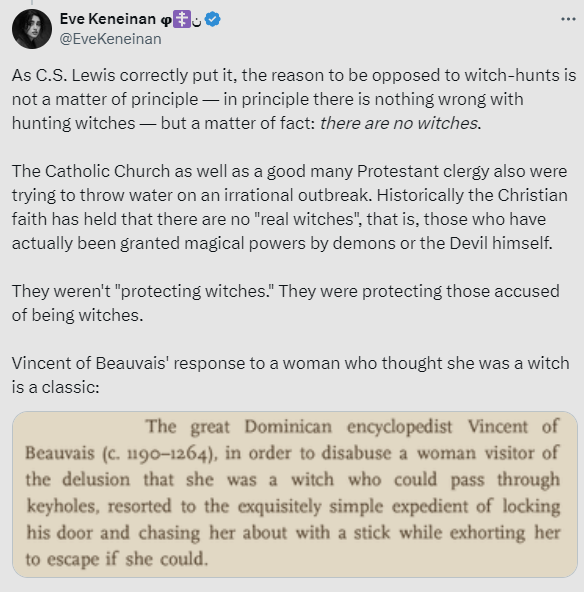
So, I was today-years-old when I discovered that there are people who believe that all real instances of the miraculous come from God and that everything else is counterfeit, illusion, and fraud:
Didn’t the Pharoah’s magicians turned sticks into snakes or something like that? So, there are “things” out there that do have power and are not of God.
And you mentioned witches. I have to…I just have to. From 1974
https://www.youtube.com/watch?v=X2xlQaimsGg
Yup. People just say things.
Also, I enjoy that movie quite a bit.
I find it ironic that some of the people in that movie went on to be typical leftists who would never make a movie like that.
John Cleese (who was the brains behind it) lives in the British Virgin Islands now. Is very left, and laments “Britain is funny anymore” and his stances are actually the reason why it isnt
I’m less into popular culture, but the scientific equivalent to John Cleese is Richard Dawkins. His objection to transgenderism is ironic, in light of the fact that his subjective morality from his scientism and humanism have led to the very thing he now opposes.
Witches is a difficult term because it has different meaning depending on age mostly. I think of witch and think of fiction, or Halloween. However, in our pagan culture, it often means an earth-firster, intentionally pagan woman.
What Jason said is also true, people get demonic powers and I guess a woman who does so would be called a witch.
I don’t think they believe in witches either, because the logical counterpart would be wizards, but they all love movies and TV dramas with young hot guys being a vampire or werewolf. Somehow, wizards are always old guys and witches are almost always pretty.
Wizards are popular in fiction, where the sources of magic are often identified as some sort of natural force of nature (e.g. Brandon Sanderson’s magic systems) or genetic heritage (e.g. Harry Potter). Only occasionally (e.g. Lord of the Rings) are magic systems associated with the analogs of angels and demons, and its generally clear which is which.
But the point is, it isn’t the supernatural that makes it wrong, it’s the association with the demonic. A Christian and a pagan can perform the same miracles, but only one can be a witch, because it is the source that matters, not the “magic” itself. In pop culture, wizards are more often considered “good” while witches are more often considered “bad.”
In the Bible, it says that the Pharoah’s magicians did this act. Witch? Wizard? Shaman? Even King Nebuchadnezzar had his “prophets, wise men, priests and soothsayers of the court” to try to figure out his dream
I remember in the 1970’s “Mister Rogers” had the actual “witch” from “The Wizard of OZ” on his show to explain that she isnt a witch, “it was just pretend and a story”
I watched the clip and ol Fred Rogers really just knew how to explain things to children. It was such a good time to be a boy back in the 1970’s.
https://www.youtube.com/watch?v=Oglo3iUYFPY&t=11s
Witches have now moved of course to the overtly sexualized trappings of “Charmed” and other movies and popular shows. Even in a “Halloween” sense I saw somewhere in the 1990’s it moving from a “kids fun / teen” thing to adult costumes accepted on a wide scale and of course “sexy” costumes for teenage girls now. You say anything about it, the culture calls you a “prude” and “its just a costume”
These comments dont come from women mostly, they come from Red Pilled Men.
Anyway, a “witch” is a broad term now. The pointed hat and riding on a broom and cartoonish images and fun from the 1970’s is now “real” I guess and of course…..overtly sexual. No old crones anymore.
Witches have now moved of course to the overtly sexualized trappings of “Charmed” and other movies and popular shows. Even in a “Halloween” sense I saw somewhere in the 1990’s it moving from a “kids fun / teen” thing to adult costumes accepted on a wide scale and of course “sexy” costumes for teenage girls now. You say anything about it, the culture calls you a “prude” and “its just a costume”
These comments dont come from women mostly, they come from Red Pilled Men.
Yeah which is why its very zllolzzollzzzing hearing latter-day Redpill Men take credit for ”warning everyone of the lavender mafia’s sexualization of children & the rest of society,when you know they were part of Limbaugh’s ”everything is going Conservatively splendid” & pooopooed Doc Savage as ” from what I hear others say about him(as I never listen to him even though some of my topics now are d@mn close to being like his) he is a an insane sounding ”kook”” back when that book ”101 People Who Are Really Screwing America (and Bernard Goldberg is only #73)” by Jack Huberman(who wished that Savage was more ”gentlemanlyzlolzz” like Limbaugh) came out and that author was on his radio show in Summer 2006.
But as stated here at Wikipedia(that contradict latter-day barely existing ”red pill”lore):
United States
As early as 1997, reports found that sexualization of younger children is becoming more common in advertisements.[28]
The causes of this premature sexualization include portrayals in the media of sex and related issues, especially in media aimed at children; the lack of parental oversight and discipline; access to adult culture via the internet; and the lack of comprehensive school sex education programs.[29]
In 2007, the American Psychological Association (APA) first published Report of the APA Task Force on the Sexualization of Girls, which has had periodic updates. The report looked at the cognitive and emotional consequences of sexualization and the consequences for mental and physical health, and impact on development of a healthy sexual self-image. The report considers that a person is sexualized in the following situations:
A person’s value comes only from his or her sexual appeal or sexual behavior, to the exclusion of other characteristics;
A person is held to a standard that equates physical attractiveness (narrowly defined) with being sexy;
A person is sexually objectified—that is, made into a thing for others’ sexual use, rather than seen as a person with the capacity for independent action and decision making; and/or
Sexuality is inappropriately imposed upon a person.[4]
Research has linked the sexualization of young girls to negative consequences for girls and society as a whole, finding that the viewing of sexually objectifying material can contribute to body dissatisfaction, eating disorders, low self-esteem, depression, and depressive affect. Medical and social science researchers generally deployed “sexualization” to refer to a liminal zone between sexual abuse and normal family life, in which the child’s relationship with their parents was characterized by an “excessive”, improper sexuality, even though no recognizable forms of abuse had occurred. The American Psychological Association also argues that the sexualization of young girls contributes to sexist attitudes within society and a societal tolerance of sexual violence as well as that consumerism and globalization have led to the sexualization of girls occurring across all advanced economies, in media and advertisements, to clothing and toys marketed for young girls.[4]
The APA cites the following as advertising techniques that contribute to the sexualization of girls:[4]
Including girls in ads with sexualized women wearing matching clothing or posed seductively.
Dressing girls up to look like adult women.
Dressing women down to look like young girls.
The employment of youthful celebrity adolescents in highly sexual ways to promote or endorse products.
The APA additionally further references the teen magazine market by citing a study by Roberts et al that found that “47% of 8- to 18-year-old [girls] reported having read at least 5 minutes of a magazine the previous day.”[30]
A majority of these magazines focused on a theme of presenting oneself as sexually desirable to men, a practice which is called “costuming for seduction” in a study by Duffy and Gotcher.[31]
Studies have found that thinking about the body and comparing it to sexualized cultural ideals may disrupt a girl’s mental concentration, and a girl’s sexualization or objectification may undermine her confidence in and comfort with her own body, leading to emotional and self-image problems, such as shame and anxiety.[4]
Research has linked sexualization with three of the most common mental health problems diagnosed in girls and women: eating disorders, low self-esteem, and depression or depressed mood.[4]
Research suggests that the sexualization of girls has negative consequences on girls’ ability to develop a healthy sexual self-image.[4]
In 2012, an American study found that self-sexualization was common among 6–9-year-old girls. Girls overwhelmingly chose the sexualized doll over the non-sexualized doll for their ideal self and as popular. However other factors, such as how often mothers talked to their children about what is going on in television shows and maternal religiosity, reduced those odds. Surprisingly, the mere quantity of girls’ media consumption (television and movies) was unrelated to their self-sexualization for the most part; rather, maternal self-objectification and maternal religiosity moderated its effects.[32]
A result of the sexualization of girls in the media is that young girls are “learning how to view themselves as sex objects”.[3] When girls fail to meet the thin ideal and dominant culture’s standard of beauty they can develop anxieties.[3] Sexualization is problematic for young children who are developing their sexual identity as they may think that turning themselves into sex objects is empowering and related to having sexual agency.[10]
Products for children
Some commercial products seen as promoting the sexualization of children have drawn considerable media attention:
A number of doll lines have drawn controversy. The original Bratz Dolls, marketed to children as old as 12, were considered by at least one preteen to be “sexy” and were noted for their more mature styles such as shrunken sweaters, shredded jeans, and other suggestive clothing. They were noted in a New York Times article to “look as though they might be at home on any street corner where prostitutes ply their trade.”[33] Bratz Baby Dolls marketed at 6-year-old girls that feature sexualized clothing, like fishnet stockings, feather boas, and miniskirts also advertised fashion similar to that of the mainline “Bratz” line.[3] The My Scene Barbie line, aiming for children in the 8-12 age demographic as the answer to the Bratz line, also drew criticism as the dolls wore low-rise pants, revealed the navel, and wore lots of makeup.[34]
Highly sexualized and gendered Halloween costumes marketed at young girls, such as the “sexy firefighter”, a costume that consists of a tight fitted mini dress and high heeled boots. A girl’s version of a policy officer costume also designed similarly.[35] Costumes made for somewhat older girls, such as those around ten-years-old, may be much shorter in length. Comparing and contrasting similar costumes designed by pre-tweens and tweens, the differences in costumes for the somewhat older girls was so dramatic that one observer noted that “According to the costume manufacturers of America, once a girl child reaches double digits, it is officially time for the Halloween hoochification process to begin.”[36]
Thong underwear designed by Abercrombie & Fitch made specifically for ten-year-olds. Released in 2002, the thongs were “adorned with the images of cherries and candy hearts and also include the words “‘kiss me’” and “‘wink, wink.’” While a company spokesman specifically stated that the thongs are not appropriate for children younger than ten, the thongs may have been small enough for girls as young as seven-years old to wear.[37] Despite the controversy, at least some of the thongs were sold; one Abercrombie clerk stated at a mother bought thongs for both of her daughters, who looked to be ten or younger, because all the others girls in their class had at least one.[38] While the Abercrombie & Fitch thongs were eventually pulled, girls aged 10 and 11 wearing thongs in primary school became a regular enough occurrence in at least English school that the headmaster sent a letter asking parents to not allow their daughters to wear them.[39] In France, also in 2003, girls, some of them ten-years old, revealed whale tails on their way to school by exposing their thong underwear above their pants.[40]
Clothing such as T-shirts being marketed for young children in preschool and elementary school with printed slogans like “So Many Boys So Little Time.”[10] Other examples include the retailer Big W selling T-shirts for young girls with the slogan “nice baubles” in 2014 and the UK-based company Twisted Tee selling t-shirts that had nipple pasties. Some onesies also drew controversy. A Target onesie made for baby girls with the phrase “I only date heroes” and a TinyHaute Couture creating a cotton onesie for babies that had designs of a lace corset on it.[41]
Clothing originally aimed at young adult women marketed to tweens. Advertised to tween girls since at least the year 2000,[42] low-rise jeans, tight-fitting miniskirts,[43] and shirts that expose the midriff,[44] once worn predominately by young adult women, became core fashion staples for many American tweens in the 8-12 age range in the 2000s.[45][46] These styles, sold across the country, were so popular at one point that finding other styles for preteen girls became a difficult task for parents.[47]
Padded bras on bikinis aimed at seven-year-old girls. The bikinis were pulled after complaints in 2010. [48] While made for girls slightly older, previously, in 2006, an Australian Target began selling a lightly padded Target brand bra designed for girls as young as eight-years-old.[49] However, there is also evidence that with the mean age of puberty declining in Western cultures, a higher percentage of preteen girls will have enough breast development to justify wearing a functional brassier than ever before.[50]
The Scottish Executive report[18] surveyed 32 High street UK retailers and found that many of the larger chains, including Tesco, Debenhams, JJ Sports, and Marks & Spencer did not offer sexualized goods aimed at children. The report noted that overall prevalence was limited but this was based on a very narrow research brief. Whilst this shows that not all High street retailers were aiming products deemed sexualized by the researchers, the research cannot be taken out of context and used to say that there is not an issue of sexualization.
Where were all the loudmouth ”rp””leaders” then?
Quietly being chicken$#its in their churches, homes, workplaces, schools & courts like they also do now as loudmouth ”rp””leaders” in the sphere(with just a tad more hatred of and ”dealing with” of ”other” MEN-which they actually turn down in the sphere TBH as I also SMH).