
This is part of a series. See the index here.
Hypergamy and polygamy are related terms that originally referred to marriage. Hypergamy, as traditionally defined, is marrying up into a higher caste and polygamy is having more than one wife at the same time.
These days even monogamous marriage is on the decline. It is now sometimes useful to refer to hypergamy and polygamy in terms of attraction, selection, and mating (without respect to marriage). Thus, we can discuss the underlying behaviors without the (decaying) marital framework.
In my series on hypergamy, I’ve portrayed all types of serial or plural fornication and extra-marital sexual activity as a kind of polygamy in the same way that others refer to hypergamy in non-marital terms. Modern humans are unofficially practicing polygamy (and divorce) in everything but name.
Now, what happens if you think about hypergamy and polygamy as risk factors? Let’s explore that idea further.
It’s known that circa all mental issues correlate positively, and thus one can speak of a general index or factor of psychopathology (called p).
Fewer people know that the same is approximately true of physical diseases too. They too correlate positively, so one can get a general physical health factor.
And these two factors from the two domains are also a bit correlated. Many people have been talking about the links between mental issues and auto-immune disorders for decades, but is this just part of the general pattern and not special?
Curiously, two papers recently saw the light of day. Nearly identical titles. Only overlap is Samuele Cortese.
It is well-known that mental pathology comes in clusters. People who have one mental illness are much more likely to develop multiple mental illnesses over their lifetime than people who have no mental illness.
Something similar is true of physical pathology. Someone who is susceptible to a particular disease is more likely to be susceptible to a different, unrelated disease than another person who is not susceptible to that first disease.
But these categories are also correlated with each other. Someone with a physical health pathology is more likely to have a mental health pathology (and vice versa). Pathology likes to show up in clusters, whether serially or at the same time.
This would seem to analogize to illicit sexual ‘pathology’: serial monogamy (i.e. fornication and hypergamy) and polygamy (having sexual relationships with multiple partners). We can speak of the factor of psychopathology ‘p’ and the factor of physical pathology ‘d’, so why can’t we speak of a factor of illicit sexuality?
In fact we do. It is called the n-count (or ‘body count’). Unsurprisingly, people with high body counts are more likely to have a mental health diagnosis—a higher ‘p’—and they are more likely to suffer from physical disease—a higher ‘d’—especially with respect to STDs.
Remember this from “Upon Further Examination: Hypergamy?”
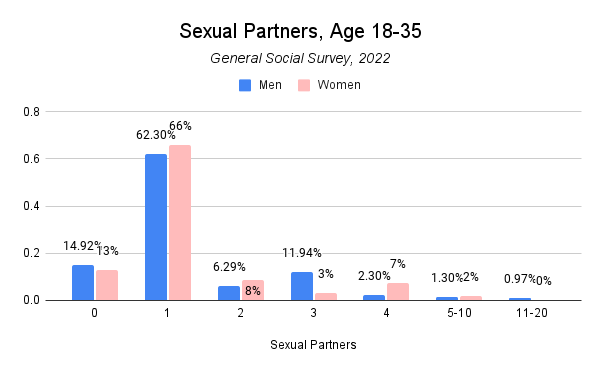
Most people are sexually active (and the GSS also shows that most sex occurs within committed relationships, see: How Many Sexual Partners Did Men and Women Have in 2022?). Additionally, a similar percentage of men and women are sexually inactive. This leaves the remaining 20% in a mating pool with one another. An additional percentage (perhaps 6-10% based on the distribution above) may accumulate an additional annual partner through serial monogamy; these are people who have switched from one committed relationship to another within the span of a year. This leaves the remaining 10% of men and women in a mating pool with one another.
These figures are consistent with what STD/STI epidemiologists have called the “promiscuous 10%” (Bellis et al., 2004; Álvarez-Dardet & Ashton, 2004). This is the simple observation that 10% of the population (men and women both) become sexually active younger and have significantly more sexual partners than the bottom 90%.
It is well known that the risk of illicit sexual pathology (including divorce) is significantly higher among those with positive n-counts that include anyone other than their one-and-only spouse. Like mental and physical pathology, sexual pathology comes in clusters: non-random clusters. Hypergamy, fornication, polygamy, and divorce all cluster among those (or their partner) with a high factor of illicit sexuality ‘n’.
To avoid the clustering problem, single men and women who have non-zero factors of illicit sexuality ‘n’ should refrain from entering into marriage and be celibate for life.
Now, as far as psychopathology and physical pathology go, it would be interesting if future research would look at the correlation between those two and a high n-count. Should people with greater susceptibility to mental and/or physical illnesses avoid marriage? Probably!
Back when marriages were arranged, parents would automatically avoid such bad matches. Anyone with a personal (or even family) reputation for sexual promiscuity, bad health, or mental illness would likely not end up being selected for an arranged marriage.
These days it is up to men to ‘arrange’ their own marriages. This, of course, is working out rather poorly. It the absence of formal arranged marriage, single men (and women) are pretty bad at picking their own mates (while remaining virgins before marriage). Humans have evolved to have arranged marriages and its easy to see what happens when that is abandoned.
I wonder if the Manosphere has always just been spinning its wheels trying to solve this problem. I’m not convinced that there is a solution beyond bringing back arranged marriages. This itself is an insurmountable hurdle, but at least it has the benefit of having a proven track record. Little else does.
Even if, for sake of argument, we accept that hypergamy is a real phenomenon, by the time this becomes a problem for men of the ‘sphere, it is far too late to do anything about it. All the effective “interventions” must occur far earlier in the process.
It is some irony, then, that “I kissed dating goodbye” ultimately failed. This was a somewhat successful attempt to solve the problem at an earlier point in the relationship pipeline. Rather than abandoning that, we should have built upon it. After all, if you want to bring back parental arranged marriages, it’s a good starting point to teach young people how to arrange a marriage for themselves. Instead of fixing the simple problems with “purity culture,” it was abandoned entirely.
Even if, for sake of argument, we accept that hypergamy is a real phenomenon, by the time this becomes a problem for men of the ‘sphere, it is far too late to do anything about it. All the effective “interventions” must occur far earlier in the process.
It is some irony, then, that “I kissed dating goodbye” ultimately failed. This was a somewhat successful attempt to solve the problem at an earlier point in the relationship pipeline. Rather than abandoning that, we should have built upon it. After all, if you want to bring back parental arranged marriages, it’s a good starting point to teach young people how to arrange a marriage for themselves. Instead of fixing the simple problems with “purity culture,” it was abandoned entirely.
Even if, for sake of argument, we accept that hypergamy is a real phenomenon, by the time this becomes a problem for men of the ‘sphere, it is far too late to do anything about it. All the effective “interventions” must occur far earlier in the process.
WHAT about the REAL phenomenon of alpha fux & beta bux,let alone like what Anonymous Commenter ALWAYS,ALWAYS ,ALWAYS says ”WE NEED TO TELL MEN ”YOU’RE NOT GBFM NOR ROISSY LADZ NOR PUT THE LIMITZ OF HYPERGAMEY ON DA WIMMINZ LIKE THEY ALWAYS,ALWAYS,ALWAYS DO, EITHER!!!”?
Speaking of which is this post from 2010!:
https://heartiste.org/2010/08/27/the-limits-on-hypergamy/
The Limits On Hypergamy
Aug 27th, 2010 by CH
Via Randall Parker, here is a study of birds showing that less attractive female birds choose equally unattractive mates.
Less-pretty female house sparrows tend to lower their aim when selecting a mate. Addressing the lack of studies on condition-dependency of female mate choice, researchers writing in the open access journal BMC Evolutionary Biology found that female sparrows of a low quality prefer males of an equally low quality.
Researchers from the Konrad Lorenz Institute for Ethology in Vienna studied sexual selection preferences in the common house sparrow. Though it has always been assumed that females will want to choose the best possible mate, in terms of reproductive and genetic fitness, Matteo Griggio and Herbert Hoi have found that, in fact, unattractive females dare not dream of mating with males who are considered out of their league. […]
“Actually, we found that overall, female sparrows don’t have a preference for badge size in males”, Griggio explains, “but we did find that less attractive females – those with a low weight and poor condition – have a clear preference for less attractive males with smaller or average-sized badges”. Rather than not find a partner, unattractive females will simply settle for an unattractive male.
Griggio continues: “There is some good news for the plainer females though – while they may be forced to settle for less dominant males with small chest badges, these males have been shown to invest more time in parental care than their good-looking counterparts.”
We here at the Chateau write a lot about female hypergamy, as it is a powerful motivating force in shaping the dating market and, ultimately, influencing your own success or failure with the opposite sex. Female hypergamy gets short shrift in studies and in popular culture because it is one of the uglier truths about women’s natures. Since gender is one of the four pillars of protected PC classes holding up the high church of leftist blank slate theology — right behind race but trumping homosexuality and any-religion-that-isn’t-Christianity — it makes sense that our commissars of media agitprop would work hard to avoid having to touch the subject of female hypergamy.
But we touch it here! And grope and fondle it lasciviously. That’s why it’s worth mentioning that even hypergamy must occasionally bow to the restrictions imposed on free market choice by female mate value. Although the above study is of birds, some parallels can be drawn to human behavior; parallels which are corroborated by real life experience. Women may loathe the idea of settling, but many of them do, as you can readily see by walking out your door and noticing all the ugly ass couples canoodling like they really enjoy the prospect of fornicating with each other.
Like the female house sparrow, less attractive women may deliberately avoid dating higher quality men in favor of beta males for a number of reasons:
Less attractive women sacrifice too much to keep an alpha male around. There are plenty of couples where a much better looking man invested absolutely nothing into a skewed relationship and got all the sex he wanted in return. This might be fun for the plain jane for a while, but I’m sure the thrill wears off after a few months, (or years, if she’s truly deluded about her own value).
Less attractive women figure they don’t have a shot, and so don’t bother flirting with alpha males. Call it the Sour Grapes Syndrome; a homely chick insists she prefers niceguys or nerds to the exclusion of those “meathead jocks” or “douchebags”, but in reality she is simply rationalizing her limited options. Sour Grapes Syndrome explains why ugly chicks don’t commit suicide en masse.
Less attractive women have to make a trade off that more attractive women don’t. A hot babe can land *and* keep an alpha male around to help her raise her young, but a homely chick has to decide between a one night stand with a horny alpha who will be embarrassed by his slumming the next morning and a relationship with a beta who will lavish more caring attentiveness on her and any brood she may have with him.
Less attractive women like to feel they are better looking than what their partner normally gets. This is a power law of mating dynamics. We all want to leverage our power in the dating market to the hilt, and a relationship where there is a big imbalance in power sharing is inherently unstable. Homely chicks know, either through experience or instinct, that dating alpha males results in a huge power differential that will almost always result in a breakup with her in tears. So she avoids dating alphas when it’s time to get serious about landing a committed man. Homelier women are smart to do this; studies have shown that the strongest relationships are ones where the woman is better looking than her partner. When a women feels pretty in the context of the man she is with, she will be happier… as long as the man keeps up his end of the bargain by having higher social status and/or game.
Note that none of the above reasons should imply that female hypergamy is rendered null and void for unattractive women. Human females are a little more complicated than house sparrows. In real life what we see are homely girls giving hypergamy the ol’ college try until their options, and their ability to stoically endure continual pump and dumps, are exhausted. This often plays out in practice with the widely observed phenomenon of urbanized 4s, 5s, and 6s suffering a series of humiliating short term flings with men well above their level during their 20s, followed by a grudging acceptance of the utility of settling for the boring beta male in their later 20s and 30s.
Seduction artists who like to dumpster dive (and really, you should probably turn in your PUA card if you prefer taking the easy road to low quality pussy) should continue treating the playing field as if female hypergamy was in full effect all the time, because most homely chicks — even the married ones — can’t resist getting used like a disembodied hole by a superior man.
& the ALWAYS,ALWAYS,ALWAYS as Anonymous Commenter likes to say tasteful commenters & comments in the comment section(as usual)
greatbooksformen GBFM(this was before he had the other ways of saying GREAT BOOKS FOR MEN)on August 27, 2010 at 7:59 pm
i recall dose alpha fux to beta bux
i was benrnake’s fav. hottie back in the day
losta cocka in my gina and lotsa cocka i sux
now it’s juts me and my cats every day.
lzozozzlozozozzlzl buthex
greatbooksformen GBFM on August 27, 2010 at 8:01 pm
“Bling Bing
“find the most suitable husband at the earliest age – but most women reject it.”
Maybe to most women and men it is not just about youth and beauty?
”
lozozozozozlzlz
yah, maybe to womenz its more about lotsa cocka and butthex and sevctive taping of butthes withh is why power womenxz promote and publish and por teh lies of buthexers and secrteiev tapers of butthex iwthout the girtlths ocntentnt.
when women get empowere not only are we ruled by gina tingles, but anuth tingleths too lzozlzozzozozozozozz
Oh yeah, does DEREK have anything to say on the Ericka Kirk’s ”NEVER DATING” stuff in light of “I kissed dating goodbye” & “purity culture” as i know that that Anonymous Commenter fellow would ask/tell DEREK ”DOESN’T THAT PROVE HYPERGAMEY IS IN EVERY WOMAN?”
lol Erica Kirk.
Woman lost her husband. I wont attack her odd behaviors since that horrible day. And there have been many odd behaviors
What I will say is:
Strange………that she was on a Reality Show drinking, partying, and being a flirtatious woman with men. She will say “oh that was just acting, and Reality Shows are not real-life”
Okay. Can buy that to a point. Knew Andrew Firestone in San Francisco when he was on “The Bachelor” in 2002 / 2003. A “reality show”. He lived down the street from me. No, we were not friends, nor did we share secrets, but was at his place a few times to party, hang out. We would meet in the neighborhood (Cow Hollow / Marina) and he would say “Hey, party tonight at my place. Come by?!”
He mentioned about the show “dont believe everything you see on that show, but believe me when I say those, I f*cked all those women. All of them. I have the pantie collection to prove it”
I just rolled my eyes at the time. Years later, after living in LA, I did believe him. The behaviors of young / younger women for any clout, TV/ Internet views, clicks, fame…….and seeing firsthand how all their “rules” for dating went out the window when it was a lean jawline, good looks, good hair and height and of course connections / fame / wealth
A Miss Arizona. Connections all over the place. A gazillion opportunities to actually be around very handsome, above average looking men her own age…..and then……settles for Charlie kirk, who is articulate isnt unattractive by any stretch….but hardly matches what she was running around with. Including her two previous boyfriends (which she never had evidently)
And curious enough no pictures of her anywhere “ever” pregnant. None.
The timelines she has repeatedly claimed from meeting Charlie to the wedding……just. dont. line. up. Especially with the other two boyfriends (which she never had)
I dont think she ever really liked Charlie to be honest. He in the end probably became the “safe” guy (gasp!!!!! A BETA!!!!!!!!) especially after the life she had in modeling, and TV and everything else.
I cant blame her really, and Charlie…..lets be real here. He had no swimsuit models, or Miss Arizona’s, or hot college aged girls fawning over him even when he was winning debates on college campuses.
Most of this now to me, isnt adding up. The math isnt mathing and I think there is more to come sadly out of all of this.