
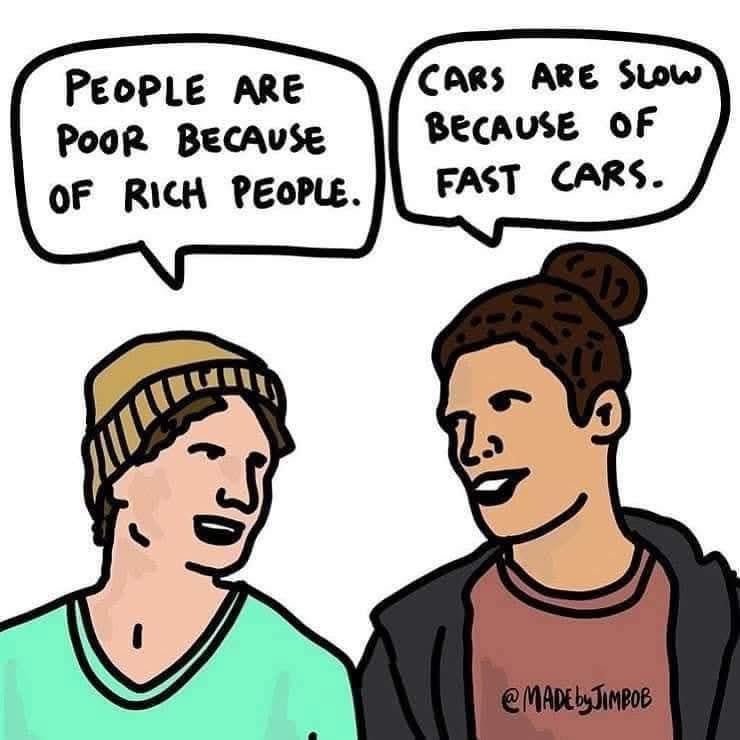
The following is what happens when you ignore the reality of genetic influences on populations:
one of the best gifts you can give your child is one of the simplest, and completely free (in terms of money)
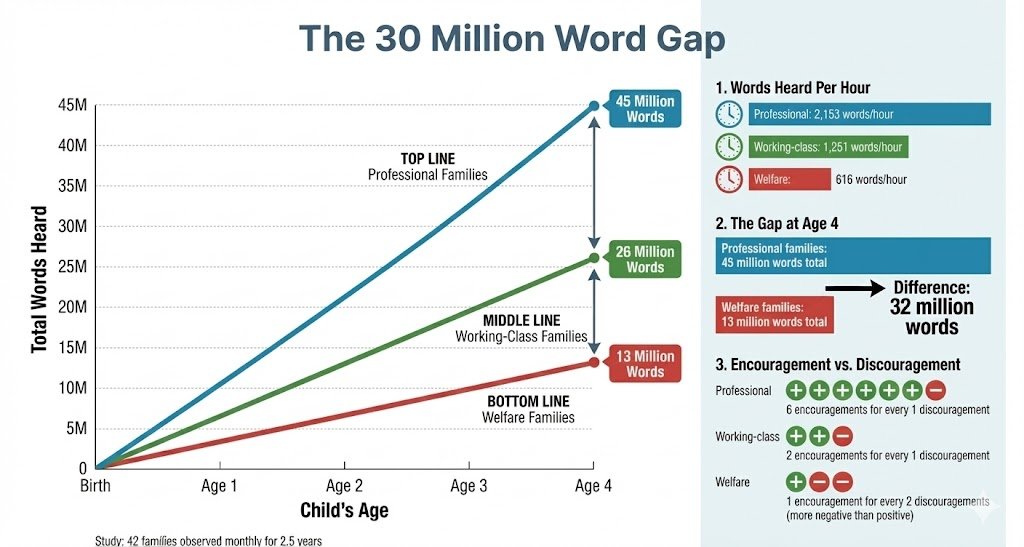
the “30 Million Word Gap” study is one of the most cited pieces of research in early childhood education
researchers followed 42 families for 2.5 years, recording every word. by age 3, children in professional families had heard 45 million words. kids in poverty: 13 million
the ramifications are long-lasting. even at ages 9-10, the kids exposed to more words had stronger language skills, vocabulary, and reading comprehension
there is also a socioeconomic disparity here. the good news is, this may be solvable by simple talking more! the bad news is, it may be harder than it sounds. perhaps the disparity exists in the first place because low-SES parents focus more on making ends meet than talking to their kids
so to summarize — you should be talk-maxxing as much as you can! narrate your day, respond to their babbling, read to them. talking is all you need
I’ve raised five children in the same nurturing environment. I’ve incessantly “talk-maxxed” them all. Nevertheless, the verbal ability of those five children on a variety of standardized tests is, as predicted, perfectly correlated with their IQ scores. No matter how many words they are exposed to, what parenting techniques are used, or how much money they have access to, their relative ordering will remain invariant.

The blankslatist myth is that poverty drives disparity.
Philadelphia ranks 92nd out of the 100 largest U.S. cities in educational attainment. 17.4% of adult Philadelphians—an estimated 225,000—do not have a high school diploma, compared to 10.5 percent in Pennsylvania at large, and only 28% of Philadelphians 25 and older have a bachelor’s degree or higher, ahead of only Cleveland and Detroit, and 6% behind the national average.
The literacy crisis in Philadelphia’s public schools produces adults who struggle to read. Philadelphia ranks at the bottom among large American cities in reading proficiency; according to recent federal data, roughly 22 percent of Philadelphians aged 16 and older lack the most basic literacy skills. 52% of Philadelphia’s adults are functionally illiterate, and 67% are low-literate, reading at a sixth- to eighth-grade level. Almost 40% of adult Philadelphians struggle to fill out a job application, to read doctors’ instructions on their medicines, and to help with their children’s homework.
…
According to a National Adult Literacy Survey, adults living at the lowest levels of literacy are, on average, almost ten times more likely to be living below the poverty line.
Excluding step-children, adoption is generally higher-SES adoptive parents adopting a child from lower-SES biological parents. It is a robust result that artificially eliminating poverty by adoption into a higher SES class has only a marginal impact on a child’s eventual adult verbal ability. Children grow up to be most like their biological parents, not their adoptive parents.
The reality is that disparity and poverty are collectively driven by intelligence, which largely cannot be changed (especially in adults). Exposing kids to more words will not meaningfully increase their intellectual capacity beyond what they already experience without any special interventions. At the very most, it will merely allow them to hit their maximum ability ceiling a bit earlier in life. Once a student hits that point, remaining in school is more-or-less wasting time.
Two out of three Philadelphians will hit their maximum ability by the 8th grade level. For them, high school provides little additional benefit. High school (and, often, parts of middle school too) is basically a glorified taxpayer-funded daycare for a majority of students in Philadelphia.
“Smart” people (i.e. people with IQs of at least 90) don’t really know what life is like for the average kid with an IQ in the 70s living in the “brain-drained” inner city of Philadelphia, Baltimore, Chicago, or Washington DC. More than half of the kids have a borderline intellectual disability (or worse). You can throw a billion words at them and it won’t matter. The problem isn’t the number of words they are exposed to. The problem is their limited intellectual capacity. No matter what you try, they’ll still struggle to fill out a job application or to correctly follow medication instructions.
(Everyone has a limited intellectual capacity. The difference between individuals is the different points in the educational pipeline at which each person reaches this limit, if at all.)
Blankslatists—who view intelligence with moral overtones—don’t like the idea that unintelligent people are inherently stuck being unintelligent, because then there would be no victims and, thus, no one to blame and villify. And so they tell themselves sweet lies and imagine that if only we used more words, things would be magically better.
You may have heard of ‘trickle down economics.’ There is a similar concept in intelligence, and it has the advantage of being true.
If you want to raise the average SES for the entire population (including those with a low SES), you want a policy that increases the average intelligence of the population. This is far more impactful on the whole than vainly trying to increase the intelligence of individuals.
The so-called “cycle of poverty” is not driven by failure to educate individuals, but by downward pressure on the average intelligence of the population caused over time by importing low IQ workers and exporting high IQ former residents.
See more here.